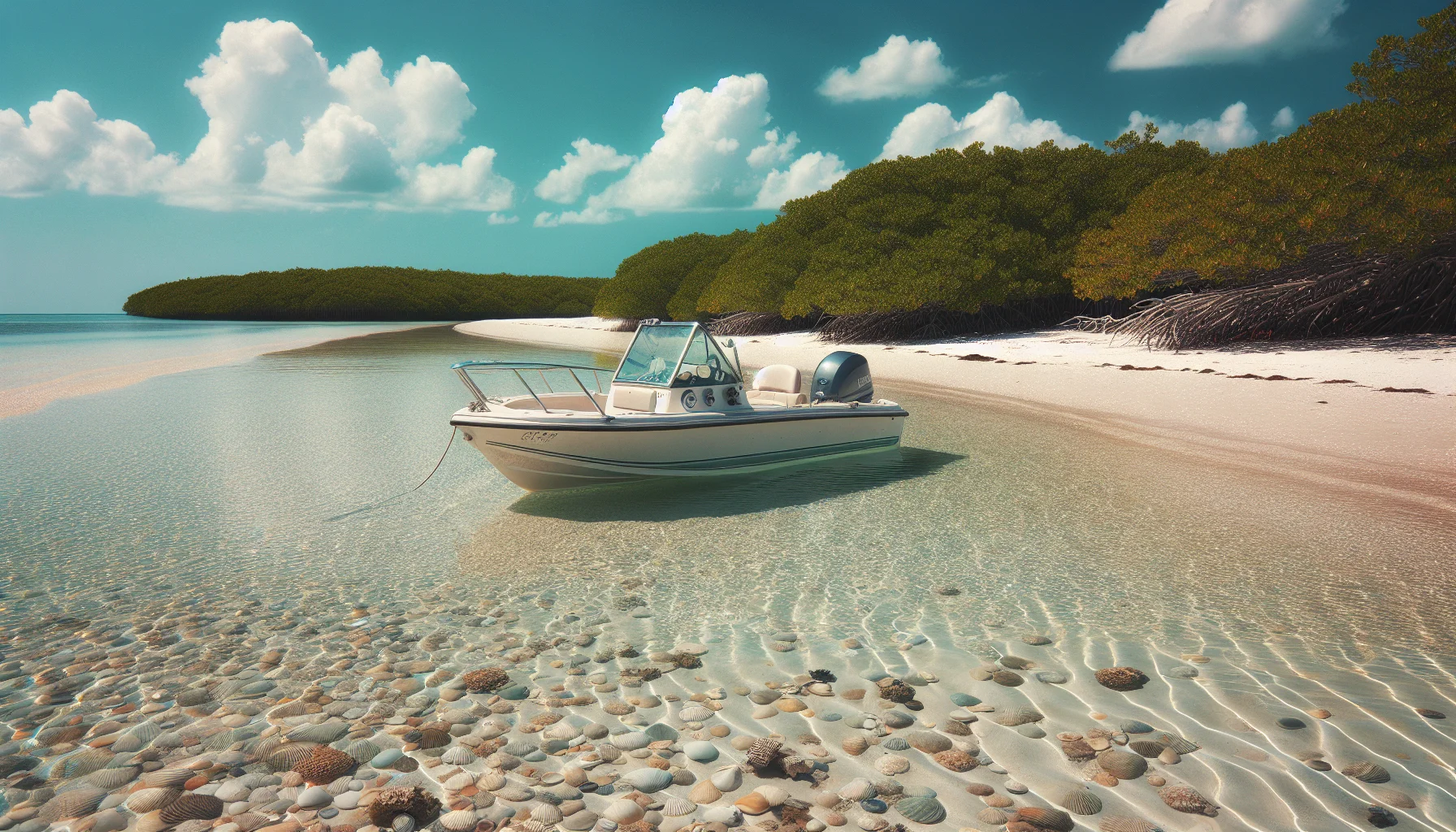
Captiva Island sits at the center of the "Shelling Capital of the World," where the island's east-west hook catches Gulf currents and piles the beaches with lightning whelks, fighting conchs, coquinas, and the occasional dreamed-about junonia. Arriving by boat unlocks stretches that foot traffic never reaches. But that access comes wrapped in a knot of rules: where the public's rights end and private property begins, where you can legally anchor, how much you can collect, and which shells you can never take home. This guide walks you through all of it, so your next shelling run stays legal, safe, and genuinely sustainable.
You'll learn how Florida's mean high water line actually works, which Captiva access points welcome boaters, what Lee County's collection limits and the state's live-shell prohibition mean in practice, how to anchor without shredding seagrass, and how to shell in a way that leaves the beach as productive for the next visitor as it was for you. Along the way we'll flag where boater education and the law intersect, because responsible shelling starts before you ever leave the dock.
Before you launch: Anyone born on or after January 1, 1988 must carry a Florida Boating Safety Education Card to operate a vessel of 10 horsepower or more. If you still need yours, our Florida boating safety course covers the environmental and navigation rules that keep trips like this legal. Start with the state-standards online boater education card.
Understanding Florida Beach Access Rights
The single most important legal concept for a boat-based sheller is the mean high water line (MHWL) — the average reach of high tides measured over a long period. In Florida, everything seaward of that line is sovereign submerged land held in public trust. Everything landward can be privately owned.
What the wet sand really means
In practical terms, the wet, hard-packed sand near the water is generally public, and you can walk it even in front of expensive Captiva homes. The soft, dry sand up by the dunes and vegetation is frequently private, and stepping onto it can be trespassing. The line isn't painted on the beach, so err toward the water. If you're on damp sand within the swash of the waves, you're almost always on the right side of the law.
Captiva complicates this because so much of its shoreline is privately held, with relatively few dedicated public beach parks compared to neighboring Sanibel. Ownership is a patchwork of resorts, private residences, and a handful of public access points. Treat every stretch as potentially private above the tide line, and you'll avoid the confrontations that shellers occasionally provoke.
Access from the water is a right; crossing land is not
Arriving by boat gives you a real advantage: you can reach the public wet-sand zone directly, without crossing private uplands that landlocked visitors would have to trespass over. That's exactly why boat shelling is so appealing here. What it does not give you is permission to walk up the beach to private facilities, cut through resort property, or picnic in the dry-sand yard of a home. Stay low, stay near the water, and your access is secure.
Legal Boat Access Points Around Captiva
You don't have to guess where you're welcome. A few reliable public-oriented spots anchor most boat-based shelling trips.
Turner Beach (Blind Pass)
At Captiva's southern tip, Turner Beach straddles Blind Pass between Sanibel and Captiva and is one of the region's best-known shelling and public-access beaches. The pass funnels shells onto the sand, especially on a falling tide. Boaters typically anchor offshore, outside the swimming area, and wade in. Be warned: Blind Pass runs a strong, sometimes dangerous current, so swimming near the pass mouth is risky and anchoring demands attention to the tidal set.
Alison Hagerup Beach Park
At the north end of the developed island, Alison Hagerup Beach Park offers public beach frontage. Parking is limited and resident-focused on the land side, but from the water you can anchor off and access the public wet sand. Currents here are also brisk.
North Captiva and Cayo Costa
North of Redfish Pass lies North Captiva Island, largely accessible only by boat, plus Cayo Costa State Park just beyond it. These barrier islands see far less foot traffic, which means less-picked-over beaches and superb post-storm shelling. Cayo Costa in particular is a state park with public beaches renowned among serious shellers. If you're planning a longer run up Pine Island Sound, these are the payoff. For a broader itinerary, see our perfect day trip to Captiva Island by jet ski, which maps the same waters.
Anchoring Rules and Seagrass Protection
Where you drop the hook matters as much as where you shell. Bad anchoring is the fastest way to earn a citation, damage the ecosystem, or lose your boat to a shifting tide.
Anchor smart, anchor legal
- Stay outside marked swimming areas. Buoyed swim zones are off-limits to anchored vessels; keep a comfortable buffer.
- Keep clear of navigation channels and passes. Blind Pass and Redfish Pass are working channels with strong flow — anchoring in them is both illegal and dangerous.
- Don't anchor off private beach frontage any closer than you need to; you have a right to the public wet sand, not to park your boat in someone's front yard.
- Never anchor overnight at these day-use beaches, and display a proper anchor light if you're ever out near dusk.
Protect the grass flats
Pine Island Sound and the back bays are carpeted with seagrass beds — critical habitat for manatees, sea turtles, and the juvenile fish that feed the whole estuary. Anchoring or dragging through seagrass tears it up, and Florida has been steadily tightening protections against prop scarring and anchor damage.
- Anchor only on sandy bottom. If the water is dark green over grass, move to a light, sandy patch before dropping.
- Motor at idle over the flats and trim up to avoid prop-scarring the grass.
- Retrieve cleanly — pull straight up rather than dragging, and stow the anchor without letting the rode saw across the bottom.
These same habitats hold the manatees you'll want to give a wide berth; our guide to Florida manatee zones and speed regulations explains the slow-speed rules that apply throughout this area. If you'd rather beach the boat than anchor off, the mechanics translate directly from our piece on legal beaching and anchoring in Treasure Island.
Shell Collection Limits and the Live-Shell Law
Here is where good intentions meet hard law. The rule that trips up more visitors than any other is the prohibition on taking live shells.
No live shelling — period
Across Sanibel, Captiva, and Lee County, collecting live shells is prohibited. A "live" shell is any shell that still has its animal inside — a living mollusk, a hermit crab that has taken up residence, or a sand dollar or sea star showing any movement or color of life. Lee County's live-shelling ban is enforced, and penalties are real.
The test is simple: look inside and underneath. If there's an animal home, it stays on the beach. When in genuine doubt, put it back. "I didn't know it was alive" is not a defense, and rangers have heard the "just one" line countless times.
Empty-shell limits
For empty shells — the ones you can legally keep — Lee County has historically set a per-person daily limit on quantity (measured by volume). Because these local quantity limits and the list of specifically protected species can change, confirm the current numbers with Lee County or Florida Fish and Wildlife Conservation Commission (FWC) signage at the beach before you fill a bag. The safe default: collect modestly, keep only empty shells, and don't stockpile.
Species you should never take
Certain species carry additional protection regardless of whether they're alive. Queen conch harvest is prohibited in Florida waters. Live sand dollars, sea stars (starfish), and sea urchins are protected as living animals. Sea turtles and their eggs, of course, are strictly off-limits and federally protected — if you spot a nest marked on the beach, stay well clear. When you're unsure whether something is a shell or a protected living organism, the answer is always to leave it.
Conservation Ethics: Shelling That Lasts
Legality is the floor, not the ceiling. Millions of visitors pass through these beaches every year, and shells are not an infinite resource. The ethic that keeps Captiva productive is restraint.
Take less than the law allows
- Collect sparingly. A few meaningful shells beat a bucket of duplicates. Quality over quantity keeps the beach stocked for the next family.
- Leave live everything. Beyond being illegal, live shells are working parts of the ecosystem — empty shells become hermit-crab homes, bird-nesting material, and recycled calcium.
- Photograph the rare finds. A junonia or a perfect lightning whelk makes a better photo than a shelf trophy, and a photo can be shared endlessly with zero impact.
- Leave the beach cleaner than you found it. Carry out any line, plastic, or trash you encounter. Boat-based shellers are often the only visitors these remote beaches get.
Model it for the next generation
If you're bringing kids, this is where stewardship is taught. Show them how to check a shell for its animal, how to gently return a live one, and why the "three-shell rule" — a self-imposed personal limit — feels better than a full bucket. The habits set on a Captiva beach at age eight tend to stick. Punta Gorda's approach to responsible riding around sensitive habitat, covered in our guide to Punta Gorda's wildlife protection zones, reflects the same ethic applied to the throttle instead of the shell bag.
Timing the Tides and Weather for the Best Shelling
Access and ethics settled, the fun part is stacking the odds of a great find — safely.
Low tide is prime time
Falling and low tides expose the most beach and the freshest deposits, and negative (minus) tides around the full and new moons are the shelling calendar's holy grail. Early morning adds two advantages: you beat other shellers to the fresh wrack line, and the light is gentle for both spotting and photos. Check a reliable tide app before you leave; our walkthrough on reading tide charts and local patterns applies cleanly to the Captiva side of the coast.
After a storm — but only after it passes
The single best shelling follows a cold front or a blow, when heavy surf tears shells loose and stacks them onshore. The catch is obvious: you shell after the storm, not during it. Never run out into building seas or an active thunderstorm chasing shells. Watch the radar, respect the forecast, and let the water calm before you go. When Gulf Coast thunderstorms fire up fast, the response we outline in our Tampa Bay thunderstorm safety guide is the standard: get off the water early and wait it out.
File a plan and carry the essentials
Barrier-island shelling means shallow bars, shifting passes, and stiff pass currents. Tell someone your float plan, carry enough correctly-sized life jackets for everyone aboard, keep a charged VHF or phone, and remember the state rule that children under six must wear a life jacket on any vessel under 26 feet while it's underway. Keep your engine cut-off lanyard attached whenever you're moving between spots — it's the law and it's what stops a runaway boat if you go over the side.
Respecting Private Property and Other Shellers
Most access conflicts on Captiva come down to two things: crossing onto private dry sand, and crowding other people's finds.
Read the boundary and stay below it
Homeowners' rights kick in above the mean high water line. Watch for the visual cues — seawalls, private docks, landscaping edges, and posted signs — and keep your feet on the public wet sand. Don't use private beach chairs, showers, or walkovers. If someone asks you to move and you've drifted up-beach, apologize and step back toward the water; you don't have to leave the public zone, but you do have to stay in it.
Shelling etiquette among boaters
- Spread out. When multiple boats hit the same beach, fan apart rather than clustering on one wrack line.
- Don't hover over someone crouched on a promising patch, and don't reach for a shell another person is clearly working toward.
- Coordinate anchoring so boats aren't swinging into each other on the tide.
- Share the good news, not the exact GPS pin. On social media, celebrate conservation and general areas rather than broadcasting a spot into oblivion.
Getting Your Florida Boating License Before You Go
Every skill in this guide — anchoring off seagrass, reading a pass current, keeping your cut-off lanyard attached, giving manatees room — is part of the standard Florida boater education curriculum. If you're operating the boat and were born on or after January 1, 1988, you're legally required to carry the education card, and the knowledge genuinely makes trips like this safer.
The course is fully online and state-standards online. The final exam is 25 questions, you need 80% to pass, and retakes are unlimited, so there's no pressure and no reason to put it off. You can study at your own pace and print a temporary certificate as soon as you pass.
Core topics that map directly to boat shelling include:
- Beach access, anchoring, and navigation rules
- Manatee zones, seagrass protection, and wildlife law
- Weather awareness and float planning
- Required safety equipment and life-jacket rules
- Boating Under the Influence (BUI) — a 0.08 BAC limit for adults, 0.02 for operators under 21
Start the state-standards online course - $12.99
Conclusion: Anchor Only Memories
Shelling by boat around Captiva is one of Florida's great small pleasures — a private-feeling beach, a falling tide, and the anticipation of what the last storm delivered. Keeping it that way is simple in principle: stay on the public wet sand, anchor off the seagrass and out of the swim zones and passes, never take a shell with an animal inside, and collect less than the law allows so the next sheller finds a beach worth walking. Learn the tides, respect the weather, and treat both the property owners and your fellow shellers with the courtesy you'd want in return.
Do that, and you're not just following the rules — you're helping guarantee that Captiva stays the Shelling Capital of the World for the kids you brought along today. Take only pictures, leave live shells where they belong, and let the tide keep restocking the beach.
Get your state-standards online Florida boater education card - $12.99 and launch your next Captiva shelling trip the right way.