
Clearwater Beach draws millions of visitors to the Gulf every year, and personal watercraft (PWC) are one of the most popular ways to enjoy the water. But the same warm, crowded, current-swept passes that make the area beautiful also make it one of Tampa Bay's more demanding places to ride. This guide walks you through where jet ski accidents actually happen around Clearwater, the Florida laws that keep riders legal, the equipment that keeps you injury-free, and exactly what to do if something goes wrong. Read it before your next ride and you will already be safer than most riders on the water.
Nationally, the Florida Fish and Wildlife Conservation Commission (FWC) consistently reports that Florida leads the country in registered vessels and in reportable boating incidents. Personal watercraft are involved in a disproportionate share of those incidents relative to their numbers, and the leading contributing factors are almost always the same: operator inexperience, inattention, and failure to keep a proper lookout. Nearly all of it is preventable with education and a few disciplined habits.
Before you ride: In Florida, anyone born on or after January 1, 1988 must pass an approved boating safety course and carry a Boating Safety Education Identification Card to legally operate a vessel of 10 horsepower or more, including a jet ski. You can earn yours through our Florida boating safety course entirely online.
Why Clearwater Beach Waters Demand Extra Caution
Clearwater's waters are not open, empty ocean. They are a busy, tidal system where rental fleets, fishing boats, tour vessels, paddlers, and swimmers all share tight spaces. Several factors combine to raise the risk here compared with a quiet inland lake.
First, tidal flow. Clearwater Pass and the inlets around Sand Key move a large volume of water on every tide change, creating strong currents that surprise first-time riders and push them off their intended line. Second, congestion. On weekends and holidays the water near Pier 60 and the sandbars fills with dozens of vessels operating at different speeds. Third, shallow, shifting bottom. Sandbars migrate, and grounding a jet ski at speed can eject riders and damage the hull. Fourth, afternoon weather. From roughly June through September, Gulf sea breezes fuel near-daily thunderstorms that can build in under an hour.
None of this makes Clearwater dangerous for a prepared rider. It simply means the margin for error is smaller, and the value of knowing the local hazards is higher. If you are still choosing where and how to ride, our Clearwater jet ski rental guide covers reputable launch points, pricing, and what to expect from local operators.
The Most Common Jet Ski Accident Scenarios
Understanding how PWC accidents actually unfold is the fastest way to avoid them. In FWC incident reporting, a handful of scenarios account for the large majority of personal watercraft crashes, and every one of them maps to a fixable behavior.
Collisions with another vessel
The single most common serious PWC accident is a collision, either with another jet ski or with a larger boat. Jet skis accelerate quickly, turn sharply, and are hard to see against sun glare and chop. Riders in rental groups tend to cluster and jump each other's wakes, which puts machines on converging paths at speed. The fix is discipline: keep a generous following distance, never ride directly behind or beside another PWC's wake, and always look before you turn.
Loss of steering control
Here is a fact that surprises many new riders: most jet skis have little or no steering authority when you release the throttle. Off-throttle, the jet nozzle stops directing thrust, so pulling back to avoid an obstacle often removes your ability to steer around it. The correct reaction in an emergency is frequently to keep steady throttle and steer, not to chop the throttle and freeze. Practice slow-speed maneuvering before you open it up.
Ejection and re-boarding incidents
Sharp turns, wake jumps, and abrupt stops throw riders off the machine. Ejections cause a large share of injuries, from bruises and sprains to more serious impact trauma. Seating passengers properly, matching speed to conditions, and easing into turns dramatically reduces ejections. Every rider should also know how to re-board from deep water before leaving the dock.
Fixed-object strikes and groundings
Channel markers, pilings, buoys, and shallow sandbars all injure riders who are watching swimmers, scenery, or their phone instead of the water ahead. Keep your eyes moving and your speed appropriate to how far ahead you can actually see and react.
High-Risk Zones Around Clearwater Beach
Local knowledge is one of the best accident-prevention tools you have. These are the areas around Clearwater Beach where riders most often get into trouble, along with how to handle each.
Clearwater Pass
The pass between Clearwater Beach and Sand Key funnels strong tidal current and heavy boat traffic through a relatively narrow channel. Wind blowing against an outgoing tide stacks up short, steep waves that can be genuinely hazardous for a small craft. Cross it deliberately: check the tide and wind before you go, keep your speed controlled, cross channels at a near-right angle rather than riding down the middle, and stay alert for fishing boats and larger vessels that have limited ability to maneuver.
Sand Key and the bridge approaches
The waters around Sand Key and the causeway bridges see multiple launch points, tour-boat routes, and weekend congestion converging in one place. Shallow zones near the bridges catch inattentive riders. Slow down, hold a single-file line through tight areas, and give bridge pilings a wide berth.
Caladesi Island and Hurricane Pass
The approach toward Caladesi Island and Hurricane Pass hides unmarked shallows and strong cross-currents, and it fills with traffic on nice weekends. Follow marked channels, use a chart or a depth-aware GPS, and reduce speed anywhere you cannot clearly see the bottom or the vessels around you.
Sandbars and swim areas
Popular sandbars near the beach mix anchored boats, waders, swimmers, and moving PWC in one crowded space. Treat any area with people in the water as an idle-speed, minimum-wake zone. In Florida you must slow to idle speed near swimmers and anchored vessels, and it is simply good sense everywhere. Because paddlers and kayakers frequently share these same waters, it is worth understanding who yields to whom; our guide to jet ski and kayak right-of-way in Clearwater breaks it down.
Florida PWC Laws Every Rider Must Know
Riding legally and riding safely are the same thing in Florida, because the state's PWC rules exist specifically to reduce the accidents described above. Here are the requirements that apply to jet skiing in Clearwater and everywhere else in Florida.
- Education card. Anyone born on or after January 1, 1988 must pass an approved boating safety course and carry the resulting Boating Safety Education ID Card to operate a vessel of 10 HP or more, including any jet ski.
- Minimum age to operate a PWC. You must be at least 14 years old to legally operate a personal watercraft in Florida. It is also illegal to knowingly allow an underage person to operate one.
- Rental age rules. To rent and operate a PWC you must generally be at least 18. Rental liveries verify age and provide required pre-ride instruction.
- Engine cut-off lanyard. The engine shut-off switch lanyard must be attached to the operator, their clothing, or their PFD at all times while operating. If you fall off, the engine stops instead of leaving a runaway machine circling back.
- Nighttime operation. PWC may not be operated from a half-hour after sunset to a half-hour before sunrise, even with lights. Jet skis are day-only craft in Florida.
- Reckless maneuvers. Weaving through congested traffic, jumping the wake of another vessel unreasonably close or when visibility is obstructed, and swerving at the last moment to avoid a collision are all specifically prohibited.
For the full picture, including passenger rules and county-specific nuances, see our detailed guide to Florida jet ski and PWC laws and age requirements.
Safety Equipment That Prevents Injuries
Florida law sets a baseline of required equipment, and smart riders add a few items on top. Both categories matter, because gear is what turns a bad moment into a minor one.
Legally required gear
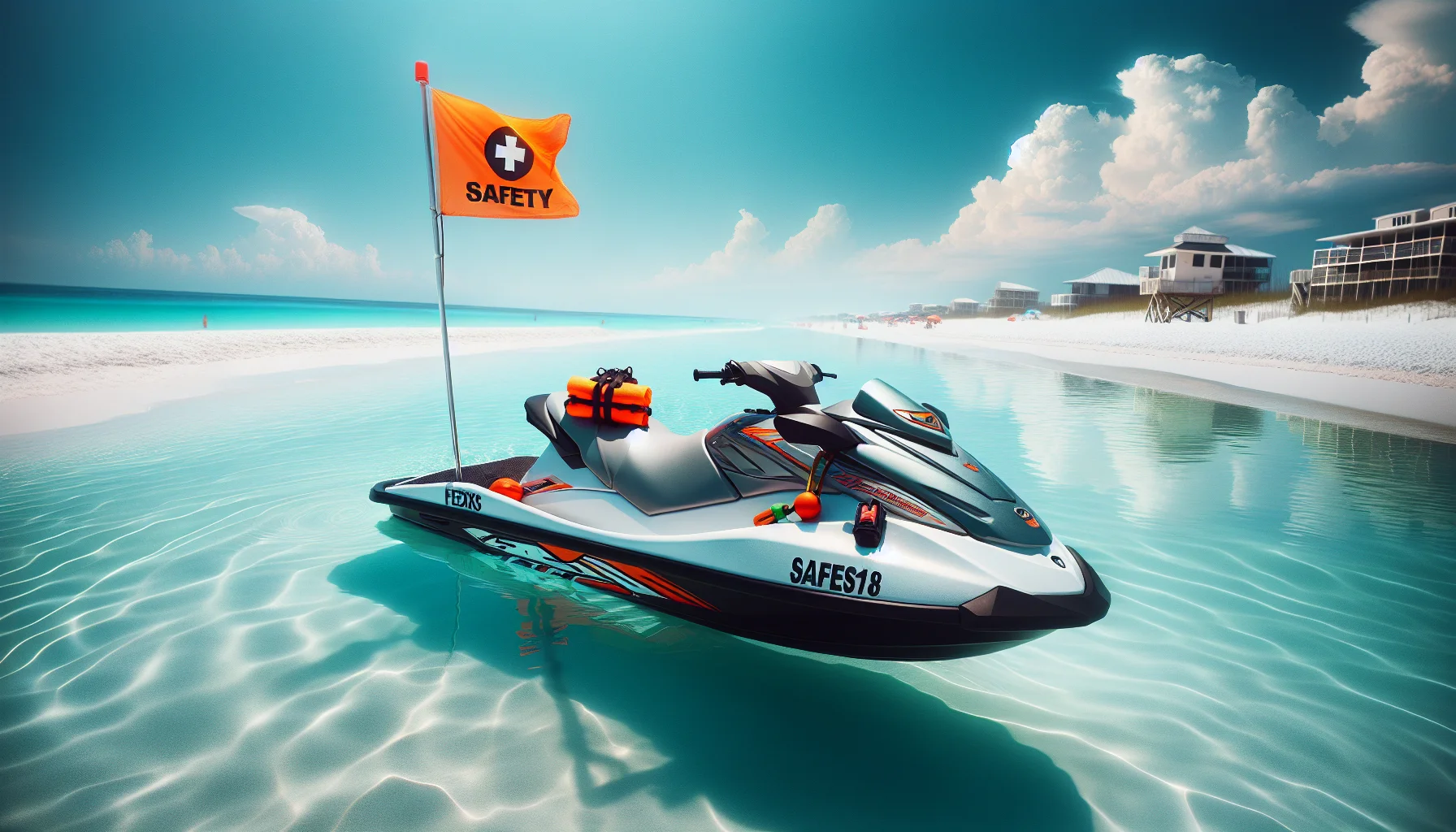
- Life jacket (PFD). Every person on board a PWC must wear a Coast Guard-approved wearable personal flotation device. Unlike larger boats where PFDs may be stowed, on a jet ski they must be worn at all times. Choose one rated for high-impact watersports and check that it fits snugly. Children under 6 on a vessel under 26 feet underway must wear a PFD, and on a PWC every rider wears one regardless of age. For a full breakdown of ratings and fit, see our Florida life jacket and PFD requirements guide.
- Engine cut-off lanyard, attached. Required, and genuinely lifesaving. Clip it every single time.
- Sound-producing device. A whistle or horn audible to other vessels. Attach a whistle to your PFD so it is always with you and works even when wet.
Highly recommended additions
- A watersports-rated impact vest for better mobility and impact protection versus a basic foam jacket.
- Polarized, shatter-resistant eyewear with a retention strap to cut Gulf glare and help you spot swimmers, markers, and shallows.
- A phone in a waterproof, floating case, or a handheld VHF radio, so you can call for help. On the water, VHF Channel 16 is the hailing and distress channel monitored by the Coast Guard.
- Protective footwear and sun protection. Reef-safe sunscreen, a rash guard, and water shoes prevent the small problems that end a ride early.
Weather and Timing: Reducing Your Risk
When you ride matters almost as much as how you ride. Clearwater's conditions shift through the day and the seasons in predictable ways you can plan around.
Beat the afternoon storms
From late spring through early fall, the Gulf sea breeze builds thunderstorms most afternoons. These cells produce lightning, sudden gusts, and rapidly building waves, and they can develop faster than you expect. The safest window is early morning: calmer water, lighter traffic, and clearer skies. Before you launch, check a marine forecast, watch the western and inland horizon for building clouds, and set a firm turn-around time. If you hear thunder, you are already close enough to be struck by lightning; head in immediately. Our guide to Tampa Bay thunderstorm safety explains how to read the sky and what to do when a cell catches you offshore.
Watch wind, tide, and glare
Wind over roughly 15 knots kicks up whitecaps that punish small craft, and wind opposing the tide in Clearwater Pass makes the steepest, most dangerous chop. Low-angle sun near sunrise and sunset creates blinding glare on the water precisely when other operators cannot see you either; polarized lenses and extra spacing help. Always check the tide before crossing the pass, because current can double the difficulty of a maneuver that felt easy in slack water.
Respect peak-crowd periods
Holiday weekends and spring break bring the highest traffic and the highest share of inexperienced and impaired operators. If you ride during these periods, add following distance, avoid the busiest sandbars and party zones, and treat every other vessel as unpredictable. Remember that boating under the influence is illegal at 0.08 percent BAC, and 0.02 percent for operators under 21, exactly as it is behind the wheel of a car.
What to Do If You're in an Accident
Even careful riders can be involved in an incident caused by someone else. Knowing the sequence in advance keeps you calm and keeps you compliant with Florida law.
On-scene, in order
- Stop immediately and account for everyone. Florida law requires you to stop your vessel at the scene. Check that every rider and passenger is above water and responsive.
- Render assistance. Help anyone injured or in the water, as long as you can do so without seriously endangering yourself or your passengers. Do not move a seriously injured person unnecessarily.
- Call for help. Dial 911, or hail the Coast Guard and marine units on VHF Channel 16. The FWC also operates a 24-hour hotline at 888-404-3922 (888-404-FWCC).
- Exchange information. Provide your name, address, and vessel identification to the other operator and to anyone injured, just as you would in a car crash.
- Document the scene. Photograph damage and positions, note the time, location, and weather, and collect witness contact information.
Reporting requirements
Florida requires that a boating accident be reported to FWC, the Coast Guard, or local law enforcement when it involves a death, a disappearance under circumstances suggesting death or injury, an injury requiring medical treatment beyond immediate first aid, or property damage of about $2,000 or more (or complete loss of a vessel). When a death or serious injury is involved, the report must be made without delay. Even when a report is not legally required, notify your rental livery and, if you own the craft, your insurer promptly and factually.
After the incident
See a medical professional even if you feel fine; adrenaline masks injuries, and impact trauma can surface hours later. Keep copies of every report and photo. If you rented the machine, review the rental agreement and your coverage; our overview of jet ski rental insurance explains what these policies typically do and do not cover.
How Boater Education Keeps You Safe
Every hazard in this guide, from the current in Clearwater Pass to off-throttle steering loss, is covered in an approved boating safety course. That is not a coincidence. Boating education exists precisely because the FWC and the National Association of State Boating Law Administrators (NASBLA) have documented, year after year, that a large majority of boating fatalities involve operators who never took a safety course.
An FWC-approved course teaches you the right-of-way rules that prevent collisions, how to read Florida's channel markers and no-wake zones, how personal watercraft actually handle in an emergency, what to do when weather turns, and the equipment and legal requirements that keep you compliant. It is the difference between reacting to a crowded pass and confidently reading it.
Our course is fully online, approved by the FWC and NASBLA, and built for exactly the rider who wants to ride Clearwater safely and legally. You study at your own pace, then pass a 25-question final exam with a score of 80 percent or higher, with unlimited retakes if you need them. When you pass, you can print a temporary certificate right away and get on the water.
Start the state-standards online course - $12.99
The Bottom Line
Clearwater Beach offers some of the best jet skiing in Florida, but it rewards preparation. Learn the high-risk zones, respect the tides and afternoon storms, wear real safety gear, follow Florida's PWC laws, and keep a disciplined lookout and a safe following distance. Do those things and you dramatically stack the odds in your favor, because the overwhelming majority of PWC accidents come down to inexperience and inattention, both of which you can fix.
The single most effective step you can take is proper education. It satisfies Florida's legal requirement for riders born on or after January 1, 1988, and it gives you the judgment that keeps every ride enjoyable.
Get your Florida boating safety certification today - $12.99 and ride Clearwater with confidence.