
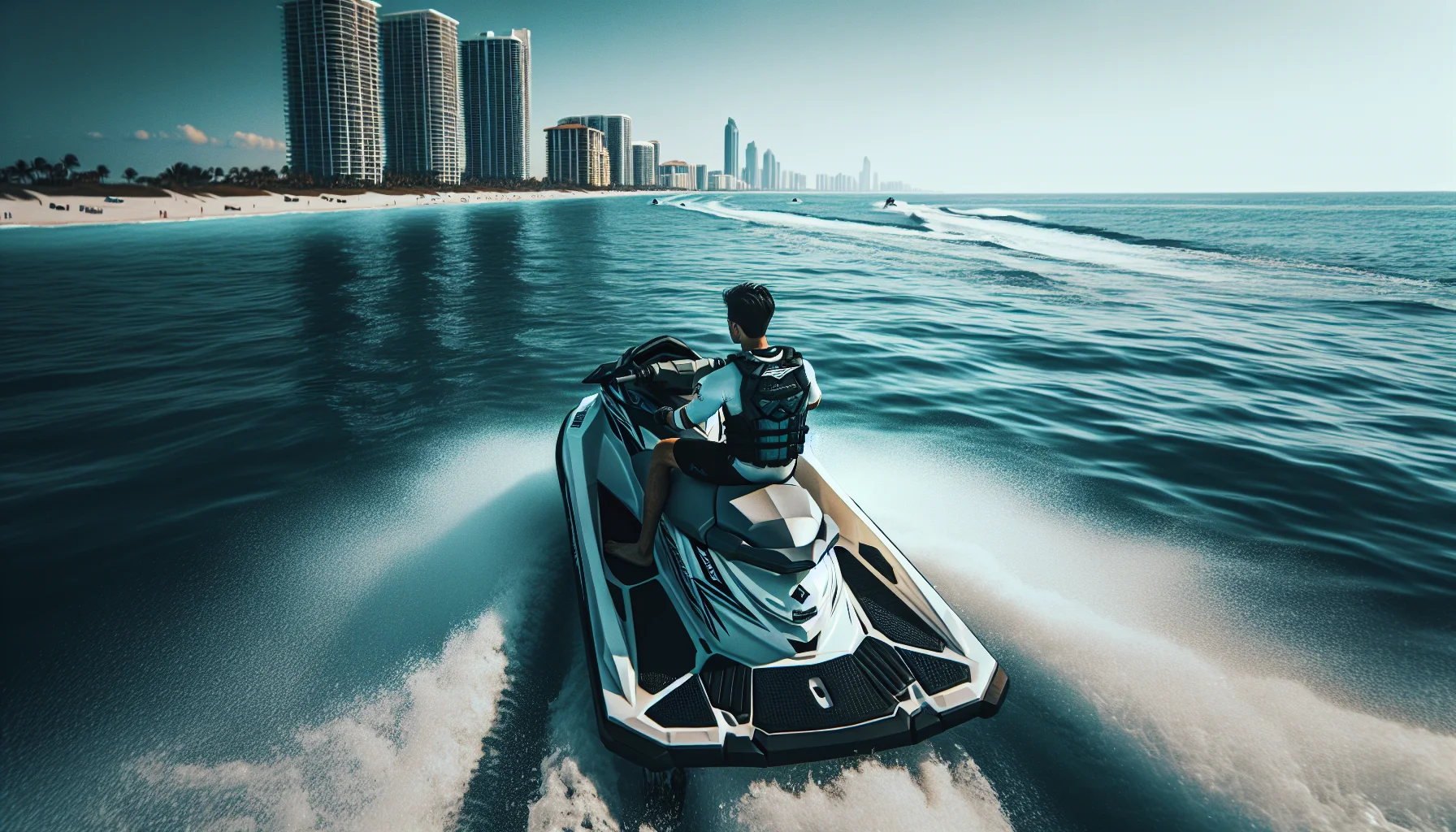
The Atlantic off Sunny Isles Beach is glassy at sunrise and hypnotic all the way to the horizon, and every rider eventually asks the same question: how far out can I actually go? The honest answer is that Florida does not set a hard mileage cap on personal watercraft, but a stack of practical, legal, and life-or-death limits absolutely does. In this guide you will learn exactly where the real boundaries are, how to calculate your safe range with the Rule of Thirds, which state and federal water lines matter, what safety gear you need beyond sight of land, and why the Bimini "crossing" that shows up on social media is one of the most dangerous decisions a PWC operator can make. Read it before your next offshore ride and you will come back with a plan instead of a prayer.
Is There a Legal Distance Limit for Jet Skis in Florida?
There is no Florida statute that says "you may not ride a personal watercraft more than X miles from shore." The popular "3-mile rule" and "12-mile rule" you hear repeated at the boat ramp are myths when applied to distance limits for recreational riders. What is real, and what trips people up, is that other laws do not stop applying just because you head offshore.
Florida still requires that anyone born on or after January 1, 1988 carry a Florida Boating Safety Education Card to operate a vessel powered by 10 horsepower or more, and every PWC operator must be at least 14 years old. A personal watercraft may only be operated from a half-hour before sunrise to a half-hour after sunset, so a long offshore run that pushes into dusk can turn legal in the morning and illegal on the way home. The engine cut-off lanyard must be attached to you, your PFD, or your wrist while under way. None of these rules relax with distance, and enforcement offshore is if anything less forgiving because help is farther away.
If you want the full breakdown of who needs a card, minimum ages, and operating hours, our guide to Florida jet ski and PWC laws covers the rules that follow you all the way to the horizon.
The rules that do not care how far you go
- Education card required for operators born on or after January 1, 1988 (vessels 10+ HP).
- PWC minimum operating age of 14.
- No PWC operation from a half-hour after sunset to a half-hour before sunrise.
- Engine cut-off switch lanyard attached while under way.
- Boating under the influence enforced at 0.08 percent BAC (0.02 for operators under 21).
Understanding Florida and Federal Water Boundaries
While no distance limit exists, jurisdictional lines change what laws and which agencies govern you. Knowing where those lines fall keeps you from stumbling into fishing violations or an international incident you never intended.
On the Atlantic coast, Florida state waters generally extend to 3 nautical miles from shore. Beyond that you are in federal waters managed under NOAA and Coast Guard authority, where different fishing seasons, bag limits, and size regulations apply. Push far enough east and you approach the boundary of foreign waters, where Bahamian and, farther still, Cuban jurisdiction take over with their own rules and consequences.
For a recreational Sunny Isles rider, the practical takeaway is simple: the deeper you go, the more the rules shift under you and the fewer people are positioned to help. Your fishing license, your catch, and even your right to be there can all change with the water you are floating over.
What changes as you cross each line
- Inside 3 nautical miles (state waters): Florida FWC regulations and state fishing rules apply.
- 3 to 200 nautical miles (federal waters): Federal fisheries rules and Coast Guard jurisdiction.
- Foreign waters: Bahamian or Cuban law applies, including customs and immigration requirements.
Fuel Range: The Real Limit Off Sunny Isles
For almost every rider, fuel, not the law, is the true boundary. A modern PWC carries roughly 15 to 20 gallons and burns anywhere from about 3 gallons per hour at an easy cruise to 8 or more when you are pinning the throttle through chop. That translates to a theoretical range of 50 to 75 miles on flat water, but theoretical range is a trap because it assumes calm seas, no headwind, and a return trip that is exactly as efficient as the trip out. The ocean never cooperates that neatly.
Headwinds can cut usable range 20 to 30 percent. A building afternoon sea can slash it 40 percent as you slow down, pound through waves, and burn fuel fighting to stay on plane. Rider weight, a second passenger, current, and hull condition all move the number the wrong way. This is why experienced offshore riders plan by the Rule of Thirds: one-third of your fuel to get out, one-third to get back, and one-third held in reserve for wind, current, a detour, or a rescue. On an 18-gallon tank that means committing only about 6 gallons to the outbound leg, which for most machines is a hard ceiling somewhere in the 15 to 25 mile range, not the 40-plus a fuel gauge might suggest.
How to run the Rule of Thirds
- Note your usable tank capacity before you leave the dock.
- Divide by three: outbound, return, and untouchable reserve.
- Turn back when you hit the outbound third, no matter how good the water looks.
- Add margin for headwind, chop, and current, which always cost more on the way home.
- Treat the fuel gauge as an optimist, not a promise.
Fueling itself deserves the same discipline, because a spill or a fire at the pump ends the trip before it starts. The step-by-step routine in our guide to safe marina fueling procedures applies just as much to Sunny Isles docks as it does up the coast.
Required and Recommended Safety Equipment
Federal and state equipment rules do not scale down when you go far, and offshore is exactly where they save lives. Every person aboard a PWC must wear a properly fitted, Coast Guard-approved life jacket at all times; this is not the "have one accessible" standard that applies to larger boats. Children under 6 must wear a PFD on any vessel under 26 feet while under way. You also need a sound-producing device and, on many machines, the correct fire extinguisher, plus visible registration numbers.
Beyond about 3 miles, the legal minimum is nowhere near enough. Cell coverage becomes unreliable past roughly 5 miles and effectively disappears by 10, so a communications and signaling plan matters more than anything else you carry. A handheld VHF radio reaches only 5 to 10 miles because of its low mounting height and line-of-sight physics, which is why knowing how to use it correctly is critical. If you are unsure how to make a distress call, our primer on VHF radio basics and Mayday etiquette walks through Channel 16 and what to say when it counts.
Carry-it-or-cancel-the-trip offshore gear
- Coast Guard-approved life jacket worn by every rider, plus the engine cut-off lanyard attached.
- Handheld VHF radio and a fully charged, waterproofed phone.
- A Personal Locator Beacon (PLB) or satellite messenger for anything beyond a few miles.
- Visual distress signals such as flares or a signal mirror.
- GPS with your departure point marked, plus a magnetic compass as backup.
The PFD rules alone catch a lot of riders off guard, especially with kids aboard. Our complete breakdown of Florida life jacket requirements spells out the age, fit, and wear rules so you are not guessing offshore.
Reading Sunny Isles Weather Before You Head Out
South Florida weather is the single most reliable reason offshore rides go wrong, and it follows a daily rhythm you can plan around. Early morning is the friend of the distance rider. Before roughly 10 a.m. the seas off Sunny Isles are often at their calmest, fuel economy is best, and the water is most forgiving. As the day warms, the sea breeze builds, waves stack up, and the classic Florida afternoon thunderstorm can develop from a clear sky in under an hour, bringing lightning, blinding rain, and dangerous seas exactly when you are farthest from the dock.
Match your ambitions to the conditions honestly. In 1 to 2 foot seas an experienced, well-equipped rider can reasonably reach into the low double digits of miles with full safety margins. At 3 to 4 feet, cut those expectations by a third or more; the ride is exhausting, fuel burn spikes, and small problems become big ones. At 5 feet and up, there is no offshore ride worth taking on a PWC; stay close to shore or stay home. Lightning is non-negotiable. If a storm builds, the only correct move is to head in early, and the guidance in our guide to thunderstorm safety on the water applies to the Atlantic coast as much as it does to Tampa Bay.
A simple go/no-go weather rule
- Glassy to 2 feet, clear morning sky: Go, with a firm turnaround time before the sea breeze fills in.
- 3 to 4 feet or building clouds: Shorten the plan, stay closer, and watch the radar constantly.
- 5-plus feet, dark buildups, or lightning: No offshore ride. Return or cancel.
Popular Destinations and Distances from Sunny Isles
Riders leaving Sunny Isles often aim south toward the landmarks of Biscayne Bay and the reef line. Knowing the real round-trip mileage keeps ambition inside your fuel math. Stiltsville, the cluster of historic houses on the flats, sits roughly 8 miles south, making a 16-mile round trip that is very achievable in good conditions but demands respect for shallow water and shifting sandbars. The Fowey Rocks Lighthouse on the reef is about 12 miles southeast, a 24-mile round trip that puts you in genuine open ocean where a handheld radio may already be out of range. Elliott Key, deeper into Biscayne National Park, is around 15 miles south and a 30-mile round trip that most single-tank PWCs should not attempt without careful planning and a group.
Every one of these numbers assumes a calm day and a machine you trust. The moment the wind turns or the seas build, that 24-mile round trip can quietly become a fuel emergency. Ride each destination as a distinct plan, not a casual "let's see how far we get," and always mark your departure point on the GPS the instant you leave the beach so you can navigate home when the shoreline becomes a thin gray line.
Round-trip reality from Sunny Isles
- Stiltsville: about 8 miles out, 16-mile round trip; watch the shallows.
- Fowey Rocks Lighthouse: about 12 miles out, 24-mile round trip; true open water.
- Elliott Key: about 15 miles out, 30-mile round trip; group and reserve fuel only.
The Bahamas and Foreign Waters: Why "Just Crossing" Is a Trap
Bimini sits roughly 45 miles east of the South Florida coast, and every season someone decides a jet ski can make the jump. It is one of the most dangerous ideas in recreational boating. A 90-plus mile round trip exceeds the practical fuel range of nearly every PWC, crosses the Gulf Stream where current and steep waves can build without warning, and leaves zero margin under the Rule of Thirds. It is also an international voyage: entering the Bahamas legally requires a passport, customs and immigration clearance, and proper vessel documentation. Arriving illegally can mean vessel seizure, heavy fines, and detention.
Cuban waters carry even sharper consequences. The 12-mile territorial limit is strictly enforced, and a GPS drift you never intended can put you somewhere you very much do not want to be. If you ever ride in that direction, set a conservative distance alarm on your GPS well short of any foreign boundary and monitor it constantly, because current and wind move you even when your throttle says otherwise. The safe, sane, and legal position is unambiguous: do not attempt open-ocean international crossings on a personal watercraft. The thrill is not worth a life or a criminal record.
Emergency Response and Self-Rescue Offshore
The farther out you ride, the longer help takes and the more you must be prepared to save yourself. Coast Guard and rescue response scales with distance and weather: close to shore you might see help in well under an hour, but 10 to 20 miles out you could be waiting one to two hours or more, and that assumes someone knows where you are. A person in the water is a tiny, low, hard-to-spot target, and drift makes a reported position stale within minutes.
This is why your gear and your plan matter more than your luck. A PLB or satellite messenger cuts search time dramatically by broadcasting your exact position; a VHF Mayday on Channel 16 alerts everyone within range. Warm South Florida water, often in the upper 70s to mid 80s, buys you time, but it does not make the ocean safe, hypothermia is still possible over many hours, and dehydration and fatigue set in fast. Knowing the reporting rules helps too: a boating accident must be reported when there is a death, a disappearance, an injury beyond first aid, or property damage of roughly two thousand dollars or more.
If your machine simply quits far from the beach, calm, methodical troubleshooting beats panic every time. The step-by-step approach in our guide to what to do during a jet ski breakdown is exactly the mindset you want when the engine goes silent and the shoreline is out of sight.
Before you lose sight of land
- File a float plan with someone ashore: where you are going, who is with you, and when you will be back.
- Carry a PLB or satellite messenger and know how to trigger it.
- Keep the engine cut-off lanyard attached so a fall does not leave a running ski circling away from you.
- Never ride serious distance solo; a buddy who can spot and assist is your best rescue insurance.
Building an Offshore Float Plan
Everything above comes together in a written float plan, the single habit that separates riders who come home from those who make the news. A float plan is not paperwork; it is a five-minute conversation and a note left with someone on shore. It names your intended destination and route, your departure and expected return times, a description of your PWC, who is aboard, and the safety gear you carry. If you are overdue, that document is what turns a frantic guess into a focused search.
Group riding strengthens the plan further. Ride with machines of similar range and speed so no one is left behind by a thirstier engine, agree on hand signals and radio check-ins before you launch, and maintain visual contact the entire way. Progress your distance the way you would progress any skill: start close, ride in perfect conditions, learn what your machine actually does in real seas, and extend your range slowly. The ocean rewards humility and punishes ego, and the horizon will still be there next weekend.
Skill is what actually extends your range, and it is the one upgrade that costs less than a tank of gas. The knowledge that keeps you safe offshore, navigation, weather, right-of-way, and emergency procedure, is exactly what a Florida boating safety course is built to teach, and it is the same card the law requires for most operators anyway.
Ride Smart: Get Educated Before You Go Far
So how far offshore can you ride a jet ski from Sunny Isles Beach? Legally, there is no fixed line, but practically, fuel range, weather, safety gear, and rescue reality combine to make somewhere in the 10 to 20 mile range a sane maximum for a well-prepared rider on a good day, and far less than that when conditions turn. The riders who go the distance safely are not the boldest; they are the best prepared. They run the Rule of Thirds, watch the morning weather window, carry real communications and signaling gear, file a float plan, and never chase the Bahamas on a personal watercraft.
The fastest way to build that competence, and to satisfy Florida's education requirement at the same time, is to get certified. Our state-standards online course is fully online, the exam is just 25 questions with an 80 percent passing score, and you get unlimited retakes until you pass, then print your certificate right away. Learn the navigation, weather, and emergency skills that genuinely extend your range before you ever untie from the dock.
Start the state-standards online course - $12.99
Because out past the last sandbar, knowledge is the only fuel you can never run out of.