
Fire is the one boating emergency where you cannot simply drift and wait for help. On the water, seconds decide whether you lose a fender or lose the whole vessel. This guide walks you through exactly what Florida and the U.S. Coast Guard require aboard your boat in 2026: how many marine fire extinguishers you must carry by vessel length, what the April 2022 rule change means for your older units, where to mount them so they are actually reachable, and how to use one when your hands are shaking. Read it before your next trip and you will be ahead of the majority of boaters on the water.
Why Boat Fires Demand Extra Respect
People assume that being surrounded by water makes a boat fire less dangerous. The opposite is true. A boat fire is harder to escape and harder to fight than almost any fire on land.
You cannot walk out a back door. There is no fire truck four minutes away. You are floating on top of a fuel tank, most likely surrounded by fiberglass that burns hot and fast, often with only one or two ways off the vessel. The Coast Guard consistently lists fire and explosion among the leading causes of vessel loss in recreational boating, and the damage is frequently total once flames reach the engine compartment.
The most common ignition sources on Florida boats are predictable, which is exactly what makes them preventable:
- Fuel vapor ignition in engine compartments. Gasoline fumes are heavier than air and pool in the bilge. A single spark from a starter can ignite the whole space.
- Electrical shorts and corroded wiring. Florida salt air degrades insulation and terminals faster than most owners expect, even on newer boats.
- Engine overheating. A failed raw-water pump or a clogged intake can turn an engine box into an oven.
- Galley flare-ups. Enclosed cabin cooking, especially with propane, is a leading cause of cabin fires.
- Shore power arcing. Corroded dockside plug connections can arc and smolder overnight.
The takeaway is simple: boats burn, and when they do, a working extinguisher you can actually reach is often the only thing between a scare and a catastrophe. Fire safety is a core reason we built our Florida boating safety course around real-world scenarios rather than trivia.
What Florida and Federal Law Require in 2026
Florida enforces the federal U.S. Coast Guard carriage requirements, so the extinguisher rules are the same whether an FWC officer or a Coast Guard boarding team checks your boat.
The April 2022 Rule Change
Effective April 20, 2022, the Coast Guard modernized recreational fire extinguisher regulations. The old B-I and B-II classifications were replaced with a UL-based numerical rating (5-B, 10-B, 20-B), and, importantly, a 12-year expiration for disposable (non-rechargeable) extinguishers was introduced. Before this change, a disposable unit had no hard replacement date at all.
The key practical points:
- Extinguishers manufactured under the old B-I / B-II system are still acceptable while they remain within their service life.
- A disposable extinguisher is expired 12 years after its manufacture date, regardless of what the gauge reads.
- Rechargeable units are exempt from the 12-year rule but must be inspected and serviced on schedule.
A green gauge does not mean your extinguisher is compliant. The gauge only measures internal pressure. It cannot tell you the seals have degraded or that the unit is past its date. Flip the cylinder over and read the manufacture date stamped on the bottom.
Old Ratings vs. New Ratings
| Old Rating | New Equivalent | Roughly Equivalent Capacity |
|---|---|---|
| B-I | 5-B | Smallest size accepted on most small boats |
| B-I | 10-B | Mid-range, increasingly common |
| B-II | 20-B | Large capacity, often replaces two smaller units |
If your label shows only "B-I" or "B-II" with no numeric rating, it was made under the old system. It counts only if it is still within service life and, for disposables, within 12 years of manufacture.
How Many Fire Extinguishers Your Boat Needs
You are required to carry portable fire extinguishers if your boat has any condition that traps fuel or vapor. That includes:
- Enclosed or partially enclosed engine compartments
- Closed compartments where portable fuel tanks are stored
- Double bottoms not sealed to the hull or not filled with flotation
- Closed living spaces such as cabins and berths
- Closed storage compartments holding combustible materials
- Permanently installed fuel tanks
In plain terms: if your boat has an inboard engine, a cabin, permanent fuel tanks, or enclosed spaces, you must carry extinguishers. Most motorboats over roughly 16 feet fall into this group.
Requirements by Vessel Length
| Vessel Length | No Fixed System | With Approved Fixed System |
|---|---|---|
| Under 26 ft | One 5-B (or larger) | None required |
| 26 to under 40 ft | Two 5-B or one 20-B | One 5-B or one 20-B |
| 40 to 65 ft | Three 5-B, or one 20-B plus one 5-B | Two 5-B or one 20-B |
Go bigger than the minimum. A 5-B gives you only a handful of seconds of discharge, which is very little time when you are panicking. Stepping up to a 10-B or 20-B roughly doubles or triples both your discharge time and your extinguishing agent for a modest extra cost. It is one of the best safety upgrades you can make.
What About Open Outboard Boats?
If your boat is completely open with no enclosed spaces, runs an outboard, and carries only portable fuel tanks stored in the open, you are technically exempt from the requirement. Many small flats boats, jon boats, and bay boats qualify.
Even so, carry a small 5-B anyway. Electrical fires still start from corroded battery terminals, and a leaking gas can on a hot day is a real hazard on any boat. The exemption exists because the risk is lower on open boats, not because it is zero. The same logic applies to the rest of your kit, which is why we treat extinguishers as part of the same core loadout as your Florida life jacket and PFD requirements.
Where to Mount Them for Real Emergencies
A large share of boats carry their extinguisher somewhere that would be useless in an emergency: buried in a locker under a pile of life jackets, or clipped inside the very engine compartment that is on fire. Placement matters as much as compliance.
Placement Principles
Mount between the hazard and your escape route. If the engine box catches fire, you do not want your only extinguisher on the far side of the flames. Position it so you can grab it while keeping a clear path off the boat.
The helm always gets one. The operator usually responds first. A unit in a quick-release bracket beside the captain's chair can be reached without standing up.
Never mount inside the engine compartment. It seems logical to put it where the fire is likeliest to start, but if the compartment is engulfed you will not open that hatch. For engine-box protection, install a fixed suppression system and keep portables outside, where you can crack the hatch and aim the nozzle into the gap rather than opening it fully.
Give the galley its own unit. Cooking fires are among the most common on cabin boats. Mount a small extinguisher within arm's reach of the stove, especially with propane systems.
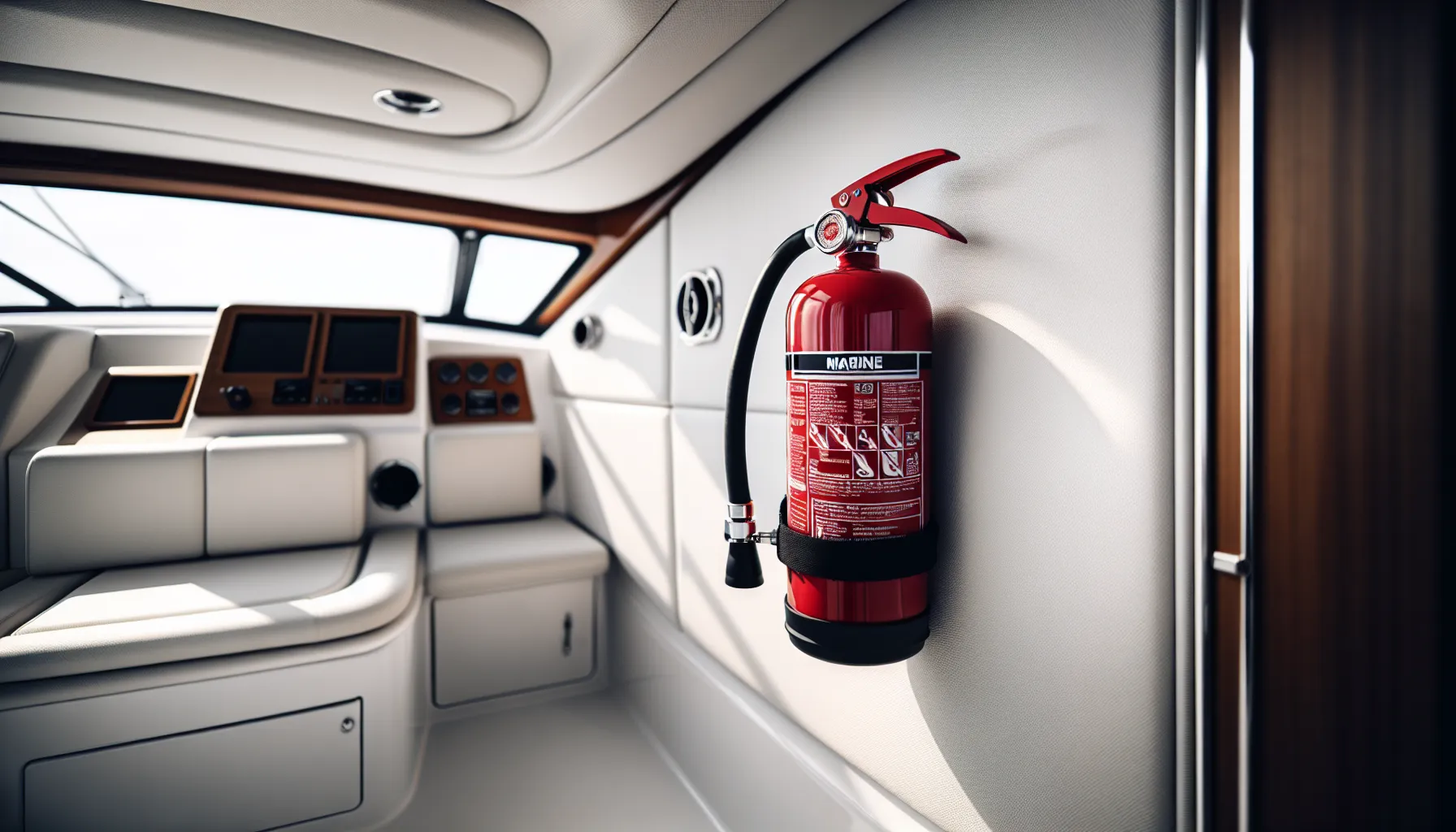
Use proper marine brackets. A corrosion-resistant bracket that holds the cylinder upright and releases with one hand keeps the extinguisher where you left it. An unsecured unit slides under the gunwale in rough water exactly when you need it. Stainless or quick-release strap brackets are inexpensive insurance.
The PASS Method: Using an Extinguisher Under Pressure
Every boater should know the PASS acronym, and just as importantly should have mentally rehearsed it. When a fire starts, your hands will shake and the smoke will sting. If you have not practiced the sequence, you can freeze.
P — Pull the pin. Twist and pull the ring firmly to break the tamper seal and unlock the handle.
A — Aim at the base of the fire. The flames are the symptom; the burning fuel at the base is the source. Point the nozzle low, at the material actually on fire, not at the tops of the flames.
S — Squeeze the handle. Use your full grip and commit. A small extinguisher gives you only seconds of discharge, so there is no time to conserve. Stand roughly 6 to 8 feet back, close enough to reach the base and far enough to stay out of the heat.
S — Sweep side to side. Move the stream steadily across the base of the fire, covering the whole fuel source rather than blasting one spot. Keep sweeping until the fire is out, then watch for re-ignition for at least 30 seconds. Fuel fires love to re-flash.
Know When to Stop Fighting
The most important judgment the PASS method does not spell out is when to quit. If you have emptied one extinguisher and the fire is still growing, or smoke is filling the cabin faster than you can see, get everyone off the boat and into the water, away from the vessel. A boat can be replaced. A useful rule of thumb: if the fire is not dramatically better after about 30 seconds of discharge, switch from fighting to evacuating and calling for help. Knowing your radio procedure ahead of time helps, which is why we cover it alongside VHF radio basics and Mayday etiquette.
Choosing the Right Extinguishing Agent
Not every extinguisher contains the same agent, and the difference matters for cleanup, electronics, and effectiveness.
Dry Chemical (Most Common)
Found in most marine extinguishers, dry chemical is cheap, effective, has a long shelf life, and hits hard on fuel and electrical fires. The downside is the powder, which goes everywhere and is corrosive to electronics. If you discharge one in an engine compartment, expect a serious cleanup to avoid lingering corrosion. For most recreational boats, though, dry chemical is the reliable workhorse.
CO2 (Carbon Dioxide)
CO2 smothers and cools the fire and leaves no residue, making it kind to electronics. It is heavier, costs more, and is less effective outdoors where wind disperses it. In a small enclosed space it can displace enough oxygen to make you lightheaded, and the discharge is cold enough to risk frostbite on bare skin. It shines in engine rooms and fixed systems more than as a handheld on a breezy open boat.
Clean Agent (Halotron and similar)
These modern Halon replacements interrupt the fire's chemistry without residue and without depleting breathable oxygen. They are excellent for expensive electronics suites and enclosed cabins but cost noticeably more and are less widely stocked. If you run a helm full of electronics or spend time in an enclosed cabin, the premium is worth it; for a basic center console, dry chemical is perfectly adequate.
Fixed Fire Suppression Systems
Any boat with an enclosed engine compartment should seriously consider a fixed automatic suppression system. These mount inside the engine box and discharge on their own when the temperature crosses a set threshold, protecting the vessel even when no one is aboard, such as overnight at a dock.
Common options include clean-agent systems (electronics-safe, no residue), CO2 systems (effective but requiring ventilation after discharge), and, less often in marine use, dry chemical systems. If you install an approved fixed system, your portable requirement is reduced as shown in the table above, but carrying the full complement of portables is still smart: the fixed system guards the engine box, while portables cover the rest of the boat.
Inspection, Maintenance, and the 12-Year Rule
Monthly Checks
Fold this into your pre-trip routine. It takes two minutes:
- Gauge in the green? If it is borderline, replace it rather than gamble.
- Pin and tamper seal intact? A broken seal you did not break can mean a partial discharge.
- Any corrosion or dents? Salt air is brutal on metal cylinders; surface rust is a warning sign.
- Still easy to reach? If gear has piled up around it since your last trip, clear it.
The Shake Test for Dry Chemical
Dry powder can compact over time, especially with engine vibration. Once a month, invert the extinguisher and shake it firmly for several seconds to loosen the powder. If it feels like a solid lump rather than loose contents, the agent has caked and the unit may not discharge properly. Replace it.
Servicing and Expiration
Rechargeable units should be professionally inspected and serviced on schedule; a marine fire-safety shop will verify pressure, agent weight, and valve condition. For disposable units, the rule is simpler and non-negotiable: replace them no later than 12 years after the manufacture date. Set a phone reminder when you buy one. If your extinguisher predates the current decade, treat it as a paperweight and replace it. A new marine unit costs less than a mediocre dinner, so when in doubt, replace.
Preventing Fires Before They Start
The best extinguisher is the one you never have to use. Prevention is mostly routine.
Before Every Trip
- Sniff the engine compartment. Open the hatch and smell for fuel. If you smell gas, do not start the engine; ventilate and check again.
- Run the blower. Boats with gasoline inboard engines are required to have powered ventilation. Run the blower for at least four minutes before starting, every single time.
- Check electrical connections. Look for corroded terminals, melted insulation, or loose wires.
- Look for fuel leaks. Inspect lines, connections, and the tank area. Any sheen on bilge water is a red flag.
At the Fuel Dock
Fueling is where most near-misses happen. Shut down the engine and electronics, close hatches and ports to keep vapors out of enclosed spaces, keep the nozzle in contact with the fill pipe to prevent static discharge, and do not top off — leave room for expansion in the Florida heat. After fueling, open all hatches, run the blower for four full minutes, and sniff the engine compartment before starting. For a deeper walkthrough, see our guide to safe fueling procedures at the marina.
Ongoing Vigilance
Service your engine on schedule, inspect shore-power connections for corrosion each time you plug in, test propane fittings with soapy water at least twice a season, and replace fuel hoses per the manufacturer's interval. Marine fuel hose has a finite life.
What FWC Officers Check During a Safety Inspection
Florida Fish and Wildlife Conservation Commission (FWC) officers routinely conduct vessel safety checks, and fire extinguishers are always on the list. Here is what they verify:
- Correct number for your vessel length and configuration. They know the table and they will count.
- Gauge in the green zone. They read the pressure indicator.
- Not expired under the 12-year rule. This is a newer enforcement point for disposable units, so check your dates.
- Readily accessible. A unit properly mounted and reachable is part of the overall safety assessment.
- Coast Guard approved. The extinguisher must carry a USCG approval or UL Marine listing mark. A household extinguisher does not satisfy the requirement even with the same capacity rating.
Fire extinguishers are one piece of a broader carriage checklist that also covers PFDs, sound-producing devices, and navigation lights. If you want the full picture of what the state expects of every operator, our complete Florida boating license guide lays it out, and the safety course itself walks through each requirement in context.
Get This Right Before Your Next Trip
Fire safety is not about owning equipment. It is about owning the right equipment, in the right place, in working condition, and knowing how to use it before you ever need to. Take fifteen minutes to check your extinguishers today: count them against the length table, read the manufacture dates, confirm the gauges, and make sure every one is mounted where you can reach it in seconds.
Our state-standards online course covers fire extinguisher types, placement, the PASS method, and engine-compartment ventilation with real-world scenarios rather than dry regulatory text. The exam is 25 questions, you need 80% to pass, and you get unlimited retakes, so you can study at your own pace and print a temporary certificate the same day.
Start the state-standards online course — $12.99
Quick Reference Checklist
- Do you need extinguishers? Enclosed spaces, a cabin, permanent fuel tanks, or an inboard engine means yes.
- How many? Under 26 ft: one 5-B minimum. 26–40 ft: two 5-B or one 20-B. 40–65 ft: three 5-B or one 20-B plus one 5-B.
- Are they current? Disposable units expire 12 years from manufacture, regardless of the gauge.
- Are they accessible? If you cannot grab it in a few seconds with one hand, move it.
- Do you know PASS? Pull, Aim at the base, Squeeze, Sweep — and evacuate if it is not dramatically better after 30 seconds.