

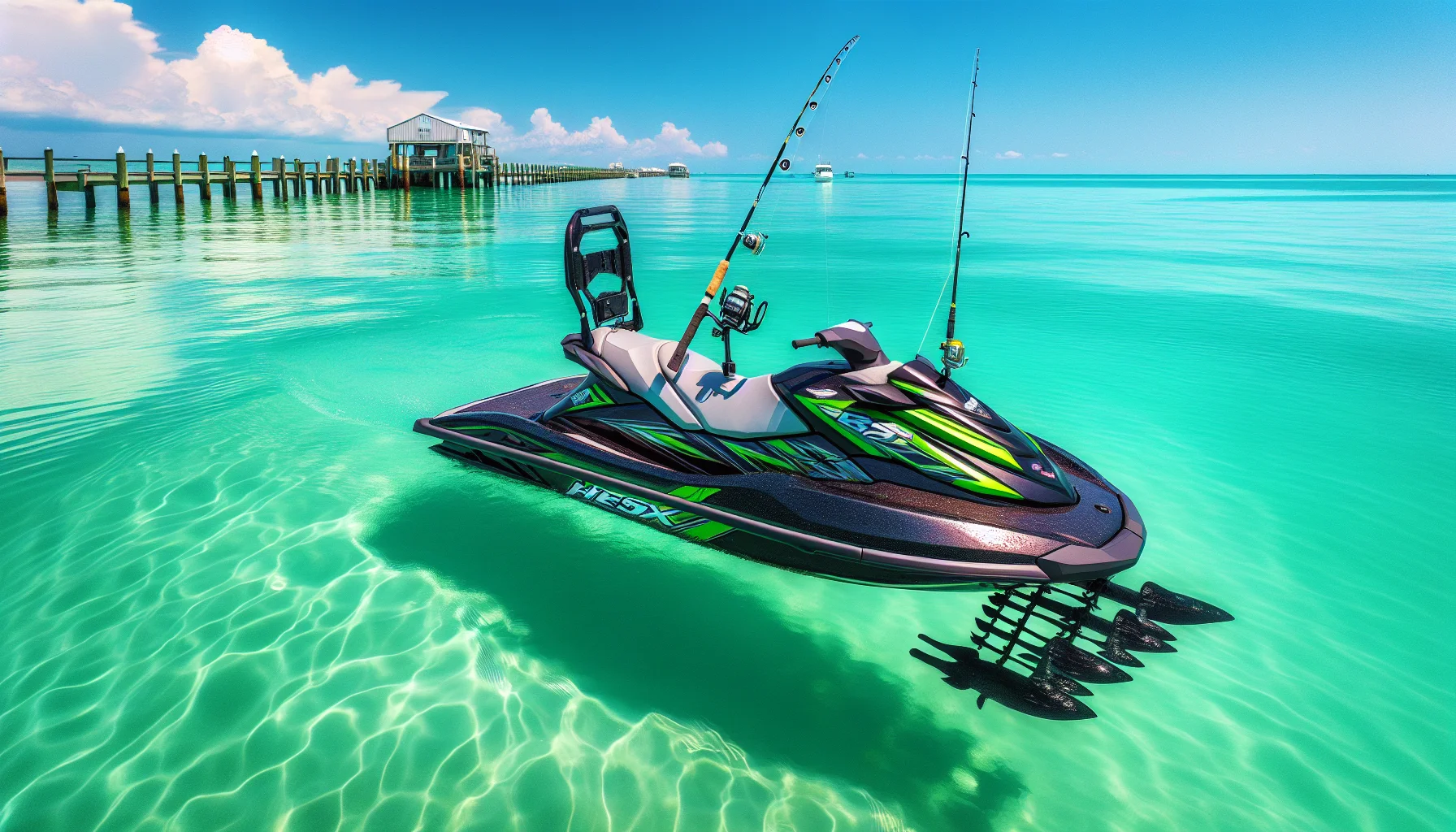
Fishing from a jet ski has gone from Emerald Coast novelty to a legitimate way to reach redfish on the flats and Spanish mackerel just past the first sandbar. It is fast, cheap to run, and reaches skinny water no center-console can touch. But a personal watercraft (PWC) is still a vessel in the eyes of the Florida Fish and Wildlife Conservation Commission (FWC), which means every boating law, licensing rule, and safety requirement follows you onto the water rod-in-hand.
This guide walks through exactly what Florida and Destin require of a PWC angler: the education card and fishing license you must carry, where state waters end and federal waters begin, the PWC-specific operating rules that never switch off while you fish, how to rig safely, and the honest safety realities of running a jet ski offshore alone. Get these right and you will fish more, worry less, and stay on the right side of an FWC officer's boarding.
Is It Legal to Fish From a Jet Ski in Florida?
Yes. Florida law places no blanket restriction on angling from a personal watercraft. The FWC classifies a PWC as a Class A vessel (under 16 feet), so it carries the same fishing rights as any boat in state waters. There is no special "PWC fishing permit," and you are not fishing in any legal gray area simply because your platform has handlebars instead of a wheel.
What trips people up is the assumption that a smaller, recreational-looking craft is somehow exempt from the rules that govern boats. The opposite is true. Because a PWC is a vessel, you inherit the full body of Florida boating law: registration, operator education, life jackets, sound-signaling devices, and the same size and bag limits on the fish you keep. The convenience of a jet ski does not shrink your legal responsibilities.
The practical takeaway is that "legal" is the easy part. Compliant is the harder part, and that is where the rest of this guide focuses.
Licenses and Education You Actually Need
Two separate credentials matter before you drop a line from a PWC in Destin, and they are commonly confused.
The Boating Safety Education Card
Florida requires a Boating Safety Education Card for anyone born on or after January 1, 1988, who operates a vessel powered by a motor of 10 horsepower or more. Every modern jet ski clears that threshold easily, so if you fall in that age group you must carry the card whenever you operate the PWC, whether you are cruising or fishing. The card is earned by passing a state-standards online boater safety course, it never expires, and it is recognized nationwide through NASBLA (the National Association of State Boating Law Administrators).
You can satisfy this requirement entirely online. Our Florida boating safety course is state-standards online, self-paced, and ends with a 25-question exam that requires an 80% score to pass, with unlimited retakes if you miss it the first time. Once you pass, you can print a temporary certificate and legally operate the same day.
The Saltwater Fishing License
The education card covers operating the vessel. Actually catching fish requires a separate Florida saltwater fishing license from the FWC, available as resident or non-resident, in short-term or annual forms. There are narrow exemptions (for example, certain shore-based situations), but fishing from a PWC in the water off Destin is not one of them. If you plan to keep or target certain species, you may also need specific harvest tags or, in federal waters, additional federal permits.
Carry both credentials on the water, either printed or accessible on your phone in a waterproof case. An FWC officer can and will check them during a routine boarding.
For a full breakdown of who must be educated and how the requirement works, see our complete Florida boating license requirements guide.
Understanding State vs. Federal Waters Off Destin
Destin's biggest angling advantage, quick access to the deep Gulf, is also its biggest legal trap. The rules change depending on how far offshore you are.
On Florida's Gulf coast, state waters extend roughly 9 nautical miles from shore. Inside that line, FWC regulations and Florida size and bag limits apply, and FWC officers hold enforcement authority. Beyond 9 nautical miles you are in federal waters, where NOAA Fisheries rules govern, size and bag limits can differ, seasons may be shorter, and certain species require a federal permit. The U.S. Coast Guard shares jurisdiction out there.
This matters because a jet ski can physically reach federal water on a calm day, but a species that is legal to keep inshore may be closed or differently regulated a few miles farther out. Two defenses protect you:
- Know your GPS position. A waterproof handheld or phone-based chartplotter that shows the 9-nautical-mile line removes all guesswork.
- Check the regulation for the exact water you are in, not just the species. Red snapper is the classic example, with tightly controlled federal seasons that change year to year.
Never rely on last season's memory. FWC and NOAA update limits and seasons constantly, and "I didn't know it changed" is not a defense.
Destin PWC Operating Rules That Still Apply While Fishing
Chasing a bent rod does not suspend a single PWC law. These are the rules FWC officers see broken most often by anglers who get absorbed in the fishing.
Age and Operation
The minimum age to operate a PWC in Florida is 14. There is no legal way around it, and a parent cannot authorize a younger child to run the machine. If you are teaching a teen to fish from a jet ski in Destin, our guide to jet ski age requirements in Destin explains exactly who can ride and operate legally.
Daylight-Only Operation
A PWC may not be operated from a half-hour after sunset until a half-hour before sunrise, statewide. That rules out dawn and dusk fishing windows that boat anglers take for granted. Plan your bite around legal daylight hours or you risk a citation regardless of how good the fishing is.
Engine Cut-Off Lanyard
The engine cut-off switch lanyard must be attached to the operator (wrist or PFD) whenever the PWC is underway. This is non-negotiable and it is a lifesaver: if you are pulled off the craft while fighting a fish or hit by a wake, the engine kills instantly instead of leaving a runaway jet ski circling you.
Life Jackets
Every person aboard a PWC must wear a Coast Guard-approved life jacket at all times, not just have one aboard. This is stricter than the rule for many larger boats. On any vessel under 26 feet underway, children under 6 must wear a PFD, and a jet ski always falls under that rule. Our Florida life jacket requirements guide covers the approved types and fit.
Reckless Operation and Wake
Weaving through traffic, jumping wakes too close to another vessel, and operating within regulated distances of swimmers, divers, or docks all count as reckless operation. Fishing does not exempt you, and enforcement around Destin's busy East Pass and harbor is active.
Divers-Down Flags
The Emerald Coast's clear water draws divers and snorkelers, and Florida law requires you to give a divers-down flag wide clearance: stay roughly 300 feet away in open water and 100 feet in rivers, inlets, and navigation channels, slowing to idle speed if you must be closer. A PWC's speed makes an inattentive angler especially dangerous here.
Rigging a Jet Ski for Fishing the Emerald Coast
A safe fishing rig is a light, tethered, low-clutter rig. The goal is to add fishing capability without compromising the stability and range that make a PWC worth fishing from in the first place.
Storage and Rod Holders
Factory fishing packages (many Sea-Doo and Yamaha models offer them) provide integrated cooler mounts and rod holders. Aftermarket cooler-rack systems and rail-mounted rod holders work well too. Whatever you choose, keep the load balanced and modest. Overloading a PWC raises the center of gravity, shortens your range, and makes the craft handle unpredictably in chop, exactly the wrong trade for a small vessel already limited on freeboard.
Tether Everything
On a jet ski you will get wet and you will get tossed. Pliers, your grip, your knife, and your phone should all be tethered or in a secured, floating dry box. A dropped tool is an annoyance on a boat and a lost tool on a PWC.
Keep Tackle Minimal
Three or four proven lures, a spool of leader, and one all-purpose spinning outfit will out-fish a cluttered deck you cannot move around. Less gear means better balance, faster spot changes, and fewer things to lose overboard.
Where to Fish: Destin Spots Within PWC Range
Match your ambition to the conditions. The best PWC fishing in Destin is inshore and nearshore, where you are protected and close to help.
Inshore: Choctawhatchee Bay and Santa Rosa Sound
These protected waters are the sweet spot for PWC anglers. Choctawhatchee Bay's grass flats hold redfish and spotted seatrout, and a jet ski's shallow draft lets you slip into skinny water and quiet creeks that spook off in a bigger hull. Santa Rosa Sound offers clear water, structure, and year-round action with far less exposure to weather.
Nearshore: The First Sandbar and Artificial Reefs
One to two miles out, the first sandbar produces Spanish and king mackerel, pompano, and spring cobia. Okaloosa County's well-documented artificial reefs hold snapper, triggerfish, and grouper in season. This is realistic PWC water on a calm morning, provided you respect the operating rules above and keep an eye on the sky.
Offshore: Only With Extreme Caution
A jet ski can reach blue water, but "can" and "should" are different questions. Treat 3 to 5 miles as a hard practical ceiling, go only on flat-calm days, and never go alone. The Gulf changes fast, and a PWC gives you almost no shelter and a small margin for error.
If you are still building confidence handling a PWC in open water, the pass-versus-open-Gulf decision is worth studying, and the lessons from nearby Pensacola Pass versus the open Gulf for beginners apply directly to Destin's East Pass.
Know Your Limits: Species Regulations Change Constantly
The single most important fishing rule is that Florida saltwater regulations are not static. Slot sizes, bag limits, and open seasons change season to season, and they differ between state and federal waters. Inshore favorites like redfish and spotted seatrout carry slot limits and daily bag limits that the FWC adjusts by region and by year. Offshore species like red snapper operate on short, tightly managed seasons.
Rather than memorize numbers that may be outdated by the time you read them, build one habit: check the current FWC saltwater regulations (and NOAA rules if you are in federal water) the day before you fish. The FWC's free Fish Rules app shows current, location-specific limits and is the authoritative source. On a PWC with no fish box and limited space, a "measure, photograph, release" approach also keeps you compliant and conservation-minded when you are not certain a fish is legal.
Handle undersized and out-of-season fish carefully and release them quickly. Ethical catch-and-release protects the fishery that makes Destin worth the trip.
Safety First: The Realities of Fishing Alone on a PWC
A jet ski strips away the safety buffers a boat provides: no cabin, minimal storage, little reserve buoyancy, and often a solo operator distracted by a fight. Respect that.
File a Float Plan and Carry Communication
Tell someone where you are going and when you will be back. Carry a waterproof VHF radio or a phone in a sealed case, and for anything beyond nearshore, a personal locator beacon (PLB) is cheap insurance. Channel 16 is the VHF calling and distress channel, and knowing how to make a proper call matters, our VHF radio basics and mayday etiquette guide covers it.
Never Drink and Ride
Boating under the influence carries the same 0.08 BAC threshold as driving (0.02 for operators under 21), and it applies to PWCs exactly as it does to any vessel. Alcohol, sun, dehydration, and a small unstable platform are a genuinely dangerous combination on the water. Keep it dry until you are back on the trailer.
Know Your Accident-Reporting Duties
Florida law requires you to report a boating accident to the FWC or a law enforcement agency without delay if it involves a death, a disappearance, an injury requiring more than basic first aid, or property damage of about $2,000 or more. Know this before you need it, not after.
Respect the Weather
With no shelter and limited range, weather is the PWC angler's biggest threat. Fish early, watch the radar continuously, and set a conservative go/no-go threshold before you launch, not after clouds build. When in doubt, stay in. The fish will be there tomorrow.
Final Thoughts: Fish the Emerald Coast the Right Way
Fishing from a jet ski in Destin is legal, rewarding, and genuinely one of the most efficient ways to reach the Emerald Coast's inshore flats and nearshore reefs. But the same rules that govern boats govern you: the education card if you were born on or after January 1, 1988, a saltwater fishing license, mandatory life jackets and cut-off lanyard, daylight-only operation, divers-down clearance, and current FWC and NOAA limits on everything you keep.
Start inshore, keep your rig light, check the regulations the day before every trip, and never trade safety for one more cast. Do that, and PWC fishing becomes an addictive, low-cost way to explore water most anglers never reach.
The first step is being legal to operate. Our state-standards online, NASBLA-recognized course gets you there online, at your own pace, with a temporary certificate the moment you pass.