
St. Petersburg sits at the edge of one of Florida's richest manatee habitats. Warm, shallow bayous, thick seagrass beds, and protected residential canals draw hundreds of West Indian manatees into Tampa Bay each winter, and a lucky rider can share the water with them from the seat of a jet ski. But sharing that water responsibly is a legal obligation, not a nice-to-have. Manatees are the single most common serious wildlife-strike victim of powered vessels in Florida, and personal watercraft (PWC) operate exactly where manatees feed: the shallows.
This guide teaches you three things at once: where the manatees actually are around St. Pete, how to recognize the subtle surface signs that give them away, and the Florida rules you must follow so that a wildlife encounter stays a good memory instead of a citation or an injured animal. If you ride here, treat this as required reading before you launch. And if you have not yet earned your boater education card, start with an state-standards online Florida boating safety course so you understand manatee-zone signage before you ever see a snout break the surface.
Why St. Petersburg Is a Manatee Hotspot
Manatees are essentially tropical mammals that cannot tolerate cold water for long. When Gulf and bay temperatures fall below roughly 68°F, they seek out warm-water refuges, and the St. Pete peninsula offers several: deep residential canals that hold heat, spring-fed pockets, industrial warm-water outflows around Tampa Bay, and sun-warmed shallow flats. Layer in the extensive seagrass meadows that carpet the bay's shallows, and you have both a warm place to rest and an all-you-can-eat buffet in the same neighborhood.
That combination is why winter cold fronts reliably push manatees into predictable, concentrated spots. In summer they spread out across the whole estuary and become far harder to find. Understanding this seasonal rhythm is the difference between a memorable sighting and an empty morning.
A protected animal, not a tourist attraction
The Florida manatee is federally protected under the Endangered Species Act and the Marine Mammal Protection Act, and separately under Florida's own Manatee Sanctuary Act. Practically, that means it is illegal to pursue, harass, feed, touch, or disturb a manatee, on a jet ski or otherwise. Violations carry serious federal and state penalties. You do not have to memorize statute numbers to stay safe — you just have to give the animals space and obey posted speed zones.
Best Places to Spot Manatees Around St. Pete
No location guarantees a sighting, but these St. Petersburg-area waters consistently produce manatee encounters, especially November through March. Every one of them is shallow, seagrass-rich, or heat-holding — and every one is subject to reduced-speed rules.
Coffee Pot Bayou
On the northeast side of the peninsula, Coffee Pot Bayou is arguably the most dependable manatee water in the city during winter. It is shallow, warm, and lined with seagrass, and much of it is a posted idle- or slow-speed area. Come at first light, keep the engine barely turning over, and watch the glassy surface for tell-tale ripples.
Salt Creek and the mangrove channels
The mangrove-lined channels around Salt Creek offer year-round sightings and calm, protected water that makes spotting easier. These are narrow corridors, so enter at idle, stay to the center of the channel, and keep your eyes moving — manatees can surface just feet from your hull with almost no warning.
Riviera Bay and Smacks Bayou
Riviera Bay's broad seagrass flats attract feeding groups on calm, high-tide mornings, and it is easily reached from Smacks Bayou. This is patient-observer water: idle in, cut the engine, and let the manatees reveal themselves through feeding trails and lazy rolls.
Big Bayou (south St. Pete)
Down by the Eckerd College waterfront, Big Bayou's deeper channels and warm pockets host manatees moving through rather than parked. Sightings are less frequent than in Coffee Pot Bayou but very rewarding, and the water is generally less crowded.
For a wider view of St. Pete's launch points, seagrass flats, and rental options, our complete guide to jet ski rentals in St. Petersburg maps out where to put in and where the protected zones begin.
How to Read the Water for Manatees
Manatees are enormous — adults commonly reach 9 to 10 feet and 1,000-plus pounds — yet they are astonishingly easy to miss. They move slowly, stay submerged for minutes at a time, and blend into murky, tannic water. Spotting them is a skill, and it comes down to reading the surface.
The "manatee footprint"
The single most useful sign is the footprint: a smooth, circular, oil-slick-looking patch of flat water, often several feet across, left when a manatee's broad tail pushes water toward the surface as it swims below. On calm mornings you can spot a series of these swirls trailing across a bayou from a hundred feet away. Follow the line of footprints and you will usually find the animal.
Breathing and surfacing
Resting manatees surface to breathe roughly every three to five minutes, and active ones more often. Watch for the brief break of two nostrils, sometimes with a soft puff of mist, and often nothing else — no back, no tail, just the snout. If you hear a sudden exhale in a quiet channel, stop and look; you are close.
Feeding and grazing signs
A manatee grazing a seagrass bed stays put and stirs up clouds of sediment, leaving muddy plumes and sometimes bits of floating grass. If you see a stationary patch of clouded water in an otherwise clear flat, watch it for a minute.
Gear that helps you see
- Polarized sunglasses are the most important piece of equipment you own for this. They cut surface glare and let you see shapes below the waterline.
- Idle speed and a quiet engine do more than the law requires — they also let you hear breathing and reduce the wake that scatters footprints.
- A slow, scanning pace. The faster you go, the less you see and the more danger you pose. Speed and manatee-spotting are mutually exclusive.
Seasonal and Daily Timing
The winter congregation (November–March)
Peak season is unambiguous: cold fronts drive manatees into warm-water refuges, and the coldest stretches of December, January, and February concentrate the most animals in the most predictable spots. After a hard cold snap, when water dips well below 68°F, head for the warmest, most sheltered water you can find at sunrise. This is also when Florida's seasonal manatee protection zones are in force, so expect stricter speed limits and more law-enforcement presence.
The summer dispersal (April–October)
Once the water warms, manatees no longer need refuges and scatter across the entire bay to feed. Sightings become a matter of luck and patience — cover more seagrass, go early, and manage your expectations. Individual encounters happen all summer; reliable congregations do not.
Best time of day
Early morning, from roughly sunrise to mid-morning, wins on every count: calmest water for spotting footprints, active feeding, the best light, and the fewest boats. If you want the whole peaceful-water experience, a dedicated dawn outing — the kind covered in our guide to sunrise jet ski routes in St. Pete — puts you on the flats exactly when manatees are most active. Note that Florida law prohibits operating a PWC from a half-hour after sunset until a half-hour before sunrise, so plan your launch for legal daylight hours.
The Law: Manatee Zones and Your Responsibilities
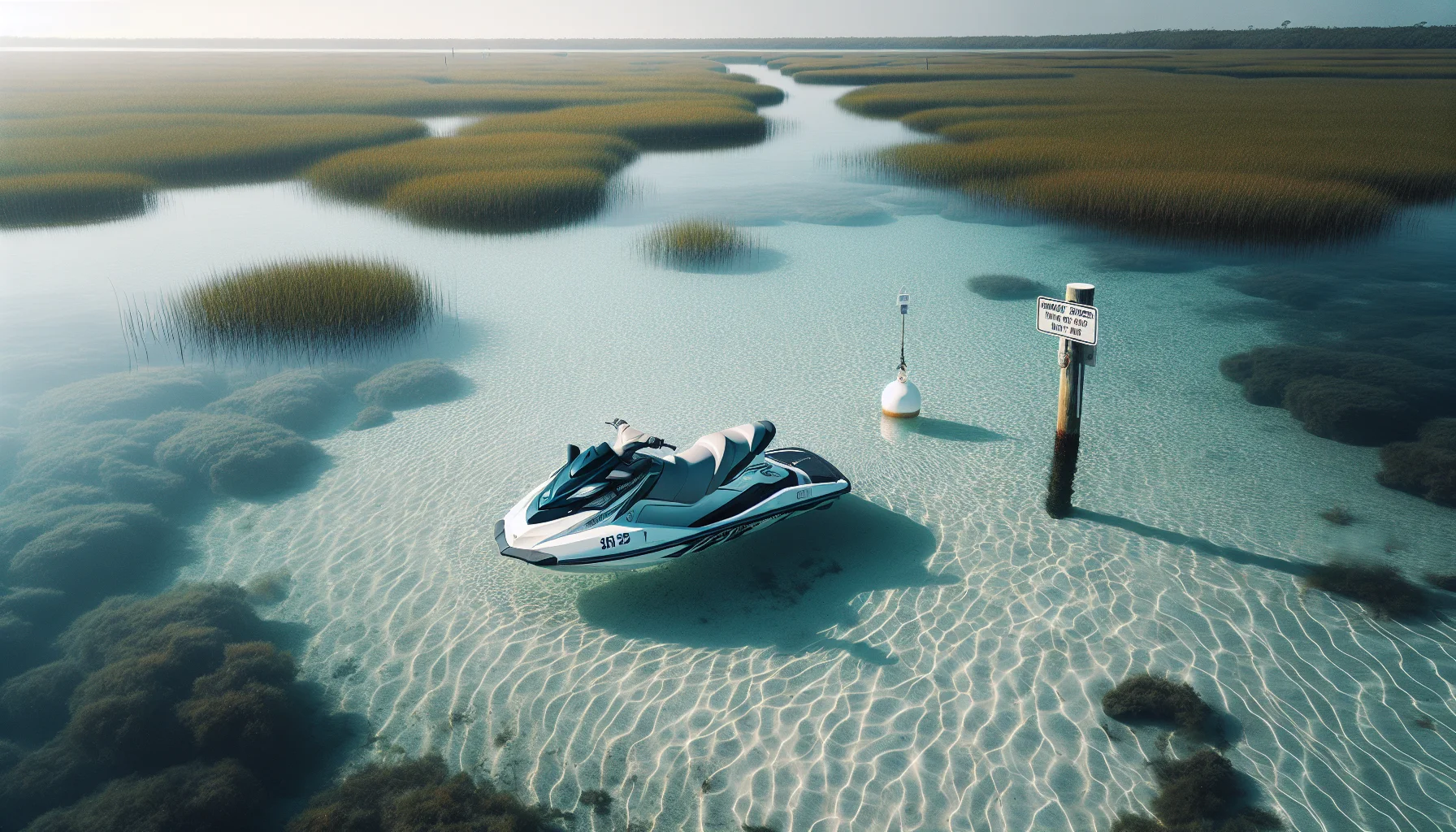
Manatee protection zones are the legal backbone of every ride you take in St. Pete. They are marked with regulatory signs and typically require one of a few reduced speeds:
- Idle Speed / No Wake — the slowest speed at which you can still maintain steering, producing no wake at all.
- Slow Speed / Minimum Wake — off plane, fully settled in the water, throwing minimal wake.
- Seasonal zones — additional areas activated during the cooler months (commonly November 15 through March 31) when manatees congregate.
Some zones apply to the whole waterway; others carve out a marked channel where faster travel is allowed. Read every sign, and when in doubt, slow down. Idle speed in the shallows is not just legal compliance — it is the single most effective thing you can do to avoid a strike, because a slow hull gives a manatee time to move and gives you time to see it.
Because manatee zones overlap with, and are enforced alongside, the broader speed framework in the bay, it is worth studying our complete guide to Florida manatee zones and speed regulations and the Tampa Bay no-wake zone map and speed-limit guide before you ride. Knowing exactly where a zone starts keeps you off the wrong side of a citation.
If a manatee approaches you
Manatees are curious and will occasionally drift up to an idling vessel. The rule is simple: do not engage. Shift to neutral or shut the engine off, stay still, keep your hands to yourself, and let the animal move on in its own time. Never touch, feed, or try to swim a jet ski alongside one, and never separate a cow from her calf. Passive observation is legal; active approach is not.
PWC Rules That Protect Manatees and You
Manatee safety does not stand apart from general PWC law — the same rules that keep you legal keep the animals safe. Before you launch in St. Petersburg, confirm you meet Florida's core requirements:
- Boater education card. Anyone born on or after January 1, 1988 must pass an approved boating safety course to operate a vessel of 10 horsepower or more — which includes every jet ski. Carry the card and a photo ID on board.
- Minimum age. You must be at least 14 years old to operate a PWC in Florida.
- Engine cut-off lanyard. The safety lanyard must be attached to you (wrist or PFD) whenever the engine is running, so the machine stops if you fall off — which prevents an unmanned PWC from circling into a manatee or a swimmer.
- Life jackets. Every rider must wear a properly fitted, Coast Guard–approved PFD on a PWC.
- Daylight only. No PWC operation from a half-hour after sunset to a half-hour before sunrise.
- Sober operation. Boating under the influence begins at a 0.08 BAC (0.02 for operators under 21). Impaired judgment in a manatee zone endangers both you and the animals.
For the full breakdown of ages, hours, and rider limits, see our Florida jet ski and PWC laws guide. Every one of these rules is on the course exam, and every one matters more in shallow, wildlife-rich water than almost anywhere else in the state.
Ethical Viewing and Photography
A good manatee photo never comes at the animal's expense. If you want images, use a zoom rather than closing distance, skip the flash, and keep your engine off while you shoot. Frame the animal in its habitat, capture natural behavior, and move on before you become an intrusion. Secure everything on board first — a floating phone case, a dry bag, nothing loose to snag or drop.
The ethic is the same one that governs every wildlife protection zone in the state, from Tampa Bay to the Charlotte Harbor estuary. Riders working those southern flats will recognize the principles laid out in our guide to jet skiing Punta Gorda's wildlife protection zones responsibly: observe, do not pursue; the wildlife's comfort outranks your photo.
What to Do If You Find an Injured or Distressed Manatee
Despite everyone's best efforts, riders sometimes come across a manatee in trouble — visibly wounded, entangled, cold-stressed and lethargic, or stranded in the shallows. If you see one:
- Note the exact location — GPS coordinates, a marker number, or a clear landmark.
- Call the FWC Wildlife Alert Hotline at 1-888-404-FWCC (3922). This is Florida's official line for reporting sick, injured, entangled, or dead manatees.
- Stand by at a distance if it is safe, so responders can find the animal, but do not try to move, feed, or handle it yourself.
- Keep other boaters back to prevent further harassment until help arrives.
Reporting fast genuinely saves manatees — cold-stress and boat-strike cases are treatable when rescuers reach them in time.
Get Certified Before You Ride
Sharing the water with manatees is a privilege that comes wrapped in real legal responsibility. Reading zone signs correctly, understanding right-of-way in a crowded bayou, knowing your PWC obligations, and recognizing a manatee footprint before your hull reaches it — these are learnable skills, and Florida law requires most riders to prove them with a boater education card.
BoatSkill's state-standards online course walks you through manatee-zone navigation, speed-zone signage, PFD and cut-off-lanyard rules, and environmental protection law at your own pace. The final exam is 25 questions, and you need 80% to pass — with unlimited retakes until you do. Pass it and you can print your certificate immediately and be legal to ride the same day.
Start the state-standards online course – $12.99
Conclusion
St. Petersburg's manatees reward the patient, quiet, law-abiding rider like nothing else on the water. Go early, ride slow, wear polarized lenses, and learn to read the footprints and the breath-puffs that give these gentle giants away. Obey every posted zone, keep your distance, and let curious animals come and go on their own terms. Do that, and you will not only stay legal and keep the manatees safe — you will see more of them than the rider who blasts through at speed ever will.
Before you launch, make sure your certification and your knowledge are current.
Get your Florida boater education card online – $12.99 and join the community of responsible riders protecting Florida's manatees.