Your cell phone is not a rescue plan. A mile off the Lake Worth Inlet, in a squall, with waves washing the cockpit, the one tool that reliably reaches the Coast Guard and every capable boat within range is your VHF marine radio. Yet most weekend boaters have never made a single Channel 16 call and would freeze if they had to. This guide fixes that. You will learn how VHF actually works, the one unbreakable rule of Channel 16, how to make a Mayday call word-for-word, the difference between Mayday, Pan-Pan and Securite, which working channels and bridges matter around Palm Beach, and how to set up Digital Selective Calling so a single button broadcasts your GPS position. Read it once, practice it twice, and you will be the calm voice on the radio when it counts.
Why Your VHF Radio Beats Your Cell Phone Offshore
Cellular networks are built to cover roads and neighborhoods, not open water. Push a few miles past the Palm Beach shoreline and your bars vanish, and even inside the inlet you will hit dead zones where a 911 call drops mid-sentence. VHF marine radio runs on dedicated maritime frequencies that owe nothing to cell towers, and that difference saves lives.
The bigger advantage is who hears you. A cell call is a private one-to-one line to a dispatcher who then has to figure out where you are and who to send. A VHF transmission on Channel 16 is heard simultaneously by the U.S. Coast Guard, which monitors the channel around the clock, and by every vessel within range. With a decent masthead antenna that range can stretch well over twenty miles. The boat that saves you is often not the Coast Guard cutter forty minutes out, it is the sportfisher a half mile away that heard your call and turned around.
Modern radios add one more layer: Digital Selective Calling, covered in detail below, lets you transmit your identity and GPS position with a single button even if you are injured or too busy fighting a fire to speak. No phone does that reliably on the water. If you are still deciding whether to invest in radio skills, treat it the way you treat your life jackets and fire extinguisher: non-negotiable safety equipment. A solid Florida boating safety course teaches communication alongside the rest of the fundamentals that keep you legal and alive.
How VHF Marine Radio Actually Works
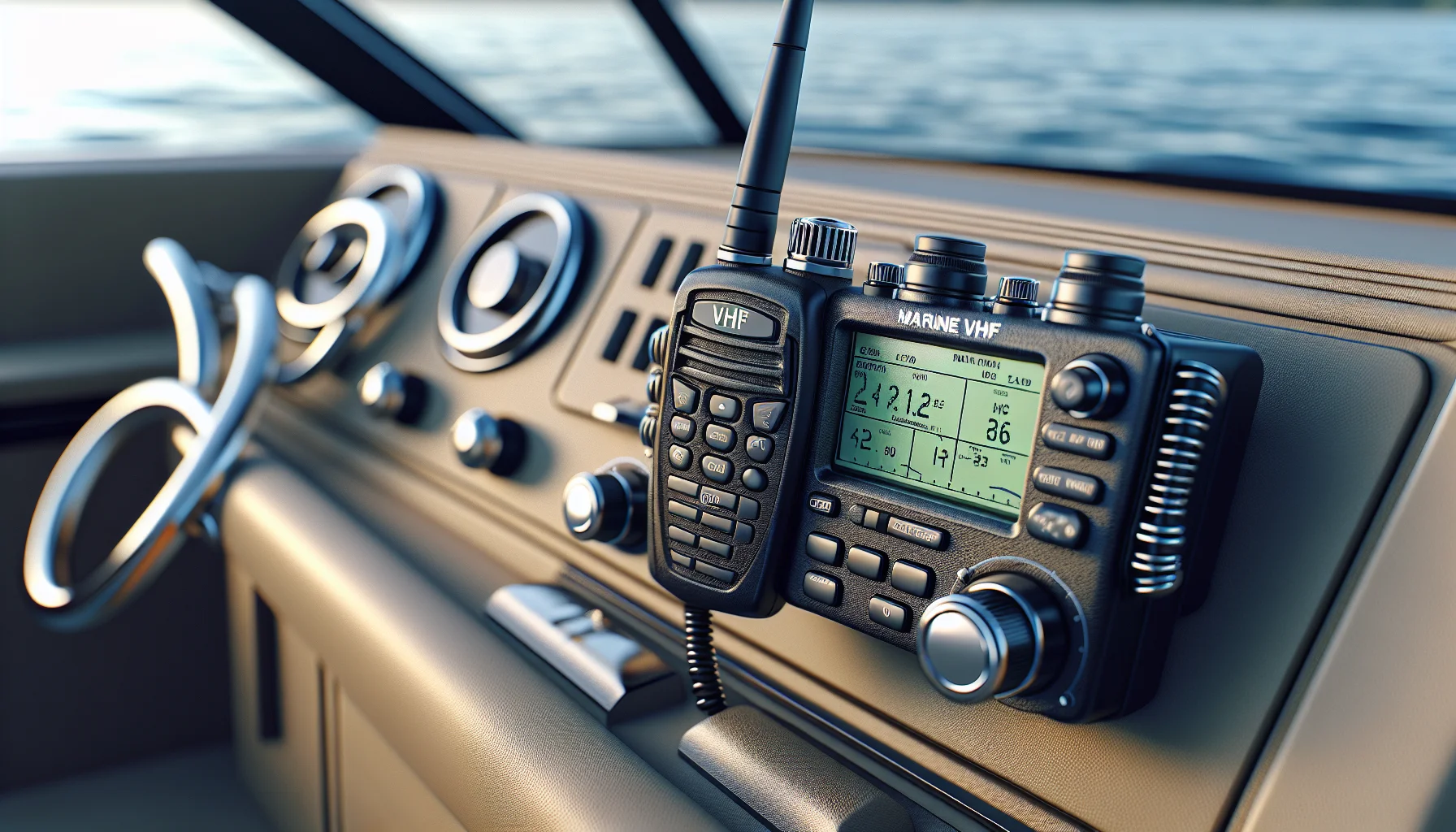
Before you can make a good call, you need to be comfortable with the hardware. Two knobs do most of the work.
Volume is obvious. Squelch is the one people get wrong. Squelch sets a threshold that mutes background static so you only hear real transmissions. Turn it up until the hiss disappears, then back it off slightly toward the noise. Crank it too high and you will silence weak, distant signals, exactly the faint Mayday you most need to hear.
Fixed-mount versus handheld
A fixed-mount radio wired to a masthead antenna and ship's power gives you the most range and typically transmits at up to 25 watts. A handheld is your backup and your abandon-ship radio, but it is limited to roughly 5 to 6 watts and a short antenna held near the water, so its range is a fraction of the fixed set. Carry both if you can, and keep the handheld charged. In a real emergency, antenna height matters more than raw watts.
Power settings and keying the mic
Most radios offer high and low power. Use low power, around one watt, for chatting with a boat a few slips away; it cuts interference and saves battery. Switch to high power for distance and for every emergency call. To transmit, press the microphone button firmly, pause half a beat so you do not clip your first word, then speak at a normal conversational volume with the mic a couple of inches from your mouth. Say "over" when you expect a reply and "out" when the exchange is finished. You never say "over and out," despite the movies.
The One Rule of Channel 16 Every Boater Must Know
Here is the rule: Channel 16 is not a conversation channel. It exists for four things only. Distress calls (Mayday), urgency calls (Pan-Pan), safety broadcasts (Securite), and brief hailing to make first contact before you both switch elsewhere. That is it.
Because the Coast Guard and most boats underway monitor 16 continuously, every transmission you make there lands in hundreds of wheelhouses at once. That is exactly the reach you want in an emergency and exactly the disruption you cause when you use it to plan lunch at the sandbar.
Hailing follows a set pattern. Say the other vessel's name twice, then identify yourself once: "Motor Yacht Paradise, Motor Yacht Paradise, this is Sailing Vessel Windward." The moment they answer, propose a working channel: "Switch to six-eight." You both change channels and 16 is clear again. If you get no answer, wait about two minutes and try once more; after a couple of failed attempts, give it fifteen minutes before hailing again. The other boat may be off the radio, out of range, or listening on a different channel.
Keeping 16 clear is not merely good manners, it is federal law. The FCC prohibits unnecessary transmissions on the distress and calling frequency, and enforcement is real. The habit that protects everyone is simple: hail, switch, and get off 16.
How to Make a Mayday Call, Step by Step
Reserve Mayday for grave and imminent danger to life: the vessel is sinking and you may abandon ship, an uncontrolled fire is spreading toward the fuel, someone is having a heart attack, a person is overboard and unrecoverable. If life is not on the line, use Pan-Pan instead.
Say it in this order. It is built for clarity under stress, so slow down and follow the sequence.
- "MAYDAY, MAYDAY, MAYDAY." Three times, so everyone stops and listens.
- "This is [vessel name], [vessel name], [vessel name]." Your boat's name, three times.
- "MAYDAY [vessel name]." Reinforces who is in distress.
- Your position. GPS latitude and longitude if you have it, or distance and bearing from a landmark, for example "two miles east of the Lake Worth Inlet."
- The nature of the emergency, in plain words.
- The assistance you need.
- Number of persons aboard. Rescuers plan around how many lives are at risk.
- A description of the vessel: length, type, color, distinguishing features.
- "Over." Then release the mic and listen.
A complete example sounds like this:
"MAYDAY, MAYDAY, MAYDAY. This is Sailing Vessel Freedom, Freedom, Freedom. MAYDAY Freedom. My position is two-six degrees four-six minutes north, zero-eight-zero degrees zero-zero minutes west, approximately two miles east of the Lake Worth Inlet. We struck a submerged object and are taking on water rapidly. The vessel is sinking and we may need to abandon ship. I require immediate assistance. Four persons aboard. Freedom is a thirty-five foot white sailboat with blue canvas. Over."
If nobody answers within a minute or two, repeat the call. When you hear someone else's Mayday, stop transmitting, write down what you can, and let the Coast Guard respond first. If no station acknowledges and you can help, transmit a relay beginning with "MAYDAY RELAY" and pass along everything you heard. Print this sequence and tape it near the helm; the crew member who has to make the call may not be you.
Pan-Pan and Securite: The Calls That Are Not Mayday
Two other urgent call types exist, and knowing when to reach for each keeps Mayday sacred for true life-and-death situations.
Pan-Pan for urgent but not life-threatening trouble
Pan-Pan, pronounced "pahn-pahn," covers urgent situations that do not yet threaten life. Your engine quit and you are drifting toward a shipping channel. A crew member is seasick and unwell but stable. You are hard aground on a falling tide. You are disoriented in fog and need a bearing. The format mirrors Mayday but opens with "PAN-PAN, PAN-PAN, PAN-PAN." The Coast Guard takes these seriously while still prioritizing any active Mayday. If your Pan-Pan situation deteriorates, upgrade to a Mayday without hesitation.
Securite for navigation and safety information
Securite, pronounced "say-cure-ee-tay," broadcasts hazards and safety information. A container is adrift in the shipping lane, an inlet range light is out, a fast-moving thunderstorm is bearing down, or a large vessel with restricted maneuverability is transiting. Open with "SECURITE, SECURITE, SECURITE," add "all stations" or a specific area, then deliver a brief, factual message. Weather is the most common trigger in Florida, and knowing how to read and respond to a building storm pairs naturally with these broadcasts; our guide to Tampa Bay thunderstorm safety applies just as well to a Palm Beach afternoon squall.
Palm Beach Working Channels, Bridges, and Tow Services
Once you are off 16, you need to know where to go. Around Palm Beach, a handful of channels handle nearly everything.
Channel 68 is the workhorse for recreational boats and the default place to continue a conversation after hailing. If it is crowded, 69, 71, 72, and 78A give you alternatives. Channel 09 is a secondary hailing and commercial channel, and it is the one most drawbridges monitor.
Requesting a bridge opening
Palm Beach cruising means bridges, and a clean request gets you through faster. Identify yourself professionally on the bridge's channel, usually 09: "Southern Boulevard Bridge, this is northbound sailing vessel Odyssey, a forty-two foot sailboat, requesting your next opening." The tender will answer with the schedule and any instructions. Know the difference between an on-demand bridge and one that opens only on a fixed schedule, and never assume; ask. Precise navigation habits around markers and bridges matter here, and if you are new to the local aids to navigation, review navigating Riviera Beach channel markers before you run the Intracoastal in the dark.
Marinas, tow services, and weather
Local marinas each publish a working channel; make first contact on 16 or by phone, then switch as directed. Commercial towing outfits monitor both 16 and 09, then move you to a working channel to sort out your position and membership. For weather, NOAA broadcasts continuous marine forecasts on dedicated weather channels your radio can receive directly; make checking the forecast part of your pre-departure routine rather than a mid-trip scramble. If you plan to run the Lake Worth Inlet itself, the timing and radio awareness in our Lake Worth Inlet crossing guide will keep you out of the worst of the standing waves.
Radio Etiquette and Clear Communication
Good etiquette is not fussiness, it is what keeps the channel usable for everyone and gets your message understood the first time.
Speak at a measured pace. Nerves make people rush, and rushing forces repeats that clog the channel. Always listen before you key up; if you transmit over someone else, you cancel both signals and no one hears either. Keep transmissions short and structured: who you are calling, who you are, and what you need.
The phonetic alphabet and number pronunciation
When you spell a boat name, a location, or an odd word, use the NATO phonetic alphabet so static and accents do not garble it: Alpha, Bravo, Charlie, Delta, Echo, Foxtrot, Golf, Hotel, India, Juliet, Kilo, Lima, Mike, November, Oscar, Papa, Quebec, Romeo, Sierra, Tango, Uniform, Victor, Whiskey, X-ray, Yankee, Zulu. Maritime convention also shifts a few numbers to prevent confusion: "three" becomes "tree," "four" becomes "fow-er," "five" becomes "fife," and "nine" becomes "niner." These are not affectations; they were adopted precisely because miscommunicated numbers caused accidents.
What is prohibited
The FCC bans profanity, false distress calls, transmitting music, and superfluous chatter on the calling frequency. False distress calls in particular are a serious federal crime that pulls rescue assets away from real emergencies, and the Coast Guard pursues them. The courteous, competent operator gets on, does the job, and gets off. That same professionalism shows up in how you handle everything else on the water, and our guide to Palm Beach boating etiquette for visitors covers the unwritten rules that go beyond the radio.
Digital Selective Calling and Your MMSI
Nearly every fixed-mount VHF sold in the last fifteen years includes Digital Selective Calling, yet a large share of boaters never set it up. That is a wasted lifesaver.
DSC lets you send a distress alert with a single dedicated button. The radio automatically transmits your vessel identity and, if connected to GPS, your exact position to the Coast Guard and every DSC radio in range. It works when you are hurt, when both hands are on a bilge pump, or when panic makes speech hard. It is the closest thing to a personal emergency beacon built into gear you already own.
Setup is three steps. First, obtain a Maritime Mobile Service Identity, a unique nine-digit MMSI number that is free to register for recreational boaters through BoatUS or the FCC. Second, program that MMSI into the radio following the manual; most radios let you enter it only once or twice, so do it carefully. Third, connect the radio to a GPS source, either an internal receiver or your chartplotter, so position data flows automatically. Confirm on the display that the radio is actually receiving a position fix.
Once configured, lift the spring-loaded cover on the red distress button and press and hold for several seconds to fire the alert; timing varies by manufacturer. Always follow the automated alert with a spoken Mayday if you are able, because the voice call adds detail the data burst cannot. DSC also supports direct calls to a specific vessel by MMSI and group calls to preprogrammed contacts, which is handy for fishing tournaments and flotilla cruising.
Practice, Testing, and Radio Maintenance
The worst time to learn radio procedure is during the emergency itself, when stress shreds memory. Practice makes the sequence automatic.
Run through the Mayday format out loud on calm days and include everyone who regularly rides with you. Post the steps at the helm. To confirm your radio actually transmits well, use an automated radio-check service where available rather than cluttering Channel 16 with test calls; you will get a recorded playback of your own signal so you can judge clarity and range.
Maintenance is quick and pays off. Each month, inspect antenna connections for corrosion, which is the single most common cause of weak transmissions in the salt air, verify that your DSC is still seeing a GPS position, keep the handheld charged, and make sure every crew member knows how to turn the radio on, key the mic, and reach Channel 16. A radio that works flawlessly at the dock but fails a mile offshore because of a green, crusty antenna fitting is worse than no radio at all, because it breeds false confidence.
Turn Radio Skills Into a Real Florida Boating Education
Your VHF radio ties you to rescue services, to nearby boats, and to the shore-side help you will one day need in a hurry. In Palm Beach's crowded, current-swept waters, the boater who can hail a bridge cleanly, make a textbook Mayday, and keep Channel 16 clear is the boater everyone wants nearby when things go wrong.
Communication is one piece of the safe-boating puzzle, and Florida law requires the rest. Anyone born on or after January 1, 1988 must carry a Boating Safety Education Card to operate a vessel of 10 horsepower or more, and the fastest path to that card is a fully online, state-standards online course you can finish at home. The exam is 25 questions, you need 80 percent to pass, and you get unlimited retakes, so there is no reason to put it off.
Start the state-standards online course - $12.99
Learn the radio, learn the rules, and get your card. Then the next time the weather turns off the Lake Worth Inlet, you will be the calm, clear voice that makes the difference.