
Tampa Bay is one of Florida's most rewarding places to run a boat or a personal watercraft, and also one of its most heavily regulated. Spread across roughly 400 square miles of open water, rivers and residential canals, the bay is dotted with speed zones designed to protect manatees, prevent shoreline erosion and keep fast boats from tangling with paddlers, anglers and swimmers. This guide explains exactly what Tampa Bay's no-wake and idle-speed zones mean, where they tend to appear, how the seasonal manatee rules work, and how to read the signs and charts so you never guess at your speed. By the end you'll know how to plan a run through the bay with confidence, and how to make sure you're legally qualified to be at the helm in the first place.
Why Tampa Bay Has So Many Speed Zones
Tampa Bay isn't over-regulated by accident. Three things drive the density of speed zones you'll encounter here.
First, manatees. The bay's warm-water outflows, spring-fed rivers and shallow seagrass flats make it one of the most important manatee habitats on Florida's Gulf coast. Boat strikes remain a leading cause of manatee deaths statewide, and slow, wake-free zones give the animals time to surface and move out of the way.
Second, the shoreline itself. Bayshore Boulevard, the residential canals of Apollo Beach and St. Petersburg, and countless private docks all suffer when repeated boat wake chews at seawalls and mangroves. Idle-speed rules protect property as much as wildlife.
Third, traffic. The bay funnels recreational boats, commercial shipping bound for Port Tampa Bay, research vessels, kayakers and jet skiers through the same channels. Speed control is how all of that shares the water without constant collisions.
Understanding why a zone exists helps you anticipate one before you ever see the sign. Narrow channel with houses on both sides? Expect idle speed. Warm-water discharge or spring in winter? Expect a manatee zone. When the reason is obvious, the rule usually is too.
What the Speed Zone Signs Actually Mean
Florida uses standardized regulatory markers, and the exact wording on a sign is legally meaningful. Learning the vocabulary is the single most useful thing you can do before launching.
Idle Speed – No Wake
This is the most restrictive common zone. You must operate at the minimum speed that still lets you maintain steerage and headway — essentially a crawl — and your vessel must throw no wake at all. On most boats that means the engine is barely above idle and the hull is fully settled. You cannot be on plane.
Slow Speed – Minimum Wake
Slightly less restrictive. Your vessel must be fully off plane and completely settled into the water, producing only minimal wake. You can move a little faster than a dead idle, but you are not planing and you are not pushing a big wave toward the shore or another boat.
Resume Normal Safe Operation
This marker tells you the restricted zone has ended and you may return to a reasonable, safe speed for conditions. "Safe" still depends on traffic, visibility and how close you are to other vessels — the end of a zone is not permission to be reckless.
A useful rule of thumb: if a sign says idle, think "barely moving, zero wake." If it says slow, think "off plane, small wake." When you can't read a sign clearly, treat the area as idle speed until you know otherwise. If you want to go deeper on how Florida's regulatory and information markers are laid out, our guide to Florida channel markers and navigation aids breaks down every buoy and sign shape you'll meet on the bay.
Where Tampa Bay's No-Wake and Idle Zones Cluster
Speed zones are set by the Florida Fish and Wildlife Conservation Commission (FWC) together with local governments, and the exact boundaries are marked on the water and published on official charts. Rather than memorize coordinates that can change, learn the patterns of where slow zones appear so you're never surprised.
Rivers and river mouths
The Hillsborough River, the Alafia River, the Little Manatee River and similar tributaries carry idle- and slow-speed designations along much of their length, especially near their mouths where manatees gather. Rivers narrow quickly, so assume the zone starts earlier than you think and stay off plane as you approach.
Downtown and Davis Islands channels
The channels threading through downtown Tampa and around Davis Islands are narrow, busy and lined with development. Expect idle-speed control, heavy enforcement and plenty of cross traffic. This is not the place to test your boat's top end.
Bayshore Boulevard and developed shorelines
Long stretches of seawall — Bayshore being the classic example — carry slow-speed or idle-speed zones near shore to limit erosion and protect the constant flow of walkers, runners and cyclists just beyond the wall. Give developed shorelines a wide, slow berth.
Warm-water outflows and protected bays
Areas around power-plant warm-water discharges, along with quiet residential bayous and preserves like Cockroach Bay and Terra Ceia, carry strong protections. Many of these double as manatee refuges, so the speed rules and the wildlife rules reinforce each other.
The takeaway: rivers, narrow channels, developed shorelines and protected bays are your cue to slow down. Wide-open water away from all of those is where higher speeds are generally permitted — but only where no marker says otherwise.
Manatee Protection Zones and Seasonal Rules
Manatee protection is the reason for a large share of Tampa Bay's speed zones, and it's the area where boaters most often get caught out because the rules change with the calendar.
Year-round vs. seasonal zones
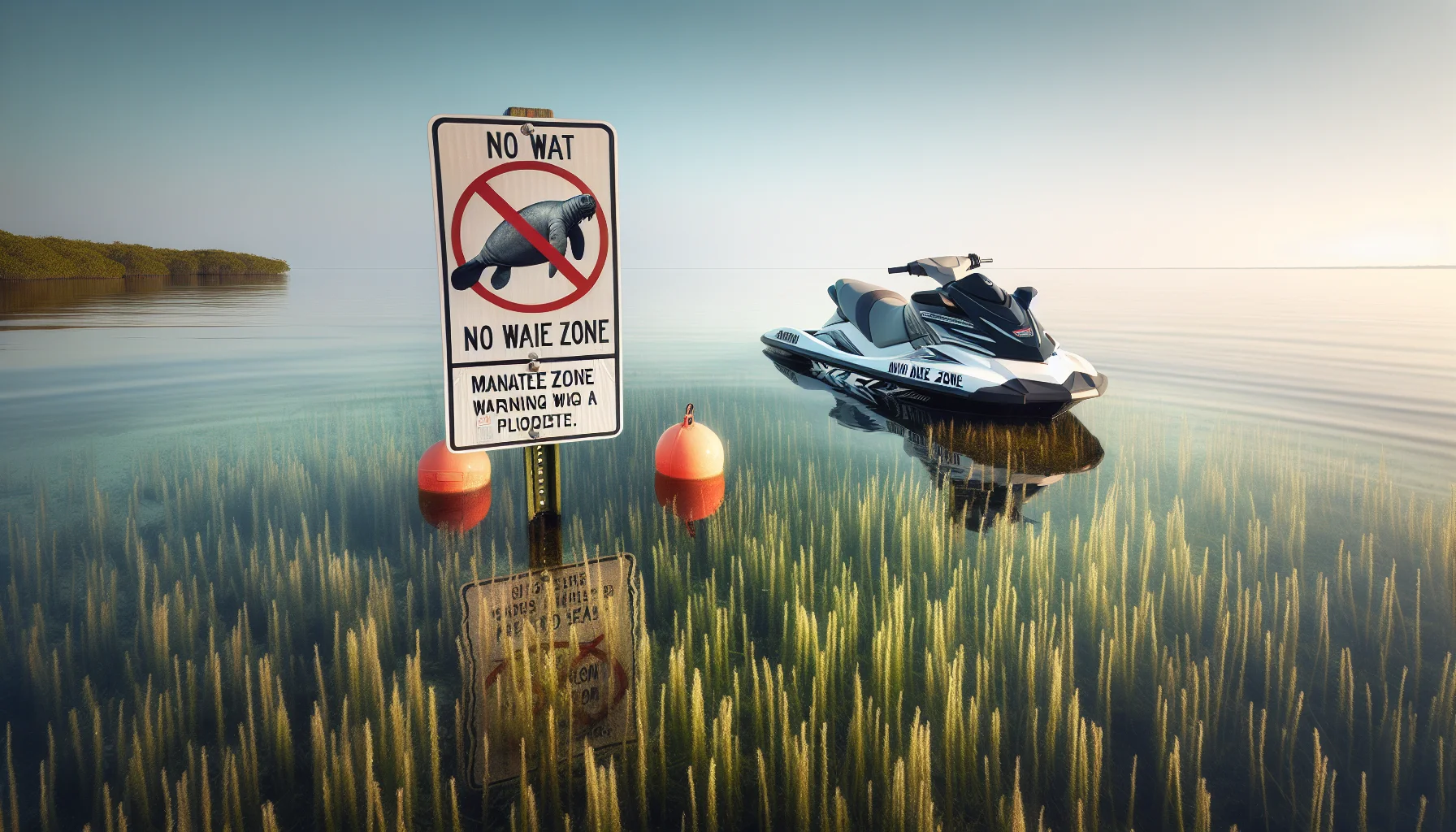
Some manatee zones are in effect every day of the year — typically the reliably warm-water refuges and critical habitat like major river mouths and discharge canals. Others are seasonal, most commonly active from November 15 through March 31, when cold Gulf temperatures push manatees toward warm water and their movement overlaps most with winter boat traffic.
The signs tell you which is which. A year-round zone is simply posted with its speed. A seasonal zone lists the dates it applies, so read the whole sign — not just the speed line.
Reading manatee zone markers
Manatee regulatory signs are usually white with the speed restriction and, where relevant, the effective dates. During the enhanced protection window the same stretch of water may carry a stricter rule than it does in summer. When you boat the bay in winter, assume more of it is slow or idle than you remember from July.
Beyond speed: how to actually avoid strikes
Slowing down is only half the job. Wear polarized sunglasses to cut glare and spot the tell-tale "footprint" swirl a manatee leaves when it dives. Watch for snouts and backs breaking the surface. Stay in marked channels and deeper water where you're less likely to be over an animal resting on a shallow flat. Our companion guide, Florida manatee zones and speed regulations, covers the statewide framework, and if you launch from the St. Pete side, how to spot manatees while jet skiing in St. Petersburg has practical spotting tips for exactly these waters.
How Speed Zone Enforcement Works on Tampa Bay
Multiple agencies patrol Tampa Bay, and knowing who does what helps you understand why enforcement can feel unpredictable.
Who's on the water
- FWC officers are the primary enforcers of Florida's boating and manatee-protection laws across the bay.
- County sheriff marine units patrol Hillsborough, Pinellas and Manatee county waters.
- The U.S. Coast Guard handles federal waters, security zones and the shipping channels around Port Tampa Bay.
- Local police marine units cover waters within some city limits.
What officers watch for
Enforcement of a no-wake zone is refreshingly simple from the officer's side: are you throwing a wake where you shouldn't be? A visible wake or a hull on plane inside an idle- or slow-speed zone is the clearest possible evidence. Officers also watch for boats ignoring posted signs, running too close to docks and swimmers, and operating in a manner that endangers others.
The excuses that don't hold up
"I didn't see the sign," "my GPS didn't show the zone," "I was just following the boat in front of me," and "it's a rental" are not defenses. Zones are marked on the water and published on official charts, and the operator is responsible for knowing them. Speed-zone and manatee violations are enforced as noncriminal boating infractions, while genuinely dangerous behavior — reckless operation, or operating while impaired — is treated far more seriously.
Speaking of impairment: Florida's boating-under-the-influence rules mirror the roads, with a 0.08 BAC limit for adults and 0.02 for operators under 21. A slow zone won't save you if you're running the bay impaired. If you want the full picture, read our Florida BUI laws guide before you ever bring alcohol aboard.
Reading Charts, Signs and Apps So You Never Guess
The best way to stay legal is to know a zone is coming before you reach it. Three layers of information work together.
On the water: the signs are authoritative
Posted regulatory markers are the legal standard. When a sign and an app disagree, the sign wins. Post a lookout whose job includes spotting markers, especially in unfamiliar channels, and slow down the moment you see white-and-orange regulatory signage ahead.
On the chart: official FWC and NOAA sources
FWC publishes manatee-protection and boating-restricted-area maps, and NOAA nautical charts show the channels and depths. Reviewing your intended route on these before you launch tells you roughly where the slow zones fall so nothing is a surprise.
On your device: navigation apps as a backup
Modern charting apps can display many speed zones and let you set proximity alerts, which is genuinely helpful. But zones and seasonal dates change, and no app is a substitute for reading the actual signs. Use apps to plan and to jog your memory — not as your sole authority.
A simple pre-trip routine
- Sketch your route and note where it crosses rivers, narrow channels and developed shorelines.
- Check whether you'll be out during the winter manatee window and adjust expectations.
- Brief everyone aboard on what idle vs. slow speed looks like on your boat.
- Keep your speed display visible and default to slowing down whenever you're unsure.
That routine costs five minutes and prevents the vast majority of speed-zone mistakes.
Residential Canals, Marinas and Security Zones
A few categories of water on Tampa Bay deserve special attention because the rules there are stricter — or the consequences of a mistake are higher.
Residential canals
As a practical rule, treat every residential canal as idle speed, no wake, whether or not you can see a sign. These narrow, dock-lined waterways are exactly where wake does the most damage and where manatees often shelter. Communities in Apollo Beach, the St. Petersburg bayous and the Westshore area all fit this pattern. Approaching a marina or fuel dock? Start slowing early and idle in — courtesy and the law point the same direction.
Marinas and fuel docks
Idle speed on approach is universal at marinas and fuel docks. Beyond speed, fueling is where a surprising number of boating fires start, so slow, careful handling matters. If you're new to fueling on the bay, the safe-fueling walkthrough in our Dania Beach marina fueling guide applies just as well to Tampa Bay docks.
Security and commercial zones
Around Port Tampa Bay and MacDill Air Force Base, you'll encounter federally enforced security and restricted zones with keep-out distances and serious penalties. Monitor VHF channel 16, give commercial ships and military facilities a wide berth, and never assume a shortcut through a restricted area is worth it. Large ships also can't stop or turn quickly and are constrained to the deep channel — stay well clear of the shipping lanes.
Personal Watercraft: Extra Rules That Apply on the Bay
If you're running a jet ski rather than a boat, Tampa Bay's speed zones apply to you exactly the same way — plus a set of PWC-specific rules.
Under Florida law, the minimum age to operate a PWC is 14, and PWC may not be operated from a half-hour after sunset to a half-hour before sunrise, even where boats can still run. The engine cut-off lanyard must be attached to the operator (or their PFD or clothing) whenever it's equipped, and everyone aboard must wear a Coast Guard–approved life jacket. Recklessly weaving, jumping wakes too close to another vessel, or spraying other boaters can all be cited as reckless operation regardless of the posted speed.
For a full breakdown of ages, hours and equipment, see our Florida jet ski and PWC laws guide. And if you're planning to rent rather than launch your own, jet ski rentals in Tampa walks through what to expect locally.
Weather, Timing and Building Good Habits
Speed zones are a constant, but the conditions around them change fast on Tampa Bay — and rushing to beat weather is exactly how people end up speeding through a no-wake zone or, worse, getting caught in a storm.
Summer afternoons on the bay bring near-daily thunderstorms that build quickly. The urge to race home when the sky darkens is understandable, but blasting through an idle zone to beat the rain is both illegal and dangerous. Plan shorter summer outings, watch the radar, and start back early. Our Tampa Bay thunderstorm safety guide explains how to read the sky and what to do if lightning catches you out.
Good speed-zone habits are really just good seamanship: keep a proper lookout, know your route, respect the reasons behind each zone, and default to slow when in doubt. Boaters who internalize the why behind the rules rarely get tickets — they slow down before anyone tells them to.
Get Certified Before You Launch on Tampa Bay
Knowing the zones is essential, but Florida law also requires most operators to be formally educated. Anyone born on or after January 1, 1988, who operates a vessel powered by 10 horsepower or more must carry a Florida Boating Safety Education Identification Card. That card comes from completing a state-standards online course and passing the exam.
The good news is that you can earn it entirely online. Our Florida boating safety course is state-standards online and NASBLA-recognized, so the card it produces is honored across Florida and in other states. The final exam is 25 questions, you need 80% to pass, and you get unlimited retakes — there's genuinely no reason to fail. The course covers navigation rules, environmental awareness including manatee protection, required equipment, and the emergency procedures that matter most on busy waters like Tampa Bay.
If you'd rather not spend another weekend guessing at speed zones or worrying about a citation, this is the fastest way to boat the bay legally and confidently. You can get your Florida boating license online at your own pace and print a temporary certificate the moment you pass.
Start the state-standards online course - $12.99
Final Thoughts
Tampa Bay's web of no-wake zones, idle-speed areas and seasonal manatee protections can look intimidating on a chart, but the logic behind them is consistent and learnable. Slow down in rivers, narrow channels, developed shorelines and residential canals. Watch for the difference between idle and slow speed, and read the seasonal dates on manatee signs — especially from mid-November through March. Treat the posted markers as the final word, use charts and apps to plan ahead, and keep a lookout dedicated to spotting both signs and wildlife.
Do those things and the bay opens up as one of the best boating playgrounds in Florida — with manatees protected, shorelines intact and your name off the citation list. Before your next launch, make sure your education card is in order and your knowledge of the rules is solid.