The DMV boating license is a search for something Florida does not issue. The card people call a Florida boating license is the Boating Safety Education ID Card, and the Florida Fish and Wildlife Conservation Commission (FWC) issues it after you pass a boating safety course. The FWC's education FAQ puts it plainly: Florida does not have a "boating license," and the card is proof that you completed the education requirement.
The Department of Highway Safety and Motor Vehicles (DHSMV), the state agency behind driver licenses and the office many people call the DMV, still has two jobs that touch boaters:
- It can add a boater safety symbol to your driver license or state ID card once you already hold the FWC card, under section 322.14 and section 322.051.
- It runs vessel registration and titling, under section 328.40, and you file the registration application with your county tax collector under section 328.48.
So the operator's card comes from the FWC, and the boat's paperwork goes through the DHSMV and the tax collector. The rest of this guide shows who handles each piece and what you carry aboard.
Who Does What: FWC, DHSMV and the Tax Collector
Three offices show up in Florida boating paperwork. The statutes split the work like this:
| Task | Who handles it | Where the rule is |
|---|---|---|
| Boating Safety Education ID Card | FWC | s. 327.395 |
| 90-day temporary certificate | Vendors the FWC authorizes | s. 327.395(8) |
| Boater safety symbol on a driver license | DHSMV | s. 322.14(1)(e) |
| Boater safety symbol on a state ID card | DHSMV | s. 322.051 |
| Vessel registration, number and decal | DHSMV, with the application filed at the county tax collector | ss. 328.40 and 328.48 |
| Vessel title | DHSMV | s. 328.03 |
In chapter 327, "commission" means the Fish and Wildlife Conservation Commission, per the definitions in section 327.02. In chapter 322, "department" means the Department of Highway Safety and Motor Vehicles, per section 322.01. When a statute says the commission issues the card, it means the FWC.
A simple way to keep it straight: the card follows the person, and the registration follows the boat. If you are the operator, start with the FWC. If you are the owner of a boat that needs a number, start with the tax collector.
Who Needs the FWC Card
Under section 327.395, anyone born on or after January 1, 1988 may not operate a vessel powered by a motor of 10 horsepower or more unless they carry the required documents aboard. The FWC's ID card page says the same: complete a boating safety course and get the Florida Boating Safety Education ID Card.
The statute lists exemptions, including:
- A person licensed by the U.S. Coast Guard as master of a vessel.
- Operating only on a private lake or pond.
- Having aboard a person 18 or older who holds the card or is exempt, and who is attending to the operation and responsible for it.
- A nonresident carrying photo ID and proof of a course or equivalency exam from another state or U.S. territory that meets the NASBLA minimum standard.
- Operating within 90 days after buying the vessel, with a bill of sale aboard that meets section 328.46(1).
- Operating within 90 days after finishing a boating safety course, with photo ID and the course completion certificate.
If none of those fit and you were born in 1988 or later, the card is the document you need, whatever office you walk into. Our guide to whether you need a boating license in Florida walks through each exemption.
How the FWC Issues the Card
The card comes from one place. The FWC's ID card page describes two routes after you pass a course from its course list:
- Your course provider sends the request. Many online providers and some classroom providers send an ID card request to the FWC for every student who passes. When yours does, the FWC says the card should arrive within two to three weeks.
- You send the request yourself. Get your course completion certificate from the provider, then send it to the FWC with your name, date of birth, return address and phone number, by email or by mail to the FWC Division of Law Enforcement, Boating Safety Unit, 620 South Meridian Street, Tallahassee, FL 32399-1600.
The FWC notes that course providers are separate from the FWC and must send student information before a card can be issued. No DHSMV office or tax collector is part of this step.
Two more facts from section 327.395(5): the card is valid for life, and the FWC may issue it in a digital, electronic or paper format. The statute also lets the FWC collect a $2 fee for each card under subsection (9).
While you wait for the card, the FWC's education FAQ says the course completion certificate and a photo ID work for up to 90 days. The certificate must show your first and last name, your date of birth and the date you passed. Our Florida boater ID card guide covers the card itself in more detail.
What the DHSMV Can Add to Your Driver License
This is the one place the DMV and the boating card meet. Section 322.14(1)(e) tells the DHSMV to include a symbol on a driver license for an applicant who presents a lifetime boater safety identification card, for an additional $1 fee. Section 322.051 gives the same option on a Florida identification card.
You do not have to wait for your next renewal. The statute lets you replace your license early with one that shows your boater safety cardholder status: you surrender the current license, pay a $2 fee and present the card. If the only reason for the replacement is adding that status, the standard replacement fee in section 322.21(1)(e) is not charged.
Why bother? Section 327.395(2) accepts "a state-issued identification card or driver license indicating possession of the Florida boating safety identification card" as proof aboard. With the symbol on your license, the license covers both photo ID and proof of education in one card.
The order matters. The DHSMV adds the symbol to show a card you already hold, so you earn the FWC card first and bring it with you. If you are still looking for a course in your area, our guide to the Florida boating license near me lists the classroom, online and renter routes.
Boat Registration and Title Go Through the Tax Collector
The other half of the DMV question is the boat. Section 328.40 places the administration of vessel registration and titling under the Department of Highway Safety and Motor Vehicles, including the records and the fees.
Section 328.48 sets out the practical steps:
- Where to apply: the owner files the registration application with the county tax collector, with the fee required in section 328.72.
- What to bring: an individual applicant provides a valid driver license or identification card from Florida or another state, or a valid passport. Proof of ownership can be a bill of sale, a builder's contract, a manufacturer's statement of origin, a federal marine document or another document the DHSMV accepts.
- Which boats: each vessel operated, used or stored on Florida waters must be registered, with exceptions for vessels used only on private lakes and ponds, vessels owned by the U.S. government, ship's lifeboats, and non-motor-powered vessels under 16 feet or non-motor-powered canoes, kayaks, racing shells and rowing sculls of any length.
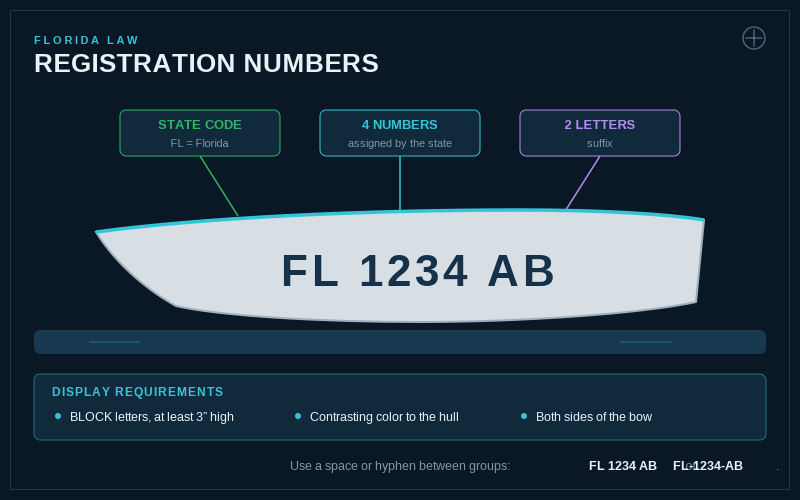
- What goes on the boat: numbers on each side of the forward half, in block characters at least 3 inches high that contrast with the hull, and the DHSMV decal on the port side within 6 inches of the number.
- What stays aboard: the certificate of registration is pocket-sized and must be available for inspection on the vessel whenever it is in operation.
Title is a separate step. Under section 328.03, the owner of a vessel that must be titled in Florida delivers a title application to the DHSMV no later than 30 days after the transfer of ownership or the date Florida becomes the state of principal use.
Fees and renewal timing for registration are in our Florida boat registration guide.
What to Carry Aboard
Put both halves together and a typical Florida operator born in 1988 or later, running their own registered boat, carries:
| Document | Comes from | Covers |
|---|---|---|
| Photo ID plus the FWC Boating Safety Education ID Card | FWC | The operator |
| Or a driver license or state ID showing the boater safety symbol | DHSMV, after you hold the card | The operator |
| Certificate of registration | DHSMV, through the tax collector | The boat |
Visitors have other options under section 327.395(2): photo ID with a boating card from another state or U.S. territory, an International Certificate of Competency, or a Canadian Pleasure Craft Operator Card. A visitor without any of those can take the FWC's temporary certificate exam online through an authorized vendor: 25 questions, with 19 correct needed to pass. The certificate is valid for 90 days, only in Florida, and the FWC will not exchange it for the lifetime card. Our temporary certificate guide explains that route.
Operating without the required proof is a noncriminal infraction under section 327.395(7).
Common Mix-Ups
A few situations send people to the wrong office:
- Lost card. Replacement goes through the FWC, the same office that issued it. Our guide to replacing a Florida boater card covers the request.
- Course certificate in hand, no card yet. The certificate and photo ID cover you for 90 days, per the FWC FAQ. The tax collector and the DHSMV cannot turn it into a card.
- Registration renewed, card question still open. A current registration decal says nothing about the operator. The card requirement in section 327.395 applies to the person at the helm on every trip.
- New boat, new operator. Buying the boat starts two clocks: 30 days to apply for title under section 328.03, and the 90-day bill of sale exemption under section 327.395(6)(e) for the operator. After those 90 days, an operator born in 1988 or later needs the card or another exemption.
- Expecting a renewal. The FWC card is valid for life, so there is nothing to renew at the DMV for the card itself. Our Florida boating license renewal guide lists the boating documents that do expire.
Start With the Course
For most boaters the card starts with a boating safety course, and that is the step you can start from home. Our step-by-step guide to getting a Florida boating license covers the course, the exam and the cost in order.
Boat Skill is preparing the Florida temporary boating certificate, the 90-day proof described above, and does not issue the lifetime card.
Get notified when Boat Skill enrollment opens
Sources
- FWC: Boating Safety Education ID Card
- FWC: FAQs About Boating Safety Education Requirements
- FWC: Temporary Certificate Program
- FWC: Boating Safety Courses
- Florida Statutes s. 327.395: Boating safety education
- Florida Statutes s. 327.02: Definitions
- Florida Statutes s. 322.14: Driver licenses, contents
- Florida Statutes s. 322.051: Identification cards
- Florida Statutes s. 322.01: Definitions
- Florida Statutes s. 328.40: Administration of vessel registration and titling
- Florida Statutes s. 328.48: Vessel registration
- Florida Statutes s. 328.03: Certificate of title required
Common questions
Can I get a boating license at the DMV in Florida?
No. The Boating Safety Education ID Card comes from the FWC after you pass a boating safety course. The Department of Highway Safety and Motor Vehicles can add a boater safety symbol to your driver license or state ID once you already hold the FWC card, under sections 322.14 and 322.051.
Does my Florida driver license count as a boating license?
Only if it shows the boater safety symbol. Section 327.395(2) accepts a state-issued identification card or driver license that indicates you hold the Florida boating safety identification card. Without the symbol, carry photo ID and the FWC card.
How much does it cost to add the boater symbol to my license?
Section 322.14(1)(e) sets an additional $1 fee for the symbol on a driver license. To add it before your license expires, you surrender the license, pay a $2 fee and present the card, and if that is the only reason for the replacement, the standard replacement fee in section 322.21(1)(e) is not charged.
Where do I register a boat in Florida?
With your county tax collector. Section 328.48 says the owner files the registration application with the county tax collector, and section 328.40 places vessel registration and titling under the Department of Highway Safety and Motor Vehicles.
Who do I contact about a lost boater card?
The FWC, which issued it. The FWC ID card page lists its Division of Law Enforcement at 850-488-5600 and the Boating Safety Unit mailing address in Tallahassee. The DHSMV and the tax collector do not issue the card.
Does the FWC card expire?
No. Section 327.395(5) makes the Florida boating safety identification card valid for life, and the FWC says it does not expire. Vessel registration is a separate document that does renew.
I just bought a boat. Do I need the card before I can run it?
Section 327.395(6)(e) exempts an operator for 90 days after buying the vessel, with a bill of sale aboard that meets section 328.46(1). Separately, section 328.03 gives the owner 30 days after the transfer of ownership to apply for a Florida title.
Can a visitor use a boating card from another state?
Yes. Section 327.395 accepts photo ID with a boating safety card from another state or U.S. territory that meets the NASBLA minimum standard. A visitor without one can pass the FWC temporary certificate exam online, which is valid for 90 days and only in Florida.