

The Short Version
You register a boat in Florida at your county tax collector's office (or a license plate agent), you have 30 days from the date of purchase to do it, and the annual fee runs from about $5.50 for a dinghy to $189.75 for a megayacht, plus small service fees and, in some counties, an optional county fee. Motorized vessels are titled and registered at the same time. Registration renews on the first registered owner's birthday — not the calendar year.
That paragraph answers most searches. The rest of this guide walks through each step, the full fee table, the documents to bring, and the corner cases (out-of-state boats, homemade boats, non-motorized craft) that generate the most confusion at the counter.
Who Must Register a Boat in Florida
Florida requires registration for essentially every vessel with a motor that touches public water:
- All motorized vessels, including jet skis (PWC), operated on Florida's public waters
- Sailboats with auxiliary engines — the engine makes them motorized
- Vessels moved to Florida from another state, once Florida becomes the state of principal use
You do not need to register:
- Non-motorized vessels under 16 feet
- Canoes, kayaks, racing shells, and rowing sculls of any length, as long as they are non-motorized
- Vessels used exclusively on private lakes and ponds
- U.S. Government vessels and ship's lifeboats
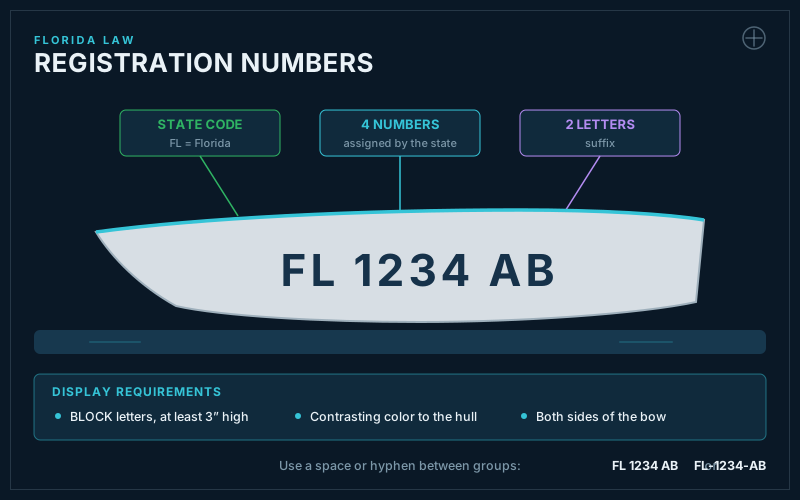
The registration decal goes on the port (left) side of the bow, next to the FL registration numbers. If you're not sure how the numbers themselves must be displayed — block letters at least 3 inches high, contrasting color, both sides of the bow — our course covers the display rules in detail.
The 30-Day Rule (and What Happens If You Miss It)
From the day you buy a boat — new or used — you have 30 days to title and register it. During that window you must keep proof of the purchase date aboard the vessel whenever you operate it. A bill of sale in a zip-top bag in the console solves this.
Operating an unregistered vessel after the 30 days is a second-degree misdemeanor. In practice that means a stop by FWC that would have been a warning becomes a criminal citation. Registering on time is cheaper in every possible way.
How Much Boat Registration Costs in Florida
Fees are set by vessel length class. These are the standard one-year registration fees:
| Class | Vessel Length | 1-Year Fee |
|---|---|---|
| A-1 | Under 12 ft | $5.50 |
| A-2 | 12 to under 16 ft | $16.25 |
| 1 | 16 to under 26 ft | $28.75 |
| 2 | 26 to under 40 ft | $78.25 |
| 3 | 40 to under 65 ft | $127.75 |
| 4 | 65 to under 110 ft | $152.75 |
| 5 | 110 ft and over | $189.75 |
On top of the base fee, expect a $2.25 service fee and a $0.50 FRVIS fee, and about a dozen counties (including Miami-Dade, Broward, Palm Beach, Hillsborough, Pinellas, and Lee) add an optional county fee — roughly half the base fee. You can register for one year or two years — two years means one trip to the tax collector instead of two.
So the most common answer to "how much is boat registration in Florida": a typical 20-foot center console in a county with the optional fee runs around $45 per year; the same boat in a county without it is closer to $31.
Looking for the cost of the boating license rather than registration? That's a different (and smaller) number — see how much a Florida boating license costs.
Titling: The Other Half of the Transaction
Florida is a title state for vessels. When you register, the boat is titled in your name at the same visit. What to bring depends on the boat:
- New boat: the Manufacturer's Certificate of Origin (MCO) from the dealer, or a bill of sale with a complete vessel description
- Used boat already titled in Florida: the current Florida title, signed over to you
- Used boat from out of state: the out-of-state title, or that state's registration plus a bill of sale
- Homemade boat: an inspection and a hull identification number (HIN) assignment first, then titling
Title fees are modest: $5.25 electronic, $7.75 paper, $11 expedited. Keep the title ashore in a safe place — it is proof of ownership, not an operating document, and it never needs to be aboard. Liens are recorded on the title, so before buying a used boat, verify the title status; an outstanding lien becomes your problem the moment you hand over the money.
When Florida Boat Registration Renews
Vessel registration for a privately owned boat expires at midnight on the first registered owner's birthday. That surprises people who expect a calendar-year or purchase-anniversary cycle. Renewal is the easy part: online through your county tax collector, by mail, or in person, for one or two years at a time.
Practical tip: if the boat is co-owned, whoever is listed first on the registration sets the renewal date. Listing the owner whose birthday is easiest to remember is a legitimate life strategy.
Registration Is Not a License — You May Need Both
Registration attaches to the boat. Boater education attaches to the operator. If you were born on or after January 1, 1988, Florida also requires you to carry a Boating Safety Education ID Card to operate a vessel of 10 horsepower or more — which includes basically everything you'd bother registering. If you have the boat sorted but not the card, our step-by-step licensing guide covers the whole process, and the Florida requirements guide goes deeper on who is exempt.
Already certified but lost the card? See our license lookup and replacement guide.
Common Situations, Quickly
Buying from a private seller on a Saturday: you can legally operate right away — keep the dated bill of sale aboard and get to the tax collector within 30 days.
Bringing your boat when you move to Florida: once Florida is the state where the boat is principally used, title and register it here; your old state's registration doesn't transfer, though its documents prove ownership.
Kayak with a trolling motor: the motor makes it a motorized vessel — it must be registered, regardless of length.
Dealer demos and new-boat delivery: dealers operate under their own registration class; your 30-day clock starts on your purchase date.
Fees and procedures come from the Florida Department of Highway Safety and Motor Vehicles (FLHSMV) and county tax collector schedules, current as of 2026. Your county tax collector is the authoritative source for exact totals in your county.