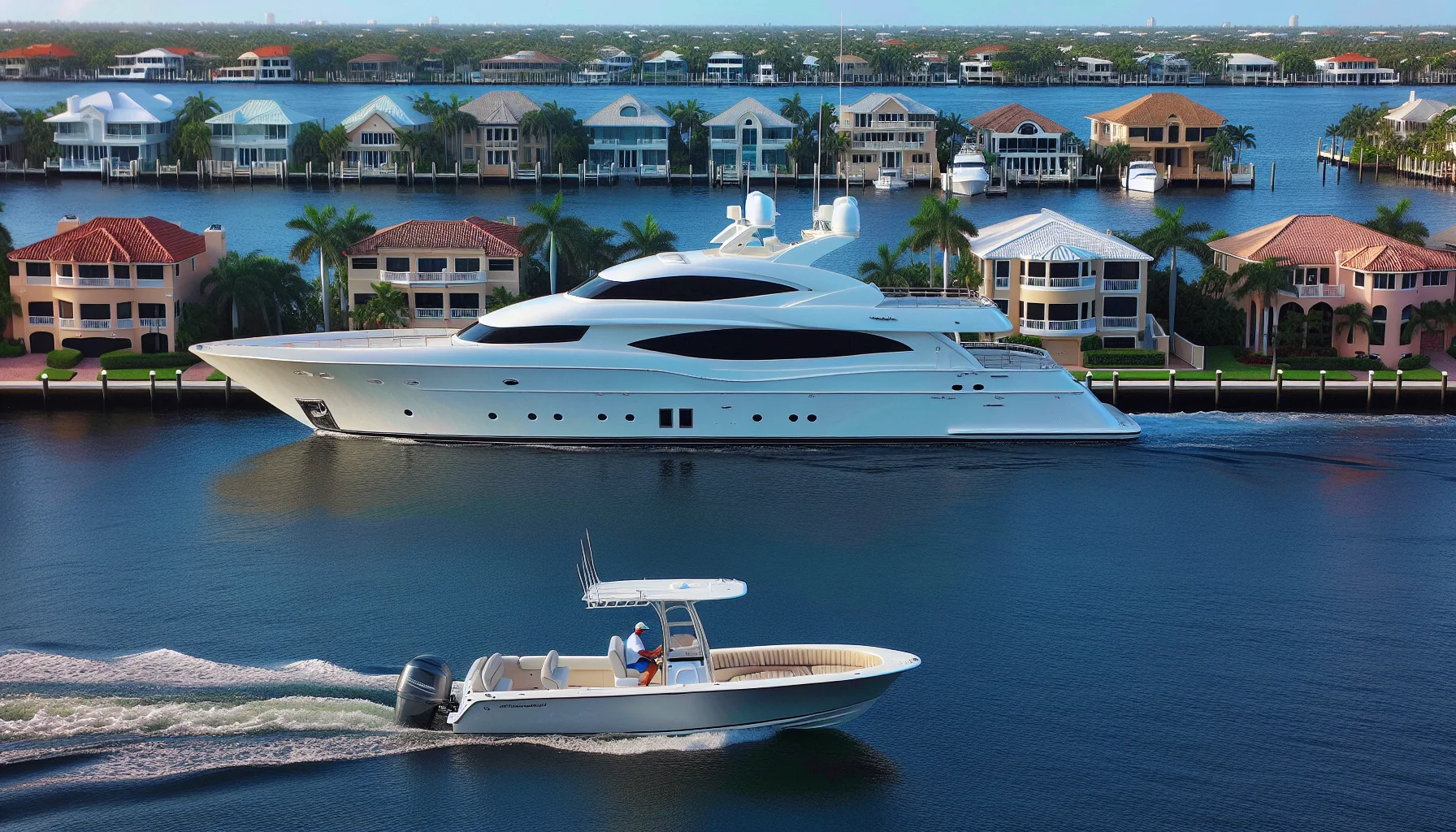
Fort Lauderdale earned its "Yachting Capital of the World" reputation honestly. On any given afternoon, a 25-foot center console might find itself sharing the same narrow Intracoastal channel with a 180-foot mega yacht that costs more than a city block. When you operate a small boat around vessels that size, courtesy is not optional and misunderstanding the rules can be expensive or deadly.
This guide explains exactly how to share Fort Lauderdale's crowded waterways with large yachts: who holds right of way, how to pass on the Intracoastal Waterway (ICW), why you are legally on the hook for your own wake, and how to communicate on VHF so professional crews know your intentions. By the end you will know how to move through the New River, the ICW, and Port Everglades with the confidence of a local instead of the anxiety of a first-timer.
Why Mega Yachts Change the Rules of the Water
A large yacht is not simply a big version of your boat. It behaves according to different physics, and those constraints are baked into maritime law.
The physics you cannot argue with
Most mega yachts in Fort Lauderdale draw somewhere between 8 and 20 feet, which means they physically cannot leave the dredged channel without running aground. A vessel that size may need a quarter-mile or more to stop and a very wide arc to turn. From the bridge deck, the captain often cannot see a small boat sitting close off the bow or tucked against the hull. Add wind and a strong tidal current on the New River and you have a vessel that simply cannot dodge you the way another runabout could.
What the law calls them
Under the international and inland Navigation Rules that the U.S. Coast Guard enforces, a large yacht confined to a channel is frequently a "vessel constrained by her draft" or, when maneuvering into a slip with tugs, "restricted in her ability to maneuver." Both categories sit above ordinary recreational power vessels in the right-of-way pecking order. In plain terms: when a mega yacht is boxed into the channel, you are the give-way vessel, full stop.
Understanding these categories is exactly the kind of knowledge tested in a Florida boating safety course, and it is the difference between a boater who reads the water and one who reacts to it.
The Right-of-Way Hierarchy Around Large Vessels
The Navigation Rules establish a clear order of who yields to whom. Memorizing it keeps you calm when a wall of white fiberglass appears around a bend.
From most privileged to least:
- Vessels not under command — a boat that has lost steering or power and cannot get out of the way.
- Vessels restricted in their ability to maneuver — dredges, tugs with tows, and yachts being warped into a berth.
- Vessels constrained by draft — deep-draft yachts and ships that must stay in the channel.
- Fishing vessels engaged in fishing with gear that limits maneuverability (not recreational anglers).
- Sailing vessels under sail alone.
- Power-driven vessels — your center console, bowrider, and most recreational boats.
Personal watercraft and recreational powerboats sit at the bottom of this list because they are the most maneuverable. That is not an insult; it is a responsibility. Being the most nimble vessel on the water means the burden of avoiding a collision falls on you.
Applying it in a real Fort Lauderdale channel
Picture a 200-foot yacht transiting the New River while you idle in a 22-foot boat. The yacht cannot move aside; the channel is barely wider than the vessel, and shallow water sits just outside the markers. Right of way here is not a courtesy you extend, it is a legal obligation. You find a wide spot, hold position, and let the big vessel pass before you continue. No horn blast, no argument, no squeezing by will change the depth of the water under that hull.
For a deeper walkthrough of these encounters beyond the Fort Lauderdale context, our guide to boat navigation rules and right-of-way breaks down every give-way and stand-on scenario you will meet on Florida water.
How to Pass Safely on the Intracoastal Waterway
Passing a slower large vessel on the ICW is routine, but it must be deliberate. The Navigation Rules treat the overtaking boat as the give-way vessel, which means the responsibility for a clean, safe pass is entirely yours.
The overtaking sequence
1. Read the water first. Before you commit, look past the yacht for bridges, oncoming traffic, no-wake zones, marina entrances, and any spot too narrow to pass. If there is any doubt about room, wait.
2. Announce your intentions. Hail the vessel on VHF (more on channels below), identify yourself, and state which side you intend to pass on. On inland waters, one short horn blast signals your intent to pass on the other vessel's port side; two short blasts signal a pass on the starboard side. The vessel being overtaken answers with the same signal to agree.
3. Pass at idle, not "slow." Come completely off plane so your hull settles fully into the water. A boat that is merely throttled back can still throw a punishing wake. Pass efficiently, hold your line, and only resume cruising speed once you are well clear and your wake will not roll back onto the vessel or nearby docks.
When you are the one being overtaken
If a faster boat is coming up behind you, generally hold your course and speed so the overtaking operator can predict your path. Acknowledge the passing vessel, and if a professional crew asks you to slow, do it. Watch for the wake as they clear you and take it bow-on if you can.
Narrow stretches where you simply wait
Some sections are too tight to pass at all. Around the 17th Street Causeway bridge, the Las Olas approaches, the Port Everglades cut, and the tighter bends of the New River, the correct move is often to hold back, find a wide spot, and let traffic clear. Forcing a pass in a pinch point is how collisions and wake-damage claims happen.
Your Wake, Your Responsibility Under Florida Law
If there is one rule that separates seasoned Fort Lauderdale boaters from the rest, it is this: you are responsible for your wake and everything it damages.
What Florida law expects
Florida law requires every vessel to be operated in a reasonable and prudent manner, and it holds the operator accountable for the effects of their wake. That liability follows your wake even after you have moved on. If your wash rolls into a marina, snaps a dock line, throws someone off a swim platform, or slams a moored boat against a piling, the fact that you were already a quarter-mile away does not erase your responsibility.
Wake damage is also a common thread in reportable boating accidents. Under Florida rules, a boating accident must be reported when it involves a death, a disappearance, an injury requiring more than basic first aid, or property damage at or above the state's reporting threshold. A serious wake incident can easily cross that line.
Why "constrained by draft" cuts both ways
Large yachts throw enormous, long-period wakes of their own, and those waves reflect off Fort Lauderdale's ubiquitous concrete seawalls and can combine into something far worse than the original. When you are near a big vessel's wake, take it at an angle across the bow and keep your own speed down so you are not adding energy to an already busy patch of water.
Minimizing your wake, the right way
- Come off plane completely. A settled displacement hull moves far less water than a boat plowing at half throttle.
- Treat marina rows, fuel docks, and residential canals as true idle zones, whether or not a sign is posted.
- Anticipate reflection. In a canal lined with seawalls, your wake bounces back. Slow earlier than you think you need to.
Fort Lauderdale's Highest-Risk Zones
Local knowledge is a safety tool. A few areas concentrate yacht traffic, current, and blind corners, and they deserve extra caution.
The New River
The New River is the beating heart of Fort Lauderdale's marine industry, home to refit yards and superyacht berths, and it is narrow, current-swept, and full of blind bends and bridges. Commercial towing operations move giant hulls through here regularly. Communicate constantly, wait at the wider stretches for opposing traffic, and never assume you can slip past a yacht mid-turn.
Port Everglades entrance
The Port Everglades cut mixes cruise ships, cargo vessels, mega yachts, and a stiff current in a confined space. Do not pass inside the cut, keep to single-file transits, monitor VHF channel 16, and get through efficiently. This is not the place to linger, fish, or sightsee.
The ICW through the city
The main ICW run past Bahia Mar, the Las Olas bridge, Sunrise Bay, and the 17th Street corridor is beautiful and crowded. Traffic peaks on Friday afternoons, weekend mornings, and holidays. Give yourself extra room and extra patience during those windows.
For the broader rulebook on operating in these waters, renters and newcomers should read our companion piece on Fort Lauderdale Intracoastal Waterway boating rules before their first outing. And if you are renting rather than bringing your own boat, the Fort Lauderdale jet ski and boat rental guide covers what operators expect of you locally.
VHF Radio Communication That Actually Works
Professional yacht crews live on the radio. Learning to hail them clearly instantly marks you as a competent operator and takes the guesswork out of a pass.
The channels that matter
- Channel 16 — the hailing and distress channel. Make initial contact here, then move to a working channel.
- Channel 13 — the bridge-to-bridge navigation channel commonly monitored by commercial traffic and large vessels for maneuvering intentions.
- Channels 68, 69, 71, 72 — common recreational working channels to switch to once you have made contact.
Keep channel 16 clear for hailing and emergencies. Never rehearse a whole conversation there.
A clean hail sounds like this
- "Motor Yacht Excellence, Motor Yacht Excellence, this is the sport boat Sea Runner off your stern, channel one-six."
- "Sea Runner, this is Excellence, switch six-eight."
- "Switching six-eight. Excellence, I'd like to overtake on your port side at idle, is that clear?"
- "Roger, Sea Runner, port side is clear, come on by."
Short, specific, professional. State who you are, where you are, and what you intend to do. If you never hear back, do not assume agreement; hold off until you can pass with obvious safe water.
New to the microphone? Our VHF radio basics and Mayday etiquette guide walks through everything from a routine hail to a genuine distress call.
When the radio fails
Not every small boat carries a working VHF, and not every crew answers. Fall back on the sound signals in the Navigation Rules and clear, unambiguous boat handling. Slow dramatically, make your intended course obvious, and never crowd a vessel that has not acknowledged you.
Reading the Channel: Markers, Depth, and Traffic
Passing safely starts with knowing where the deep water is, because that is where the big yachts must stay.
Stay oriented to the markers
Red and green channel markers define the navigable water, and around Fort Lauderdale the space outside those markers can shallow up fast. When you yield to a deep-draft vessel, you are usually easing toward the edge of the channel, so know exactly how much water you have. If you are shaky on the buoyage system, our guide to Florida channel markers and navigation aids is worth reviewing before you go.
Use technology, but do not trust it blindly
AIS-enabled apps and chartplotters can show you the name, size, speed, and heading of large vessels before you ever see them, which is invaluable for planning a route through a busy stretch. Treat these tools as a supplement to a good visual watch, not a replacement. Electronics fail, small boats often do not transmit AIS, and nothing beats a pair of eyes scanning ahead.
Seasonal Traffic: Boat Show and Winter Peaks
Timing your transits well is one of the easiest ways to reduce risk.
The Fort Lauderdale International Boat Show
Each autumn the boat show fills the waterways with an extraordinary number of vessels moving to and from display berths, many operated by crews unfamiliar with the local channels. If you can avoid the busiest show days, do. If you must transit, go early or late, monitor VHF, carry extra fuel, and plan alternate routes so you are never forced into a tight pass.
Winter season
From roughly December through April, Fort Lauderdale sees its heaviest yacht traffic of the year as seasonal boaters and the charter fleet arrive for the good weather. Weekday mornings are your friend; weekend afternoons are the most congested and least forgiving time to be learning on the fly.
Preparing to Share the Water With Confidence
Everything in this guide comes back to a handful of habits: know the hierarchy, respect the physics, own your wake, and communicate early. Those habits are exactly what a proper boater-education course builds, and in Florida that education is not just smart, it is often the law.
Anyone born on or after January 1, 1988 must carry a Florida Boating Safety Education Card to operate a vessel of 10 horsepower or more. The card comes from completing an approved course and passing the exam. The BoatSkill course is state-standards online and delivered entirely online, the final exam is 25 questions with an 80% passing score, and you get unlimited retakes until you pass. You can print a temporary certificate as soon as you finish.
Start the state-standards online course - $12.99
Conclusion
Fort Lauderdale's waterways reward boaters who understand that size, in maritime terms, translates directly into priority. A mega yacht is not being arrogant when it holds the center of the New River; it is trapped there by its own draft, and the law recognizes that reality by placing the burden of avoidance on smaller, nimbler vessels like yours.
Your job is straightforward once you internalize it: yield to the deep-draft vessel, pass only at idle when the water is clearly safe, announce your intentions on VHF, and never forget that your wake remains your legal responsibility long after you have throttled up and moved on. Do those things and you will move through the Yachting Capital with the ease of someone who belongs there.
The knowledge that makes it second nature is exactly what a structured course delivers. Get certified, ride with confidence, and keep everyone on the water safe.