Punta Gorda sits at the head of Charlotte Harbor, one of the most storm-exposed boating basins on Florida's Gulf Coast. If you keep a vessel here, hurricane preparation is not a seasonal chore, it is a core part of ownership. This guide walks you through exactly what to decide and when, how to choose between hauling out and securing in place, where the region's hurricane holes are, how to rig lines and anchors that actually hold, and how to keep your insurance claim clean. Read it before the cone ever points our way, because the hardest lessons here were paid in destroyed boats.
Why Charlotte Harbor Is So Exposed
Punta Gorda's geography works against boaters during a storm. Charlotte Harbor is a broad, shallow estuary that funnels toward the mouths of the Peace and Myakka Rivers. When a hurricane pushes water inland, that funnel shape amplifies storm surge, and the shallow bottom means even a moderate surge can float boats over docks, seawalls, and pilings that normally sit well above the waterline.
Two storms define local memory. Hurricane Charley made a direct Category 4 landfall over Punta Gorda in 2004, catching many boaters off guard when it intensified and shifted east at the last hours. Hurricane Ian in 2022 delivered a catastrophic surge that stacked vessels in marinas and canals across Charlotte and Lee counties. Both events proved the same point: the boats that survived were almost always the ones prepared early and over-built, not the ones secured in a last-minute scramble.
Know Your Surge Zone Before Season Starts
Every waterfront boater should know their evacuation zone and their dock's approximate ground elevation. Charlotte County publishes storm surge and evacuation maps, and the National Hurricane Center issues Potential Storm Surge Flooding maps for active systems. Low-lying spots near Fishermen's Village, the downtown basin, Alligator Creek, and the maze of finger canals off the Peace River are especially surge-prone. No location in the harbor is truly "safe," so plan for the worst-case surge your zone can see, not the average.
Build Your Decision Timeline
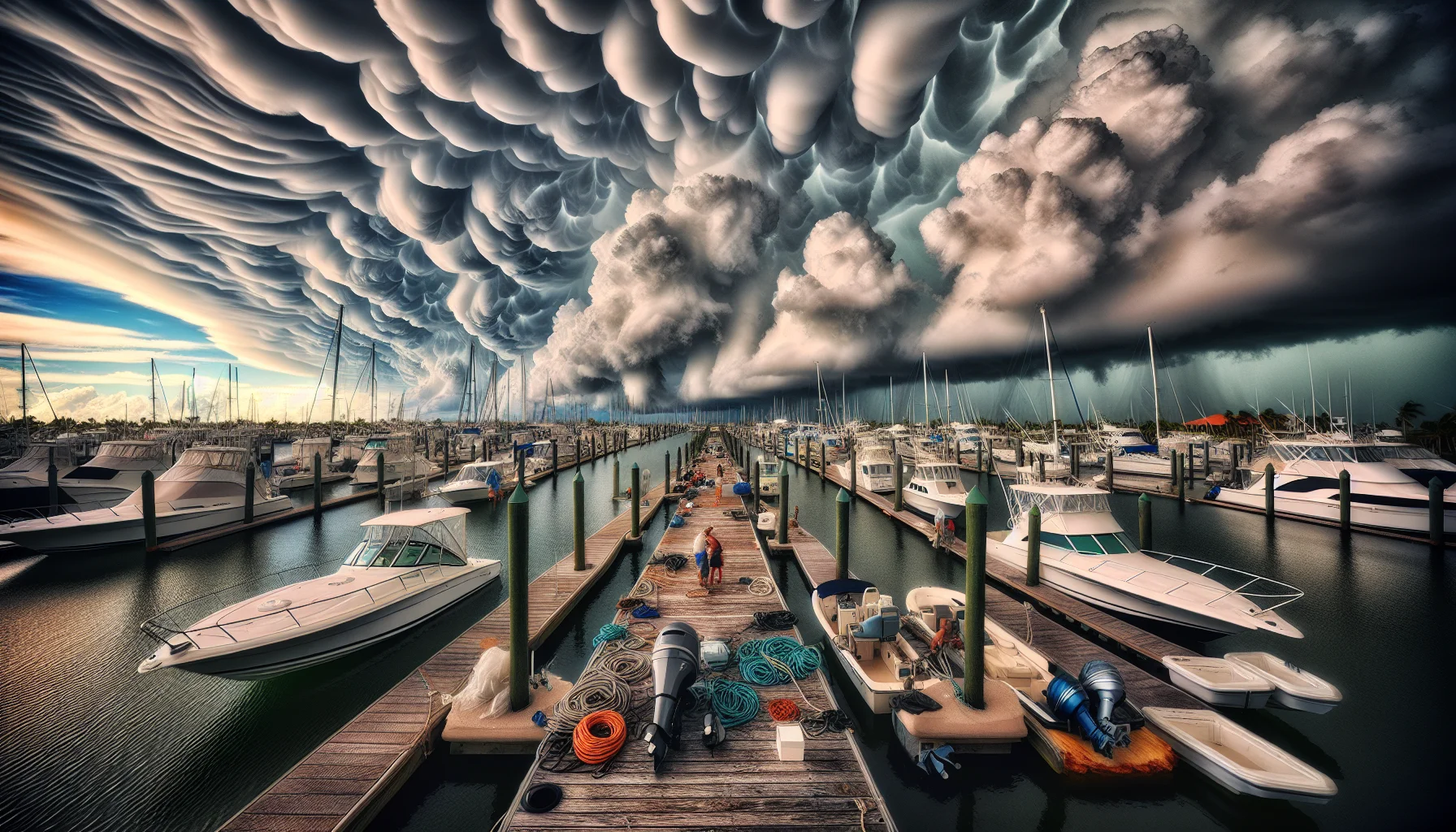
The single biggest predictor of a good outcome is how early you commit. Haul-out yards fill on a first-come basis, dock lines and chafe gear sell out, and help evaporates as a storm nears. Work from a written timeline you set before June:
- Start of season (June 1): Standing prep complete. Extra lines, chafe gear, and ground tackle staged; insurance reviewed; written plan printed.
- 5 days out: Watch the National Hurricane Center forecast closely. Do not fixate on the center line of the cone.
- 72 hours out: Initiate your plan. Call your haul-out yard now if that is your strategy.
- 48 hours out: Commit fully to haul-out or in-water securing. Second-guessing here is what sinks boats.
- 36 to 24 hours out: Execute and finish. Tropical-storm-force winds often arrive well ahead of the eye, and you do not want to be rigging lines in 40-knot gusts.
A useful habit borrowed from broader Gulf storm safety: treat rising weather as a hard stop, not a suggestion. The same discipline that keeps you off the water during a summer squall, covered in our guide to Tampa Bay thunderstorm safety, applies at hurricane scale. When conditions turn, people come first and the boat is already handled.
Haul Out or Stay in the Water?
There is no universal answer, but the factors are clear.
When Hauling Out Wins
Pull the boat if you are in a high surge zone, tied to floating docks, in an exposed or crowded marina, or protecting a high-value or older vessel that cannot absorb damage. On the hard, blocked and strapped well inland and above the surge line, a boat is out of the water's reach even if wind still poses a risk. Ask your yard to block low, tie the hull down to ground anchors or straps if available, and space boats so wind-driven neighbors cannot domino into yours.
The catch is capacity. Yards have finite space and lift schedules, and demand spikes the moment a watch is issued. If haul-out is your plan, your reservation call belongs at the 72-hour mark or earlier, not after the mandatory evacuation order.
When Securing In-Water Makes Sense
If no haul-out slot is available, or your boat lives in a more protected fixed-dock basin, a well-rigged in-water plan can work, especially in a canal or hurricane hole rather than open-water floating docks. The goal is to give the boat room to rise with surge while staying centered off pilings, seawalls, and neighbors.
Trailerable boats are the easiest case of all: pull the boat, drain it completely, and store it in a garage or strapped down at home well away from trees and power lines. If you rent or ride locally rather than own, our Punta Gorda jet ski and boat rental guide covers how area operators handle their fleets when a storm threatens, which is simply to haul everything early.
Hurricane Holes Around Punta Gorda
A "hurricane hole" is a sheltered pocket of water that blunts wind fetch and wave action, typically ringed by mangroves that both break the wind and give you something strong to tie to.
Traditional Refuges
Alligator Creek has long been used as local refuge for its mangrove cover, but space is limited and the best spots go early. The upper Peace River puts more distance between you and open-water surge and tends to be less crowded, though access and depth require local knowledge. Scout any hole in calm weather first; you do not want to be finding the channel for the first time in a rising storm.
Anchoring and the Spider Web
Single-anchor holding is not enough in hurricane conditions. Use a minimum of three anchors set in a wide spread, ideally around a 120-degree pattern so the boat is pinned from multiple directions regardless of wind shift. Oversize your ground tackle, add extra scope for surge-driven water rise, and protect every line at chocks and fairleads with dedicated chafe gear, because chafe, not anchor drag, is what parts lines in a long blow.
In mangrove holes, boaters rig the classic "spider web": lines run from the boat to multiple strong mangrove trunks and anchors, spaced so the vessel can swing and rise but never reach a hard object. Coordinate with neighbors, share anchor points where it makes sense, and never assume the boat next to you is as well secured as yours.
Securing Techniques That Actually Hold
For any boat staying in the water, work through a disciplined checklist rather than improvising.
The Line and Chafe System
- Double every dock line at minimum, then add long spring lines fore and aft.
- Rig lines long so the boat can rise with surge without loading up on a short, high-strain leash.
- Use new or near-new three-strand nylon, oversized in diameter. Nylon stretches and absorbs shock loads that would snap stiffer rope.
- Chafe-protect every line where it crosses a chock, cleat edge, or piling. Fire hose, commercial chafe sleeves, or doubled leather all work; bare line at a chock will saw through in hours.
- Center the boat in its slip or between pilings so no single point takes the full load.
Reduce Windage and Seal the Boat
Wind load is what turns a secured boat into a battering ram. Remove all canvas, biminis, and sail covers completely; a "reefed" or lashed cover will still catch wind and shred. Take down loose antennas and outriggers where practical, seal hatches and ports, secure everything below, disconnect shore power, and confirm your automatic bilge pumps and batteries are charged and functional. Sailboats need extra attention: strip and stow all sails, secure the boom, pad any rigging contact points, and get professional input before deciding whether to unstep the mast.
Coordinate Your Insurance Before the Storm
Your marine policy is only as good as your compliance with it, and hurricane season is exactly when the fine print matters.
Read the Named-Storm Clauses
Well before a storm forms, confirm the answers to a few questions with your agent: Does your policy include named-storm or windstorm coverage, and what is that deductible? Does it require haul-out or specific action once a storm is named? Are there location or geographic restrictions on where the boat may be during a storm? Some policies reimburse a portion of documented storm-prep and haul-out costs, which can change your calculus, so ask.
Document Everything, Time-Stamped
Photograph the boat from all exterior angles and inside before you begin prep, then again after you finish, capturing your line arrangement, anchors, and the removal of gear. Save receipts for lines, chafe gear, haul-out, and labor. Keep the boat's registration, insurance card, and serial numbers with you when you evacuate. If the worst happens, a clean, dated record is the difference between a smooth claim and a drawn-out fight.
Post-Storm Recovery and Safety
The danger does not end when the wind drops.
Wait for official clearance before returning to the water. Marinas and canals after a major storm are full of hazards: submerged debris, downed power lines, displaced pilings, fuel and oil sheens, and boats that broke loose. Document any damage before you touch or move anything, both for insurance and because moving a wreck can complicate liability. Recognize that access, power, and marina services may be down for days to weeks after a major hit, as Ian's aftermath showed across Charlotte and Lee counties, so keep expectations realistic and prioritize safety over speed.
Under Florida law, a boating accident that involves a death, a disappearance, an injury requiring more than immediate first aid, or property damage at or above the reportable threshold (commonly cited as $2,000) must be reported to the FWC or a marine law enforcement agency. Storm damage to your own docked boat is generally an insurance matter rather than a reportable boating accident, but if a broken-free vessel causes injury or strikes another boat, know your reporting obligations.
Year-Round Readiness and Education
The boaters who fare best treat hurricane prep as a standing system, not a fire drill.
Keep a hurricane kit staged: extra oversized lines, chafe gear, spare anchors and rode, and a printed plan with current contact numbers for your marina, yard, and insurer. Review your insurance annually so coverage values track your boat's real worth. And build your baseline weather and emergency knowledge now, not in a crisis. Reading local water is a year-round skill; our guide to reading Gulf Coast tide charts and patterns helps you anticipate how surge stacks on top of normal tides.
Formal boater education ties all of this together. In Florida, anyone born on or after January 1, 1988 must carry a Boating Safety Education Card to operate a vessel of 10 horsepower or more, and the approved, FWC-recognized curriculum covers exactly the weather, anchoring, and emergency-procedure fundamentals that storm season demands. The Florida boating safety course is delivered fully online, follows the NASBLA and state-standards online standard, and finishes with a 25-question exam that requires 80% to pass, with unlimited retakes if you need them. If you are still sorting out who needs a card and how the card differs from a rental exemption, our complete Florida boating license requirements guide breaks it down.
Start the state-standards online course - $12.99
Conclusion
In Punta Gorda the question is never whether another major storm will threaten Charlotte Harbor, only when. Charley and Ian both taught the same lesson in the harshest way possible: preparation that starts early and errs toward over-building is what saves boats, and last-minute effort in rising wind is what loses them. Know your surge zone, set your decision timeline before June, commit decisively to hauling or securing, rig lines and anchors like your boat's life depends on it, and keep your insurance documentation airtight. Above all, remember the order of priorities. Boats can be replaced; people cannot. Make conservative calls, help your dock neighbors, and let solid seamanship and education carry you through the season.