Charlotte Harbor is the second-largest estuary in Florida, and Punta Gorda sits right at its head where the Peace and Myakka rivers empty into the Gulf. That geography makes it one of the richest wildlife destinations in the state: manatees winter in the warm canals, roseate spoonbills and pelicans nest on mangrove islands, dolphins work the grass-flat edges, and seagrass beds carpet miles of shallow bottom. It is also a place where a personal watercraft can do real, lasting damage in seconds if the operator does not know the rules.
This guide gives you a practical, law-accurate playbook for riding Punta Gorda responsibly. You will learn where the manatee slow-speed zones are and when they expand, how to read bird-rookery closures, why seagrass flats are the single most fragile thing under your hull, how to view wildlife without harassing it, and which Florida PWC laws apply the moment you leave the dock. By the end you will be able to plan a route that is both thrilling and genuinely low-impact.
Why Charlotte Harbor Is a Protected Wildlife Estuary
Charlotte Harbor Preserve State Park protects tens of thousands of acres of shoreline, mangrove, and submerged land around Punta Gorda, and the open water is layered with state-designated aquatic preserves — Cape Haze, Gasparilla Sound-Charlotte Harbor, Pine Island Sound, Matlacha Pass, and Lemon Bay among them. Aquatic preserve status does not close the water to jet skis, but it does mean the seagrass, the nesting islands, and the water quality are legally protected resources, and law enforcement patrols accordingly.
For a rider, the practical takeaways are simple:
- Speed zones are real and enforced. Slow-speed and idle-speed signs are posted for a reason, and Florida Fish and Wildlife Conservation Commission (FWC) officers, the Charlotte County Sheriff's marine unit, and Punta Gorda Police all work these waters.
- Some islands are off-limits for landing. Mangrove keys used by nesting birds are marked with signs or buoys, and beaching there during nesting season can flush an entire colony.
- The bottom matters as much as the surface. Much of the harbor is shallow grass flat. Running aground here is not just bad for your ski — it scars habitat that takes years to recover.
Treat the whole estuary as a working nursery you are a guest in, and most of the specific rules below will feel like common sense.
Punta Gorda Manatee Zones and When They Expand
Charlotte Harbor holds one of the densest manatee populations on Florida's Gulf coast, and manatees are exactly the animal a fast, quiet-from-behind watercraft is most likely to injure. Watercraft strikes remain a leading cause of manatee deaths statewide, which is why the FWC blankets this area with speed regulations.
Where the zones are
Slow-speed and idle-speed manatee protection zones are concentrated in the exact places manatees rest and travel: the canal systems of Punta Gorda Isles, Alligator Creek, the lower Peace River, seawalls and marina basins, and the shallows near warm-water refuges. Signs mark the boundaries and the required speed — slow speed means off-plane and settled in the water with minimal wake, and idle speed means no faster than needed to maintain steerage.
The winter difference
Manatees are cold-sensitive and crowd into warm water when Gulf temperatures drop, so many Florida zones shift to expanded, more restrictive limits during the cooler months (roughly mid-November through the end of March). During that window, expect larger slow-speed areas, more idle-speed canals, and heavier enforcement. Always read the sign in front of you rather than relying on memory — the seasonal signs tell you exactly what applies and when.
For the statewide picture on how these zones are drawn and enforced, see our deep dive on Florida manatee zones and speed regulations. If you want to actually enjoy the animals rather than just avoid them, the spotting techniques in our guide to how to spot manatees while jet skiing transfer perfectly to Charlotte Harbor.
Bird Rookeries and Nesting-Season Closures
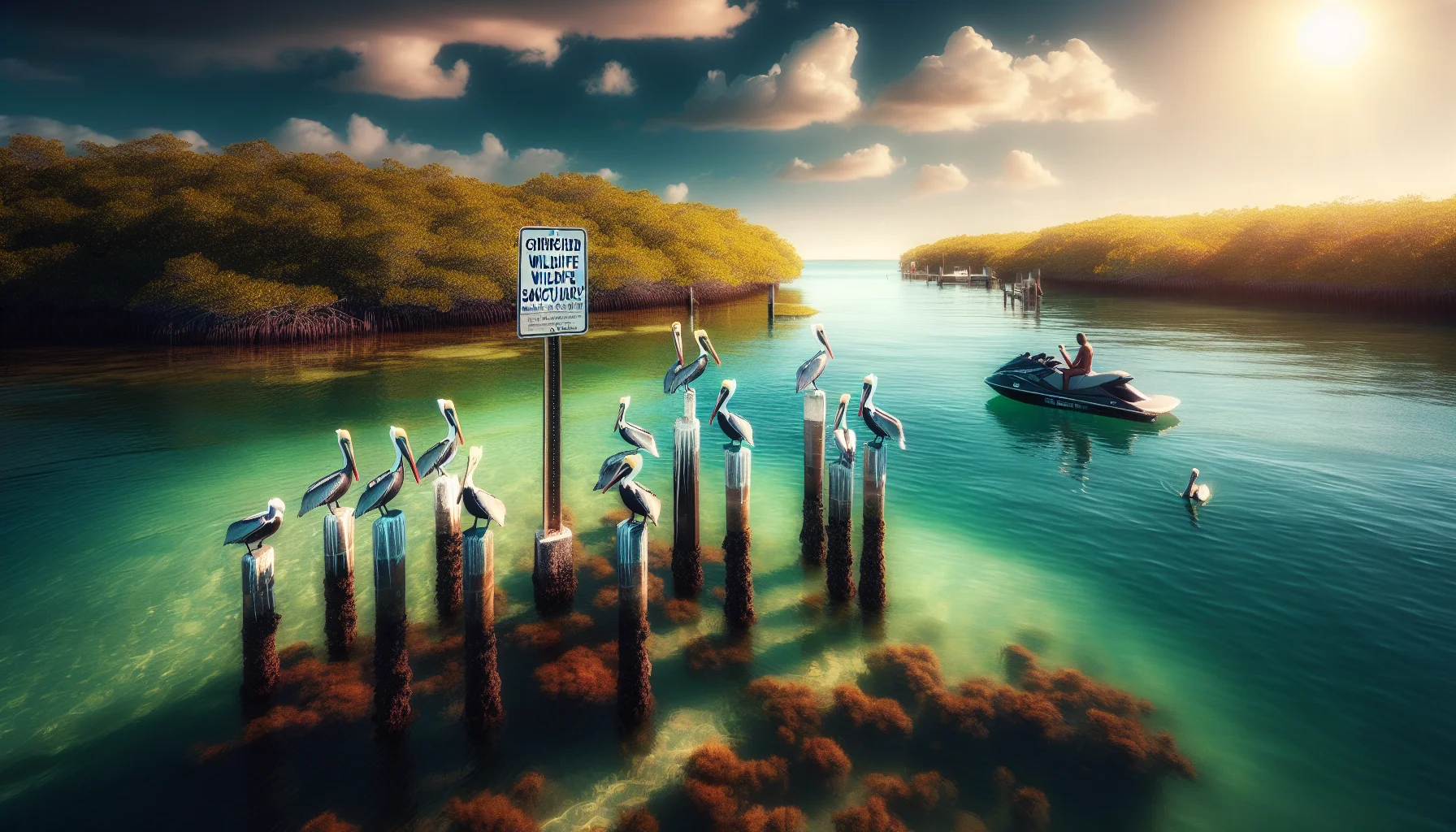
The mangrove islands scattered across Charlotte Harbor are some of the most important bird-nesting habitat in southwest Florida. Brown pelicans, great blue herons, roseate spoonbills, white ibis, and ospreys all nest here, and a single careless approach can cause adult birds to abandon a nest — leaving eggs and chicks exposed to sun and predators.
How the closures work:
- Posted islands are off-limits for landing, especially during the spring–summer nesting season. Signs and buoys mark critical wildlife areas; if you see them, do not beach, anchor close, or walk the shoreline.
- Give active rookeries a wide berth. A good rule is to stay far enough back that the birds carry on normally. If birds stand up, call in alarm, or lift off the nests, you are too close — back off immediately and do not return.
- Keep it quiet and wakeless. Idle past colonies, kill any loud music, and avoid sudden direction changes that read as a threat.
Binoculars or a zoom lens let you enjoy a rookery in detail from a respectful distance. The birds get their normal day, and you still get the show.
Seagrass Flats: The Damage You Cannot See
Seagrass is the foundation of the entire Charlotte Harbor food web — it shelters juvenile fish, feeds manatees and turtles, and holds the bottom in place. It is also astonishingly easy to destroy with a spinning impeller in water that is shallower than it looks. A prop or jet-drive dug into a grass bed leaves a "prop scar," a bare trench that can take years to grow back, and cumulative scarring has damaged thousands of acres of Florida flats.
How to protect the flats (and your ski):
- Know the depth before you commit. Much of the harbor is a foot or two deep at low tide. Use a chart, a depth reader, and your eyes — dark water is usually deeper, pale sandy or grassy patches are usually shallow.
- Stay in marked channels across the flats rather than shortcutting.
- Mind the tide. A route that is fine at high tide can be bare grass at low tide. Our companion skill for any shallow estuary is simply learning to read the water, and habits from guides like Tampa Bay no-wake zones apply directly here.
- If you touch bottom, stop. Trim up, shut down, and pole or walk the ski to deeper water. Powering off a flat is what turns a scuff into a scar.
Damaging seagrass in a protected area is not a "no harm done" mistake — it is a habitat violation, and officers do cite for it.
Navigating the Peace River Wildlife Corridor
The Peace River runs from Charlotte Harbor up past Interstate 75 toward Fort Ogden, and it is one of the best wildlife rides in the region. Manatees push up into it in the cooler months, alligators sun on the banks year-round, and otters, wading birds, and ospreys are common.
Read the river like a river
The Peace is not open harbor. As you go upstream it narrows, the water gets tannic and hard to read, and hazards multiply — submerged logs and deadheads, shifting sandbars, blind bends, and stronger current after heavy rain. Idle or slow speed is the only sensible pace once you are off the wide lower stretch, both for wildlife and for your own safety.
River etiquette
- Stay off the banks. The shallows and shoreline are where alligators, nesting birds, and basking turtles are — and where you are most likely to strand the ski.
- Never chase or corner an animal. Hold a steady line and let wildlife move on its own terms.
- Carry the basics. A charged phone in a dry bag, water, and sun protection matter more the farther up you go, because the river is remote and help is not close.
If a storm builds while you are upriver, get back to open water and off the water entirely — inland Florida afternoons turn violent fast, a point we hammer in our Tampa Bay thunderstorm safety guide.
Safe Wildlife Viewing Distances and Etiquette
The single best thing you can do for every animal in Charlotte Harbor is keep your distance and let them behave normally. Harassment — anything that changes an animal's natural behavior — is illegal for protected species, and it does not require touching the animal.
Working guidelines for viewing from a PWC:
| Wildlife | Suggested distance | Basis |
|---|---|---|
| Manatees | At least 50 feet; more is better | Florida guidance; obey posted zones |
| Dolphins | Roughly 50 yards; never pursue | Federal marine-mammal guidance |
| Sea turtles | Roughly 50 yards; never crowd | Federal marine-mammal guidance |
| Nesting birds | Far enough that they stay on the nest | State wildlife guidance |
Etiquette that keeps you legal and welcome:
- Approach slowly and off-plane, at a shallow angle, never head-on.
- Let the animal set the pace. If it changes course, dives, or flushes, you have gotten too close.
- Do not feed, water, touch, chase, circle, or separate any animal — feeding dolphins and manatees is specifically prohibited.
- No bow-riding encouragement. Dolphins may ride your wake on their own; do not steer to make it happen.
Florida PWC Laws Every Punta Gorda Rider Must Follow
Wildlife rules sit on top of Florida's baseline personal-watercraft laws, and officers enforce both. Know these cold before you launch:
- Education card. Anyone born on or after January 1, 1988 must carry a Florida Boating Safety Education Card to operate a vessel of 10 horsepower or more — which includes every rental PWC.
- Minimum age. You must be at least 14 years old to operate a personal watercraft in Florida, and rental operators set their own higher minimums.
- Daylight only. A PWC may not be operated from half an hour after sunset to half an hour before sunrise, even with lights.
- Engine cut-off lanyard. The kill-switch lanyard must be attached to you whenever the engine is running so the ski stops if you come off.
- Life jackets. Everyone on a PWC must wear a Coast Guard-approved life jacket, and children under six must wear one on any vessel under 26 feet that is underway. See our full Florida life jacket requirements guide.
- No reckless operation. Weaving through congested traffic, jumping wakes too close to another boat, and spraying wildlife or people are all citable.
- Boating under the influence. Operating with a blood-alcohol level of 0.08 or higher is BUI (and just 0.02 for operators under 21).
- Divers-down. Give a displayed divers-down flag a wide berth — roughly 300 feet in open water and 100 feet in channels.
For the complete breakdown of ages, hours, and rental rules, read our Florida jet ski and PWC laws guide.
What to Do When Wildlife Comes to You
Sometimes you follow every rule and an animal still approaches. In Charlotte Harbor that is common — curious manatees and playful dolphins do close the gap themselves. What you do next is what keeps it legal and safe.
If a manatee approaches:
- Take the ski out of gear or shut it off. A manatee under or beside a running impeller is the worst-case scenario.
- Do not touch, feed, or give it water. All three are prohibited and all three teach manatees to approach boats, which gets them killed.
- Wait it out. Let the animal pass on its own, then move off slowly once it is clear.
If dolphins or turtles are near:
- Hold a steady, predictable course and let them do their thing. No sudden turns, no circling, no pursuit.
If birds react to you:
- If a colony stands up or lifts off, you are the disturbance. Idle away immediately and note the spot so you avoid it next time.
Reporting Injured or Harassed Wildlife
You are the eyes on the water, and quick reporting saves animals. If you see an injured, entangled, or dead manatee, dolphin, or turtle, a boat strike, or someone harassing wildlife, report it to the FWC Wildlife Alert hotline at 888-404-FWCC (888-404-3922).
When you call, have ready:
- Location — GPS coordinates or the nearest marker/landmark.
- Species and what you saw — injury, entanglement, harassment, or a carcass.
- Your contact information in case responders need details.
- A photo if you can take one safely from a distance.
Do not attempt a rescue yourself. Stand off, keep other boats back, and let trained responders handle it — an panicked or injured animal can hurt both of you.
Get Certified Before You Ride Punta Gorda
Everything above is exactly what a good boater-education course teaches — how protected zones work, how to read the water, and how to stay legal around wildlife. Under Florida law that card is not optional if you were born on or after January 1, 1988, and it is the smartest 25 questions you will ever answer before a ride.
BoatSkill's state-standards online, NASBLA-recognized Florida boating safety course is fully online, self-paced, and built around the real rules you will face in places like Charlotte Harbor. You study on your own schedule, take the 25-question final exam (80% to pass), and get unlimited retakes if you need them. Pass and you can print your temporary certificate right away.
Start the state-standards online course - $12.99
Conclusion
Punta Gorda gives you a rare thing: a wide-open, wildlife-packed estuary you can explore by jet ski. The trade-off is responsibility. Respect the manatee zones and their winter expansion, give nesting rookeries and seagrass flats the room they need, keep legal distances from every protected animal, and follow Florida's PWC laws to the letter. Do that, and you get an unforgettable ride while leaving the harbor exactly as rich as you found it.
The rules are not there to spoil the fun — they are the reason there is still so much to see. Learn them, get certified, and ride Charlotte Harbor like someone who plans to come back for years.