Boating school in Florida usually means the boating safety course that earns the Florida Boating Safety Education ID Card, and every one of them ends with the Florida boating exam: a final test of at least 75 questions with a passing score of 75 percent, under FWC Rule 68D-36.104. Pass it and the school's completion certificate leads to the lifetime card. What the Florida boating exam asks, topic by topic, and how to prepare for it is in its own guide.
Under Florida Statute 327.395, anyone born on or after January 1, 1988 who operates a vessel with a motor of 10 horsepower or more must carry that card, or another accepted proof of education, along with photo ID.
The Florida Fish and Wildlife Conservation Commission (FWC) keeps the list of schools on its boating safety courses page. It splits them into two groups: classroom schools, listed by area with contact details, and online schools, listed with a price. When the list was checked on November 20, 2026, the online prices ran from $18 to $79.95, with one listed as free. Classroom schools are listed without prices.
Florida has two other kinds of boating school worth knowing about. Anyone who carries paying passengers on an airboat needs a separate airboat operator course, and a boating conviction can send you back to class under the violator rules. This guide covers all three, what a school has to teach, how to pick one, and what happens after you pass. Boat Skill is preparing an online exam for the Florida temporary boating certificate, the one renters call the jet ski test, and you can get notified when Boat Skill enrollment opens.
What a Florida Boating School Has to Teach
A course only counts toward the card if it meets the minimum requirements of the National Association of State Boating Law Administrators (NASBLA), the standard named in section 327.395(2)(a). What that standard means for choosing a course, and how out-of-state cards are treated, is in our NASBLA Florida course guide. Florida then adds its own topics. Section 327.395(4) says every course and every temporary certificate exam must include:
- Diving vessels, divers in the water, divers-down warning devices and the rules in section 327.331. Our Florida dive flag law guide covers those distances.
- The danger of a passenger riding on a seat back, gunwale, transom, bow, motor cover or any other spot the manufacturer did not design for seating.
- The danger of a passenger falling overboard, and of operating with a person in the water near the boat.
- The danger of starting a boat with the engine in gear, or leaving it running while someone boards or gets off.
- The proper use and lifesaving value of an engine cutoff switch on motorboats and personal watercraft.
Online schools face one more layer. Section 327.395(10) tells the FWC to set minimum standards for online courses by rule, covering curriculum, how students are tested and who may offer a course, and it requires every online provider to have the commission's sign-off and show it meets those standards before it offers a course to the public.
The FWC also points out on its ID card page that course providers are not affiliated with the FWC. A school teaches and tests you. The FWC issues the card. A full walk through the lessons themselves is in our Florida boating safety course guide.
The Florida Boating Exam at the End of School
Every Florida boating school finishes with a test, and the FWC sets the floor for it. Rule 68D-36.104 of the Florida Administrative Code requires a boating safety course to end with a final exam of at least 75 questions and a minimum passing score of 75 percent. That exam, taken in a classroom or online, is the one behind the lifetime card.
Florida has a second boating exam that comes without a school. The FWC's Temporary Certificate Program is an online exam of 25 questions, offered by vendors the FWC authorizes, and you need 19 or more correct to pass. It gives you a certificate valid for 90 days, the one rental counters ask for. The FWC says it cannot be submitted for the lifetime card and is not valid outside Florida.
| Course final exam | Temporary certificate exam | |
|---|---|---|
| Where you take it | At the end of a classroom or online boating school | Online, through an FWC-authorized vendor |
| Length | At least 75 questions | 25 questions |
| To pass | At least 75 percent | 19 correct |
| What passing gives you | A completion certificate, then the lifetime ID card | A certificate valid for 90 days |
| Leads to the lifetime card | Yes | No |
The same Florida topics sit in both. Section 327.395(4) says every course and every temporary certificate exam must cover divers-down rules, unsafe passenger seating, falls overboard, people in the water near the boat, starting in gear and the engine cutoff switch. The list in the section above is what to study for either one.
Boat Skill is preparing the temporary certificate exam, the one renters call the jet ski test, with unlimited free retakes, and enrollment opens soon. Our Florida boating exam guide covers what each exam asks and how to get ready for it.
Classroom Boating Schools
The classroom table on the FWC courses page had five entries when it was checked on November 20, 2026. Four are listed as statewide and one is listed for Broward County. Two of the statewide entries are national boating organizations. Each row gives a phone number or website, and none gives a price, so ask the school what a class costs and when the next session runs. One of those classroom entries is the Coast Guard Auxiliary, covered in our Coast Guard boating safety course guide. If you are trying to find a class or a quicker route close to home, our guide to the Florida boating license near me sorts the options by where you are and what you need.
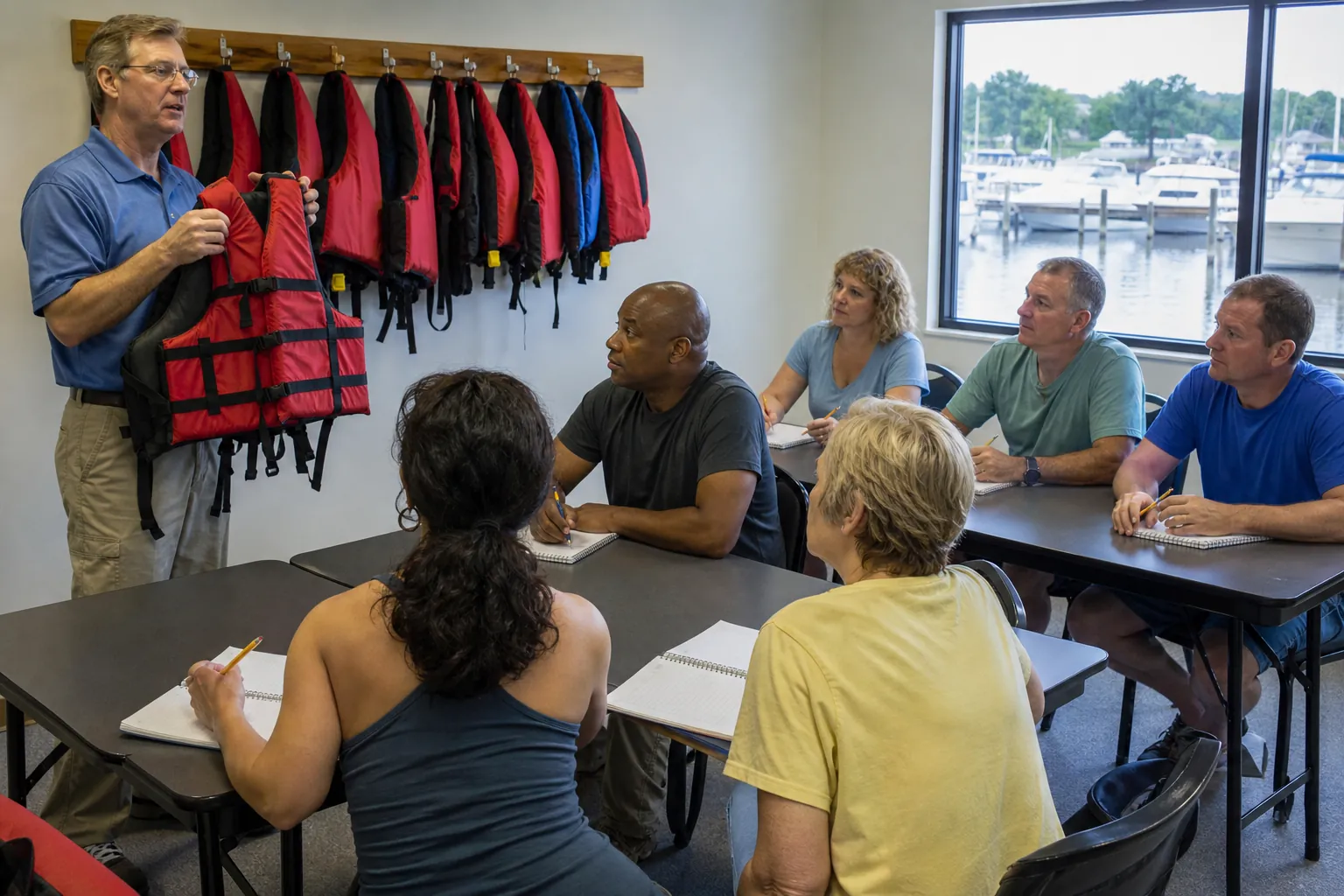
A classroom suits people who learn best with an instructor in the room, families who want to take the course together, and anyone who wants to ask questions about their own boat or home waters.
Two things to settle with a classroom school before the last day of class:
- Who requests your card. The FWC says some classroom providers send a card request for every student who passes. If yours does, the card should arrive within two to three weeks.
- What proof you leave with. If the school does not send the request, the FWC tells classroom students to ask the instructor for proof of completion that shows the name of the course, the date it was completed, and the student's name and address. You will send that to the FWC yourself.
Online Boating Schools
Most people take the online route. The online table on the FWC courses page had 19 listings when it was checked on November 20, 2026, each with a price. They ran from $18 to $79.95, one was listed as free, and one listing was a $20 military and first responder discount. Prices on that list change, so check it on the day you sign up.
Online courses are self-paced: you work through the lessons, pass the checks along the way, then take the final exam. The FWC says many online course providers send a card request for every student who passes a Florida course, and the card should then arrive within two to three weeks.
Before you start, make sure you will be able to print your completion certificate from the course website, or ask the school for an electronic copy. The FWC names that step for online students on its ID card page, because it is the document you need if the school does not request the card for you.
Our free boating resources page previews the lesson topics a Florida course covers. The test at the end of any course is covered in our Florida boating exam guide.
Free Boating School for Florida Teens
The same FWC page lists a free option for students. The Florida Virtual School Outdoor Education course is free for Florida residents ages 12 to 18, and the FWC describes it as the only course in the nation that combines hunting and boating safety.
Students who meet all of the course requirements receive their Florida Boating Safety Education ID Card and become eligible for a Florida Hunter Safety Certificate. The FWC adds that students who finish can earn a 0.5 high school credit.
Adults have fewer free routes, and our guide to the Florida boating license for free compares every one of them with what each costs.
Classroom or Online: Side by Side
Both routes lead to the same lifetime card. The differences are in price, pace and paperwork, all taken from the FWC courses page and ID card page.
| Classroom school | Online school | |
|---|---|---|
| How the FWC lists it | By area, with contact details | By provider, with a price |
| Price on the FWC page | Not listed; ask the school | $18 to $79.95, one listed free |
| Pace | The school's class schedule | Self-paced |
| Card request to the FWC | Some schools send it | Many schools send it |
| Proof you keep | Instructor's proof with course name, date, your name and address | Printed or electronic completion certificate |
| Result | Lifetime ID card | Lifetime ID card |
Whichever you pick, the completion certificate matters for the first 90 days. Section 327.395(6)(f) lets you operate for 90 days after finishing a course with photo ID and a certificate that shows your first and last name, your date of birth and the date you passed the course exam.
Airboat Operator School
Airboats carrying paying passengers have their own school requirement. Under section 327.391(5), a person may not operate an airboat carrying one or more passengers for hire unless he or she has all of these aboard:
- A photo ID card.
- Proof of completing a boater education course that meets section 327.395(2)(a). No age or exemption under section 327.395 gets an operator out of this one. The only exception is a United States Coast Guard captain's license, which must then be aboard.
- Proof of passing an airboat operator course that meets the FWC's minimum standards.
- Proof of completing courses in cardiopulmonary resuscitation (CPR) and first aid.
Operating without them is a second-degree misdemeanor. The FWC's airboat operator course providers page lists the schools that offer the course and explains why the rule exists: from 2007 through 2017, Florida recorded 55 airboat accidents involved in a commercial activity, with two deaths and 130 people injured. The requirement took effect July 1, 2019.
The FWC page also sets out what an airboat school must do. The course includes on-the-water practicals, the school renews its course every three years and keeps records for five years, and each instructor must be at least 21 and have at least 120 hours of documented airboat operation in the last three years. Recreational airboat owners who carry no paying passengers fall under the regular card rule in section 327.395.
Court-Ordered Boating School
Some people go to boating school because a judge or the FWC says they must. The FWC's mandatory boating education page lists three triggers: a conviction for any criminal boating violation, an infraction that resulted in a reportable boating accident, or one of the listed noncriminal infractions within a 12-month period. The listed infractions include careless operation, speed and restricted area violations, required safety equipment, personal watercraft rules and the safety education rule itself.
The FWC describes two courses:
- Type 1: Boating Safety Education. Any course on the FWC's list, classroom or online, taken after the date of the violation. You send the certificate of completion to the FWC within 90 days.
- Type 2: Safe Boating for Violators. A single four-hour, online-only course for criminal violations and accident-related infractions. The course provider sends proof of completion to the FWC electronically. People who need this course must also complete Type 1.
Under section 327.731, the student pays for the course and may not operate a vessel until proof of completion is filed with the FWC. Operating before then is a second-degree misdemeanor. If you request your ID card through a course you took for this reason, the FWC asks you to include a note saying so. Our Florida boating ticket guide covers the citations that lead here.
Rental Briefings and Who May Teach
A rental company's briefing at the dock is required by law, and it is separate from boating school. Under section 327.54, a livery may not rent a vessel unless it gives pre-rental or pre-ride instruction that covers at least:
- How the rented vessel handles.
- Safe operation and right-of-way.
- The operator's responsibility for safe and proper operation.
- Local conditions, such as hazards, boating-restricted areas and water depths.
- Emergency steps for capsizing, a fall overboard, taking on water and accidents.
The renter signs a written statement that the instruction covered each part, and the livery keeps it for at least 90 days. The same section bars a livery from renting to someone who needs the card unless that person shows the proof required by section 327.395(2), or is within the 90-day window after finishing a course. A dock briefing never stands in for the card. The Florida boat rental rules guide covers the rest of what a livery checks.
Section 327.54(8) also sets a rule for teachers: anyone who gives instruction on the safe operation of vessels, or gives the pre-rental briefing, must have completed a boating safety education course, whatever that person's age or exemptions. The same section says a public or private school or college located in Florida is not a livery.
How to Choose a Boating School in Florida
A short checklist before you pay:
- Find the school on the FWC list. Use the courses page for the card, or the airboat providers page for passenger airboats.
- Check what it teaches. The Florida topics in section 327.395(4) should be in the course outline: divers-down rules, passenger seating, falls overboard, starting in gear and engine cutoff switches.
- Ask who sends the card request. If the school sends it, the card should come in two to three weeks. If not, you will send it yourself.
- Ask what your completion certificate shows. It needs your first and last name, date of birth and the date you passed, so it works as proof for the first 90 days.
- Compare the price. Online prices are on the FWC page. Classroom schools set their own, so call.
- If a court notice sent you, check the type. A criminal violation or an accident-related infraction means both Type 1 and Type 2.
- Renting this weekend? The FWC's temporary certificate is an online exam of 25 questions with 19 correct to pass. It lasts 90 days, works only in Florida and cannot be exchanged for the lifetime card.
Our page on how to get a Florida boating license lays out the whole route in five steps.
After Boating School: Getting Your Card
Passing the course is the first half. If your school does not request the card, the FWC's ID card page says to send your completion certificate with your name, date of birth, return address and phone number by email, or by mail to the FWC Division of Law Enforcement, Boating Safety Unit, 620 South Meridian Street, Tallahassee, FL 32399-1600. The FWC's Division of Law Enforcement answers questions at 850-488-5600.
Section 327.395(5) makes the card valid for life, and section 327.395(9) lets the FWC collect a $2 fee for each card. The FWC's education FAQs make the point that Florida does not have a boating license: the card is proof that you completed the education requirement. Whether you need it at all is covered in Do I Need a Boating License in Florida?.
Boat Skill is preparing an online exam for the Florida temporary boating certificate, the one renters call the jet ski test, and enrollment opens soon. Get notified when Boat Skill enrollment opens
Sources
- FWC: Boating Safety Courses
- FWC: Boating Safety Education Identification Card
- FWC: FAQs About Boating Safety Education Requirements
- FWC: Temporary Certificate Program
- FWC: Airboat Operator Course Providers
- FWC: Mandatory Boating Education
- Rule 68D-36.104, F.A.C., Minimum Standards for Boating Safety Courses
- Florida Statute 327.395, Boating safety education
- Florida Statute 327.391, Airboats regulated
- Florida Statute 327.54, Liveries
- Florida Statute 327.731, Mandatory education for violators
Common questions
What is the Florida boating exam at the end of boating school?
FWC Rule 68D-36.104 requires every Florida boating safety course to end with a final exam of at least 75 questions and a minimum passing score of 75 percent. Passing it earns a completion certificate, which leads to the lifetime Boating Safety Education ID Card. The separate temporary certificate exam has 25 questions with 19 correct to pass and gives a certificate valid for 90 days.
Do I have to go to boating school in Florida?
If you were born on or after January 1, 1988 and operate a vessel with a motor of 10 horsepower or more, Florida Statute 327.395 requires you to carry photo ID and proof of boating safety education, usually the Boating Safety Education ID Card earned by passing a course. Exemptions include a Coast Guard master license, a private lake or pond, and a card holder 18 or older aboard and responsible for the boat.
How much does boating school cost in Florida?
The FWC courses page lists online courses from $18 to $79.95, with one listed as free and a $20 military and first responder discount. Classroom schools are listed without prices, so ask the school. Section 327.395 also lets the FWC collect a $2 fee for each card.
Can I take boating school online in Florida?
Yes. The FWC lists online schools alongside classroom schools, and both lead to the same lifetime card. Section 327.395 requires online providers to meet standards the FWC sets by rule before they offer a course to the public.
Is there a free boating school in Florida?
The FWC lists one online course as free, and the Florida Virtual School Outdoor Education course is free for Florida residents ages 12 to 18. Students who meet all its requirements receive the ID card and become eligible for a Florida Hunter Safety Certificate.
Do I need a special school to drive an airboat in Florida?
Only to carry paying passengers. Section 327.391 requires a passenger-for-hire airboat operator to carry photo ID, proof of a boater education course (or a Coast Guard captain license), proof of an airboat operator course that meets FWC standards, and proof of CPR and first aid training. A violation is a second-degree misdemeanor.
What is court-ordered boating school in Florida?
After certain convictions, section 327.731 and the FWC require a boating course before you may operate again. A listed noncriminal infraction calls for the Type 1 course. A criminal violation or an infraction that caused a reportable accident calls for Type 1 plus the four-hour online Type 2 course for violators.
Does a jet ski rental briefing count as boating school?
No. Section 327.54 requires every livery to give pre-rental instruction and have the renter sign a statement, but it also bars the livery from renting to anyone who needs the card unless they show the proof section 327.395 requires, or finished a course within the last 90 days.
How long after boating school do I get my card?
The FWC says that when your school sends the card request, the card should arrive within two to three weeks. Until then, section 327.395 lets you operate for 90 days with photo ID and a completion certificate showing your name, date of birth and the date you passed.