Yes, a Coast Guard boating safety course can count in Florida, as long as it is the right class. The FWC's list of boating safety courses names the U.S. Coast Guard Auxiliary as a statewide classroom provider. Finish a qualifying Auxiliary course, pass it, and you can get the Florida Boating Safety Education ID Card that Florida law requires of many boat operators.
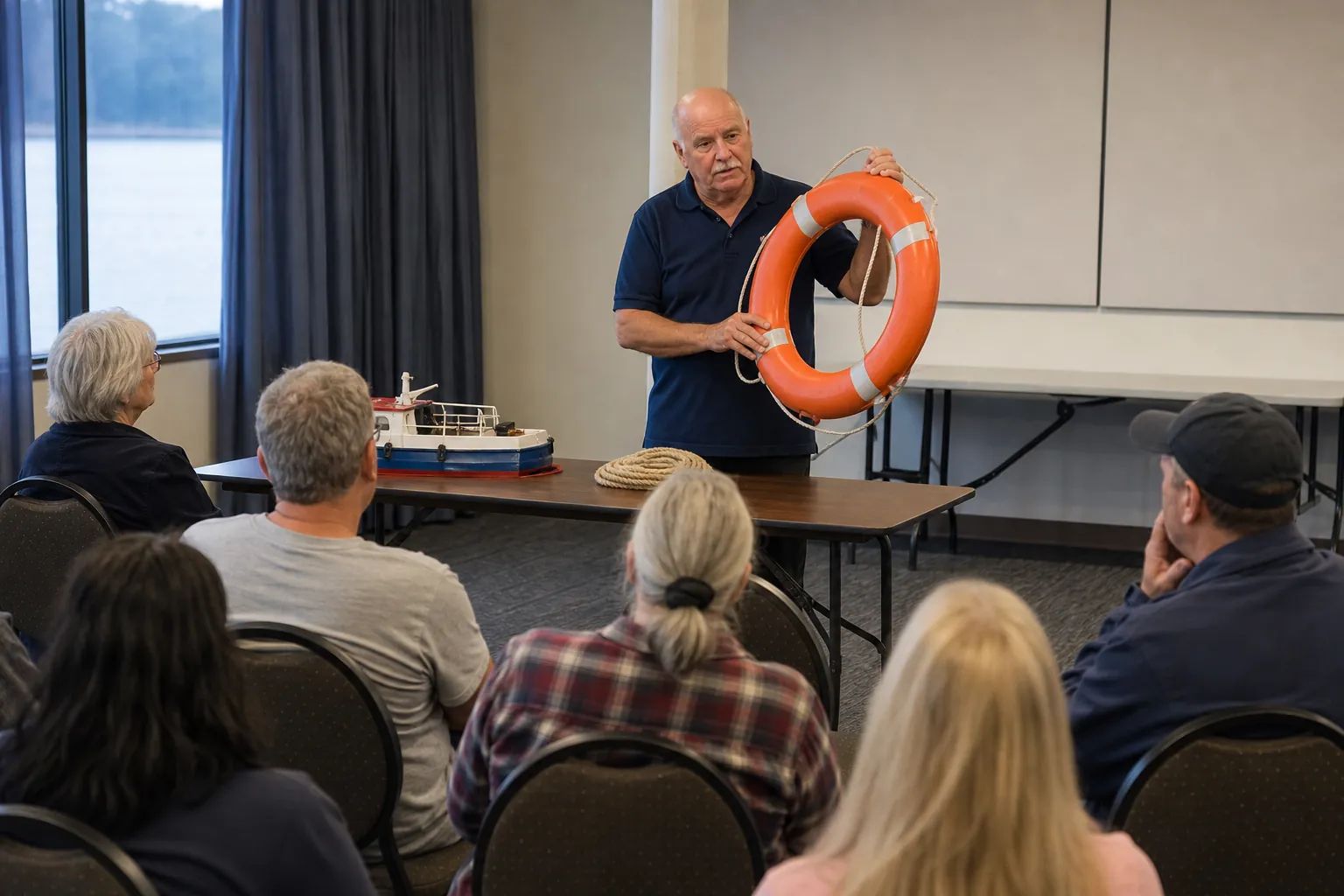
"Coast Guard boating safety course" can mean three different things, and Florida treats each one differently:
| What you have | How Florida treats it |
|---|---|
| A Coast Guard Auxiliary classroom course taken in Florida | Listed by the FWC as a classroom provider; a qualifying course leads to the Florida ID card |
| A Coast Guard captain's license (licensed to serve as master of a vessel) | An exemption from the education requirement under section 327.395(6)(a) |
| A boating course or card from another state, including one taught by the Auxiliary | Accepted if it meets or exceeds the national minimum standards, under section 327.395(2)(d) |
The rest of this guide explains each route, how the card is issued after a classroom course, and what to check before you sign up.
Who Needs a Boating Safety Course in Florida
Florida Statute 327.395(1) says a person born on or after January 1, 1988 may not operate a vessel powered by a motor of 10 horsepower or greater unless they carry the documents listed in subsection (2). For most people, that means photo ID plus the Florida Boating Safety Education ID Card.
The FWC is direct about what the card is. Its education FAQ says Florida does not have a "boating license," and the card is proof of completing the education requirement. Its ID card page adds that the card does not expire. Section 327.395(5) makes a card earned through a course valid for life.
If you were born before 1988, or your boat's motor is under 10 horsepower, the course is not required by this section, though nothing stops you from taking one. If you are unsure whether you need one at all, our boating license guide walks through the age and horsepower rule in more detail.
The Coast Guard Auxiliary Course and Florida
The Coast Guard's own boating safety courses page says qualified volunteer organizations such as the U.S. Coast Guard Auxiliary sponsor many courses, and that local Auxiliary flotillas offer classes including basic and introductory boating courses, navigation, sailing and personal watercraft safety.
Florida's question is narrower: is the course one the state accepts for the card? Section 327.395(2)(a) accepts a commission-approved boating safety education course that meets the minimum requirements set by the National Association of State Boating Law Administrators (NASBLA). The FWC's course list is where those courses are named, and under "Classroom Courses" it lists "USCG AUX (United States Coast Guard Auxiliary)" with a service area of statewide.
The Auxiliary teaches far more than one class. Its course catalog runs from a 2-hour introduction for novice boaters to courses of 8 to 13 lessons, plus classes for children, paddlers and personal watercraft riders, offered in a classroom or by video conference. Not every one of those is meant to be the full boating safety course a state accepts for its card. The catalog itself lists a separate "State Boating Safety Class."
So before you register, ask the instructor or flotilla one question: does this class meet the Florida boating safety education requirement and lead to the Florida Boating Safety Education ID Card? A yes means you are in the right room.
From Classroom to ID Card
Passing the course is the first half. The card comes from the FWC, and the FWC's ID card page explains how it gets issued:
- Ask whether your provider sends your record to the FWC. Many online providers and some classroom providers submit a card request for every student who passes. If yours does, the FWC says you should receive the card within two to three weeks.
- If it does not, get proof of completion. For a classroom course, the FWC asks for proof that includes the name of the course, the date you completed it, and your name and address.
- Send the request yourself. Email or mail the FWC your completion certificate along with your name, date of birth, return address and phone number. The page gives the mailing address for the FWC's Boating Safety Unit in Tallahassee.
You can boat while you wait. Section 327.395(6)(f) exempts a person operating within 90 days after completing the course who carries photo ID and a course completion certificate showing their first and last name, date of birth and the date they passed the course exam. The FWC's FAQ says that certificate is not a permanent replacement for the card.
Section 327.395(9) lets the commission collect a $2 fee for each card. What happens after you pass, and how to replace a card later, is covered in our Florida boater ID card guide.
A Coast Guard Captain's License Is a Separate Exemption
Some people searching for a Coast Guard course already hold, or plan to earn, a Coast Guard license. Florida handles a captain's license through an exemption in the same statute.
Under section 327.395(6)(a), a person is exempt from the education requirement if they:
- are licensed by the United States Coast Guard to serve as master of a vessel; or
- were previously licensed by the Coast Guard to serve as master of a vessel, provide proof of that license to the commission, and request that a boating safety identification card be issued in their name.
The FWC's exemption list puts it the same way: a person licensed by the U.S. Coast Guard as a master of a vessel. The statute's words are "master of a vessel," so if you hold a different Coast Guard credential, check whether it is a master's license before relying on this exemption. The second bullet matters for anyone whose license has lapsed: you can turn proof of the old license into a Florida card instead of taking a course.
Coast Guard Courses From Another State
Auxiliary courses are taught across the country, so you may have taken one somewhere else. Florida has two rules that cover that.
A card or certificate from another state counts. Section 327.395(2) accepts photo ID plus a boating safety card or certificate from another state or U.S. territory, a Canadian Pleasure Craft Operator Card, or an International Certificate of Competency, showing a course or equivalency exam that meets or exceeds the NASBLA minimum requirements.
Visitors have a matching exemption. Section 327.395(6)(d) exempts a nonresident who carries photo ID and proof of completing a course or equivalency exam in another state or U.S. territory that meets or exceeds the NASBLA minimum.
In practice, a course you passed in another state works in Florida when it produced a state card or certificate and met the national standard. Our NASBLA Florida course guide explains how to tell whether a course meets that standard, and our Florida boating license for tourists guide covers visitors in more detail.
What a Florida Course Has to Cover
Any course that leads to the Florida card, whoever teaches it, has to meet the national minimum and cover Florida's own topics. Section 327.395(4) requires components on:
- diving vessels, divers in the water, divers-down warning devices and the rules in section 327.331;
- the danger of a passenger riding on a seat back, gunwale, transom, bow, motor cover or any area not designed for seating;
- the danger of a passenger falling overboard;
- the danger of operating near a person in the water;
- the danger of starting a vessel with the engine in gear;
- the danger of leaving the vessel running while a passenger boards or gets off;
- the proper use and lifesaving benefits of an engine cutoff switch.
A national course from any provider covers the general material: equipment, navigation rules, emergencies. These Florida items are the reason to confirm the class is a Florida course. What the full syllabus looks like is in our Florida boating safety course guide.
Classroom, Online or a Temporary Certificate
The Auxiliary is one of several routes. The FWC's course page lists classroom providers and a longer list of online providers, each with its price. Which fits depends on how you like to learn and how soon you need to be on the water. How classroom and online schools compare, and the final exam each one ends with, is in our guide to boating school in Florida.
| Route | What you get | How long it lasts |
|---|---|---|
| Classroom course, such as the Auxiliary's | Instruction from a live instructor, then the Florida ID card | The card is valid for life |
| Online course from the FWC list | Self-paced lessons and an exam, then the Florida ID card | The card is valid for life |
| Temporary certificate exam | A certificate from an FWC-authorized vendor | Up to 90 days, under section 327.395(5) |
The temporary certificate is for people who need to operate a boat soon and have no card. The FWC says it is not a permanent replacement for the card and cannot be exchanged for one. Our temporary certificate guide explains that route.
A boating violation can also make a course mandatory. The FWC course page notes that people convicted of certain boating violations must complete mandatory violator education, which our Florida boating tickets guide covers.
What Happens If You Operate Without the Card
Section 327.395(7) makes operating a vessel in violation of the education requirement a noncriminal infraction, punishable as provided in section 327.73.
Section 327.73(1)(s) adds a useful detail for anyone who passed a course but left the card at home. A person cited for not having the required proof in their possession may not be convicted if, before or at the time of a county court hearing, they produce a card or temporary certificate that was valid at the time of the citation.
That protection helps only if you actually finished a qualifying course. If you took a Coast Guard class that does not count in Florida, there is nothing to produce, so confirm the class before you rely on it.
A Checklist Before You Sign Up
Use these questions with any Coast Guard Auxiliary class, or any other course:
- Is the provider on the FWC course list? The Auxiliary is listed under classroom courses.
- Does this specific class lead to the Florida Boating Safety Education ID Card? Ask the instructor directly.
- Will the provider send my record to the FWC, or do I request the card myself?
- What proof of completion will I get? For a classroom course, the FWC wants the course name, completion date, and your name and address.
- Does the certificate show my name, date of birth and the date I passed? That is what section 327.395(6)(f) requires for the 90-day window.
- Do I already hold a Coast Guard master's license? If so, the exemption may cover you without a course.
Boat Skill is preparing the Florida temporary boating certificate, the 90-day proof in the table above. Boat Skill does not issue the lifetime ID card. Our boating resources page has free study material.
Get notified when Boat Skill enrollment opens
Sources
- Florida Statute 327.395: Boating safety education
- Florida Statute 327.73: Noncriminal infractions
- FWC: Boating safety courses
- FWC: FAQs about boating safety education requirements
- FWC: Boating Safety Education ID Card
- U.S. Coast Guard Boating Safety Division: Boating safety courses
- U.S. Coast Guard Auxiliary: Boating safety education
Common questions
Does Florida accept the Coast Guard Auxiliary boating course?
The FWC's list of boating safety courses names the U.S. Coast Guard Auxiliary as a statewide classroom provider. A qualifying Auxiliary course, once passed, leads to the Florida Boating Safety Education ID Card. Ask the instructor to confirm the specific class meets the Florida requirement, because the Auxiliary teaches many kinds of classes.
Is a Coast Guard captain's license the same as a Florida boating license?
They are different things. The FWC says Florida does not have a "boating license," and the education requirement is met with the Boating Safety Education ID Card. A person licensed by the Coast Guard to serve as master of a vessel is exempt from the education requirement under Florida Statute 327.395(6)(a), so they do not need the card.
I used to have a Coast Guard master's license. Can I still use it?
Yes, through the card. Section 327.395(6)(a)2 exempts a person previously licensed by the Coast Guard to serve as master of a vessel who provides proof of that license to the commission and requests that a boating safety identification card be issued in their name.
How do I get my Florida card after a Coast Guard Auxiliary class?
Ask whether the instructor sends your record to the FWC. If not, get proof of completion with the course name, completion date, and your name and address, then email or mail it to the FWC with your date of birth, return address and phone number. The FWC says cards sent through providers usually arrive in two to three weeks.
Can I go boating right after the class?
Yes. Section 327.395(6)(f) lets you operate for 90 days after completing the course if you carry photo ID and a completion certificate showing your first and last name, date of birth and the date you passed the course exam.
Does a Coast Guard course from another state count in Florida?
If it produced a boating safety card or certificate from that state and the course meets or exceeds the NASBLA minimum requirements, section 327.395(2) accepts it when carried with photo ID. Nonresidents have a matching exemption in section 327.395(6)(d).
Who has to take a boating safety course in Florida?
Anyone born on or after January 1, 1988 who operates a vessel with a motor of 10 horsepower or more, unless an exemption applies. They must carry photo ID and the Florida Boating Safety Education ID Card or another accepted proof.
Does the Florida boater card expire?
No. The FWC says the card does not expire, and section 327.395(5) makes a card earned through a course valid for life. A temporary certificate from the temporary certificate exam is valid for 90 days.