
No boating license is needed for a paddle kayak in Florida. The state's boater education rule in Florida Statute 327.395 applies only to a person born on or after January 1, 1988 who operates a vessel powered by a motor of 10 horsepower or greater. A kayak moved by a paddle has no motor, so the rule never reaches it.
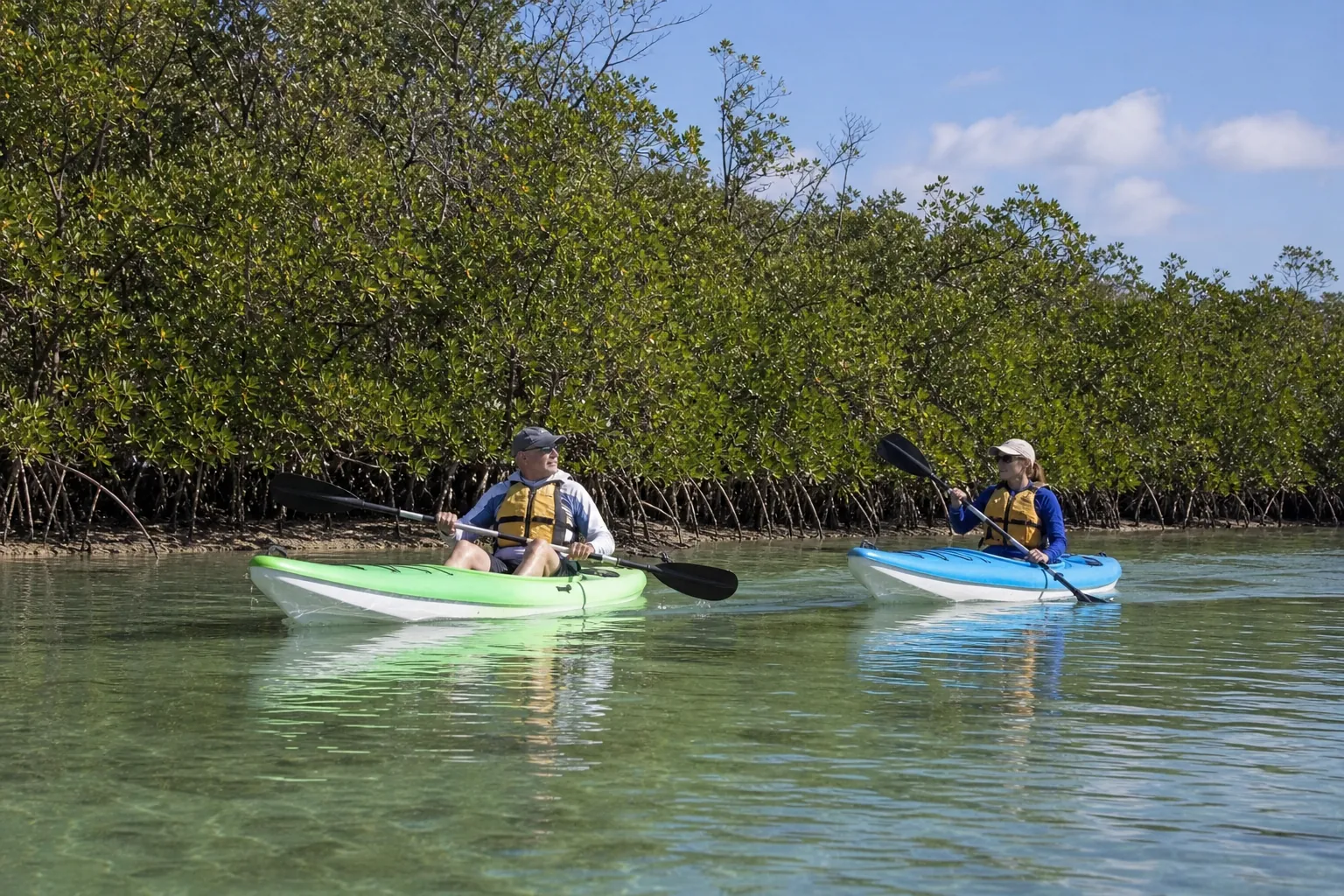
The answer changes only when a motor goes on the kayak:
- Paddle or pedal kayak: no boater card, at any age.
- Kayak with a motor under 10 horsepower (most trolling motors and small kayak outboards): no boater card.
- Kayak with a motor of 10 horsepower or more, operator born before 1988: no boater card.
- Kayak with a motor of 10 horsepower or more, operator born on or after January 1, 1988: photo ID and a Florida Boating Safety Education ID Card aboard, unless an exemption applies.
Florida does not issue a separate "boating license." The education card is what people mean by the term, and our guide on how to get a Florida boaters license explains how to earn it. Even when no card is needed, a kayak is still a vessel under Florida law, so the equipment and channel rules below apply to every paddler.
A Kayak Is Still a Vessel in Florida
Florida defines a vessel in s. 327.02 as every description of watercraft used or capable of being used as a means of transportation on water. The same section defines a human-powered vessel as one powered only by its occupants, including by their hands or feet, oars or paddles.
FWC's page on human-powered vessels says that under U.S. Coast Guard regulations, human-powered canoes, kayaks and paddleboards are classified as vessels, except paddleboards used within swimming, surfing or bathing areas, and that they are subject to the same safety and operational requirements as other watercraft in Florida.
So the education card is off the table for a paddle kayak, while the life jacket rule, the sound device, the night light and the Intracoastal Waterway rule all stay on. That is the part most kayakers miss.
Pedal Kayaks and Paddleboards
Pedal drive kayaks are popular with anglers because they leave both hands free. Under the s. 327.02 definition, a vessel powered only by its occupants' hands or feet is human-powered. A pedal kayak with no motor falls in the same group as a paddle kayak: no boater card, no registration under 16 feet, and the same equipment list.
Stand-up paddleboards work the same way. FWC lists canoes, kayaks and paddleboards together on its human-powered vessels page, with the one exception that a paddleboard used inside a swimming, surfing or bathing area is not classified as a vessel.
Motorized Kayaks and the 10 Horsepower Line
A kayak with a trolling motor or a small outboard is a different craft in the eyes of the law. Florida's definition of a motorboat in s. 327.02 is a vessel equipped with machinery for propulsion, irrespective of whether the propulsion machinery is in actual operation. A kayak with a motor mounted is a motorboat even while you paddle it.
For the boater card, though, the question is still horsepower. Section 327.395 covers vessels powered by a motor of 10 horsepower or greater. Most kayak trolling motors and kayak outboards sit well under that line, which keeps their operators outside the card rule. Before you rely on that, read the rating printed on the motor or in its paperwork, since the statute turns on the motor actually powering the kayak.
If you were born on or after January 1, 1988 and put a motor of 10 horsepower or more on a kayak, you need to carry photo ID and the Boating Safety Education ID Card, the same as on any other boat. Our jon boat guide walks through the same horsepower line on small fishing boats.
Registration: Paddle Kayaks vs Motorized Kayaks
Registration is where a motor makes the biggest difference. FWC's boating regulations page says all vessels must be registered through the local Tax Collector's Office, except non-motor-powered vessels under 16 feet and non-motor-powered canoes, kayaks, racing shells or rowing sculls, regardless of length.
FWC's human-powered vessels page adds that all motorized vessels, including canoes, kayaks and paddleboards, must have a Florida Certificate of Registration and a Certificate of Title unless used exclusively at private ponds and lakes.
| Kayak setup | Boater card (born 1988 or later) | Registration and title |
|---|---|---|
| Paddle kayak, any length | Not required | Not required |
| Pedal kayak, no motor | Not required | Not required |
| Kayak with a motor under 10 hp | Not required | Required, unless used only on a private pond or lake |
| Kayak with a motor of 10 hp or more | Required, unless exempt | Required, unless used only on a private pond or lake |
Adding even a small electric trolling motor moves a kayak into the registration column. For the steps at the Tax Collector's Office, see our Florida boat registration guide.
Safety Equipment Every Kayak Needs
FWC's human-powered vessels page lists the equipment for nonmotorized vessels:
| Item | What FWC requires |
|---|---|
| Life jacket | One U.S. Coast Guard approved wearable life jacket for each person on board. Children under 6 must wear one. |
| Sound device | A bell, horn or whistle that can be heard for at least one half nautical mile. |
| Light | One lantern or flashlight shining a white light when operating between sunset and sunrise or when visibility is restricted. |
| At anchor at night | Between sunset and sunrise, a vessel at anchor away from a dock must display a white light visible from all directions. |
| Night distress signals | Three pyrotechnic or one non-pyrotechnic night signal when on the Atlantic Ocean, the Gulf and coastal waters from sunset to sunrise. |
The same page says boats that are manually propelled or under 16 feet do not have to carry day visual distress signals. It also says lighting for motorized paddlecraft is the same as for all power-driven vessels, so a kayak with a motor that goes out after dark needs the navigation lights a powerboat would show. Our Florida life jacket requirements guide covers sizing and wear, and our guide to the life jacket kayak law in Florida covers the child rule, the throwable exemption and inflatables for paddlers.
The Intracoastal Waterway Rule for Kayaks
Florida has one rule written only for paddlers. Under s. 327.371, a person may not operate a human-powered vessel within the marked channel of the Florida Intracoastal Waterway except:
- When the marked channel is the only navigable part of the waterway because of congestion or obstructions, and then only until you can safely move outside it.
- When crossing the channel in the most direct, continuous and expeditious manner possible without interfering with other traffic.
- During practices or competitions of school-affiliated rowing teams, under conditions the statute lists.
- During an emergency endangering life or limb.
A violation is a noncriminal infraction under s. 327.73. In practice, plan routes along the edges of the waterway and cross the channel at a right angle, quickly, when it is clear.
Renting a Kayak in Florida
Renting a paddle kayak is simpler than renting a powerboat. Under s. 327.54(6), a livery may not knowingly rent a vessel other than a human-powered vessel to anyone under 18. That limit does not cover kayaks, canoes or paddleboards moved by their riders, and the same section says its insurance requirement does not apply to human-powered vessels.
A rented kayak with a motor is a livery vessel like any other powered boat, so the under-18 limit applies to it. Visitors renting on vacation can find the card rules for out-of-state boaters in our guide for tourists.
When a Kayaker Should Get the Card Anyway
If you only paddle, Florida never asks for the card. Plenty of kayakers end up wanting it anyway: a friend hands over the helm of a center console, a fishing trip moves to a rented skiff, or the family books a pontoon or a jet ski on vacation. For anyone born on or after January 1, 1988, those boats usually carry motors well over 10 horsepower.
The card is valid for life under s. 327.395(5). According to FWC's ID card page, many online course providers send the card request to FWC for students who pass, and the card should then arrive within two to three weeks. Courses are listed on FWC's boating safety courses page. For the full list of who needs the card, see Do I need a boating license in Florida?
Boat Skill is preparing the Florida temporary boating certificate, a 90-day proof that s. 327.395 also accepts, and does not issue the lifetime card.
Get notified when Boat Skill enrollment opens
Sources
- Florida Statutes s. 327.395: Boating safety education
- Florida Statutes s. 327.02: Definitions
- Florida Statutes s. 327.371: Human-powered vessels regulated
- Florida Statutes s. 327.54: Liveries; safety regulations
- Florida Statutes s. 327.73: Noncriminal infractions
- FWC: Human-Powered Vessels (Canoes/Kayaks/Paddleboards)
- FWC: Boating Regulations
- FWC: Boating Safety Education ID Card
- FWC: Boating Safety Courses
Common questions
Do I need a boating license for a kayak in Florida?
Not for a kayak moved by paddle or pedals. Florida Statute 327.395 requires the boater education card only for operators born on or after January 1, 1988 who run a vessel powered by a motor of 10 horsepower or more.
Do I need a boater card for a kayak with a trolling motor?
Only if the motor is 10 horsepower or more and you were born on or after January 1, 1988. Most kayak trolling motors are under that line. Check the rating on the motor itself.
Does a kayak need to be registered in Florida?
A kayak without a motor does not, at any length. FWC says all motorized vessels, including kayaks, canoes and paddleboards, must have a Florida Certificate of Registration and a Certificate of Title unless used only on private ponds and lakes.
Is a pedal kayak considered human-powered?
Yes. Florida Statute 327.02 defines a human-powered vessel as one powered only by its occupants, including by their hands or feet, oars or paddles. A pedal kayak without a motor follows the same rules as a paddle kayak.
What safety equipment is required on a kayak in Florida?
FWC lists a wearable life jacket for each person, worn by children under 6, a bell, horn or whistle audible for one half nautical mile, a white light between sunset and sunrise or in restricted visibility, and night distress signals on coastal waters from sunset to sunrise.
Can I paddle a kayak in the Intracoastal Waterway?
Not in the marked channel, except to cross it directly and quickly, when the channel is the only navigable water because of congestion or obstructions, for school rowing teams, or in an emergency. That rule is in Florida Statute 327.371.
Can someone under 18 rent a kayak in Florida?
Florida Statute 327.54(6) bars liveries from knowingly renting a vessel other than a human-powered vessel to anyone under 18. A paddle kayak is human-powered, so that limit does not apply to it. A kayak with a motor is covered by it.
Do children have to wear a life jacket in a kayak?
Yes. FWC's human-powered vessel rules say a life jacket must be worn by children under 6 years of age, and every person on board needs a wearable life jacket of their own.