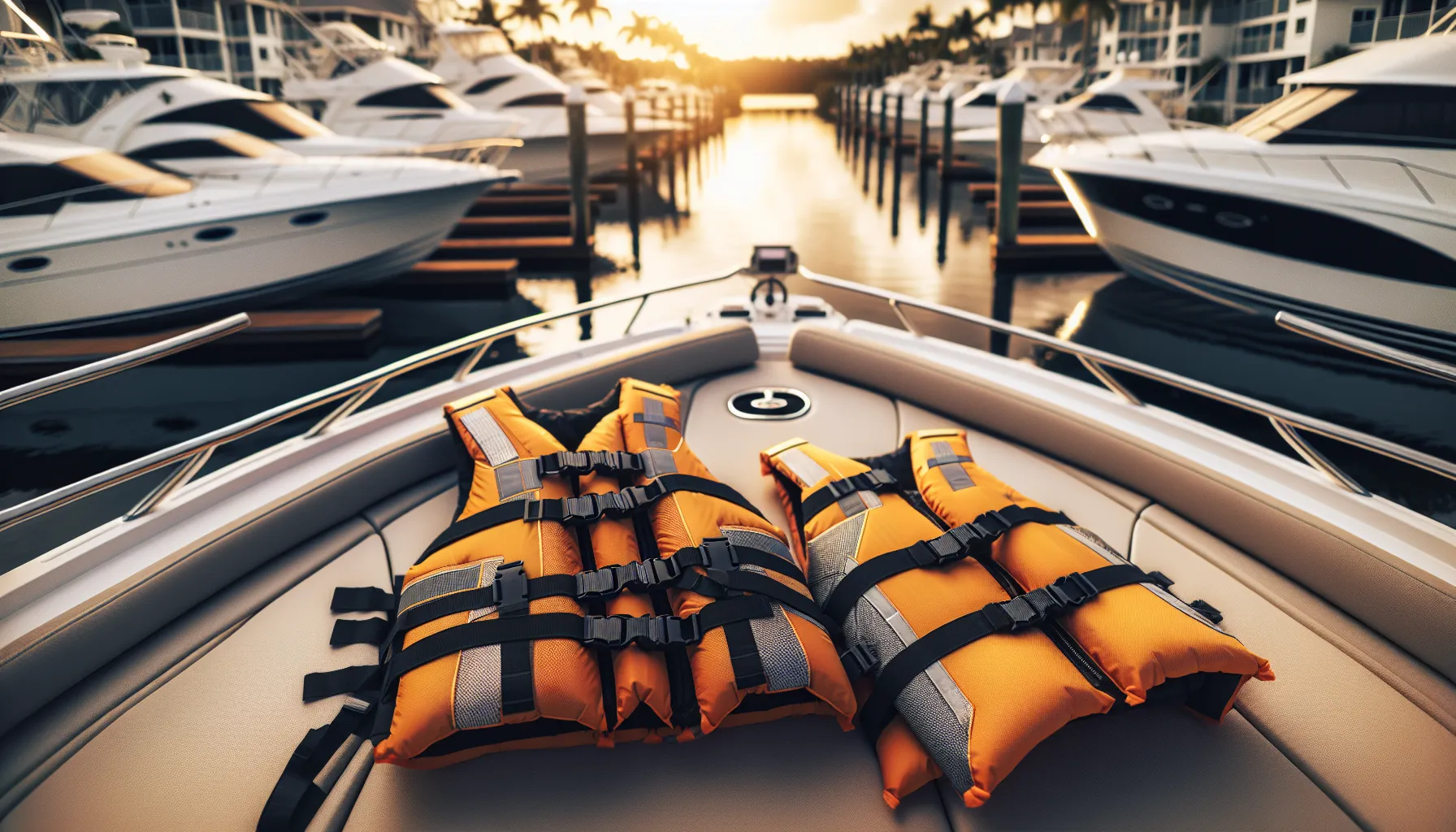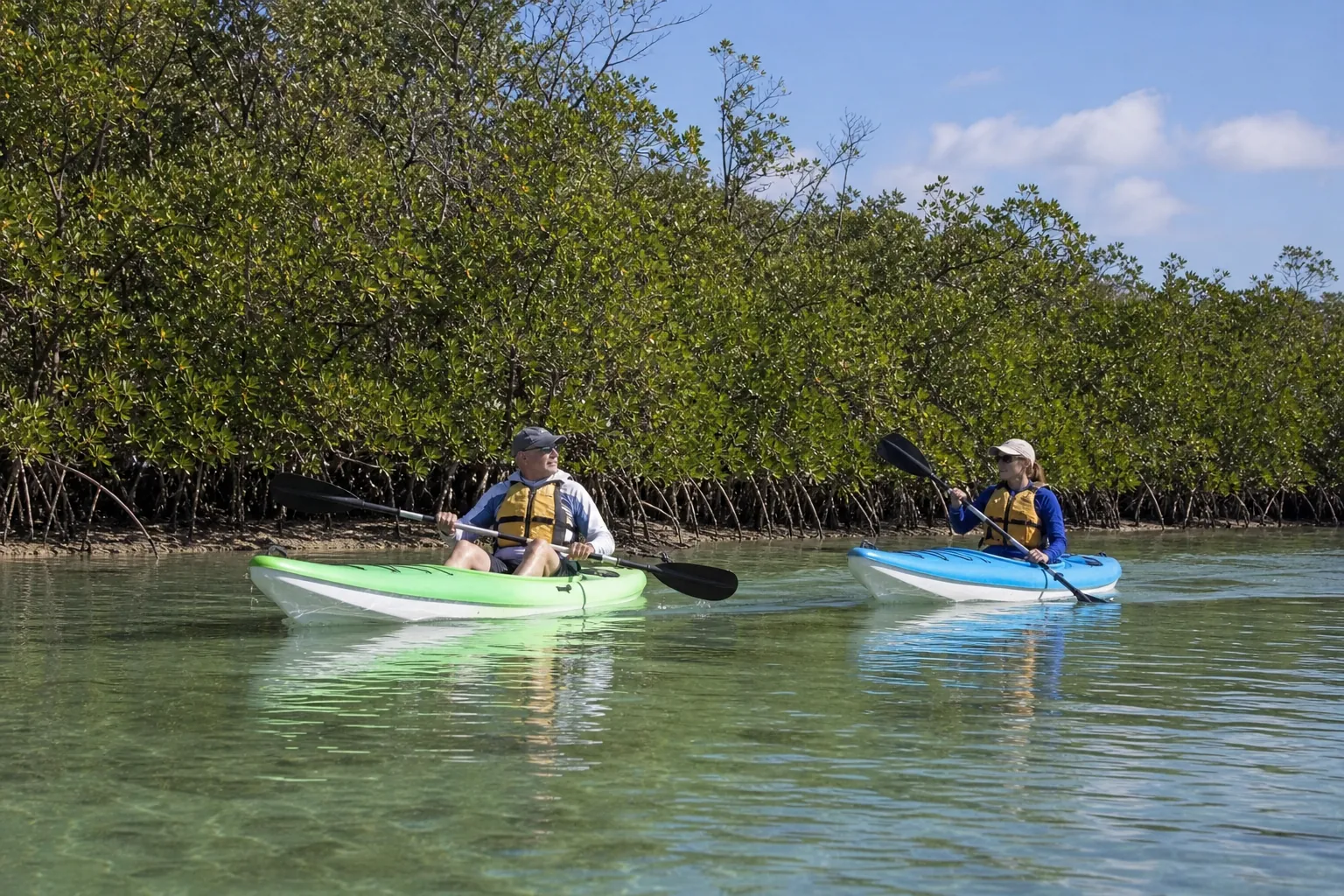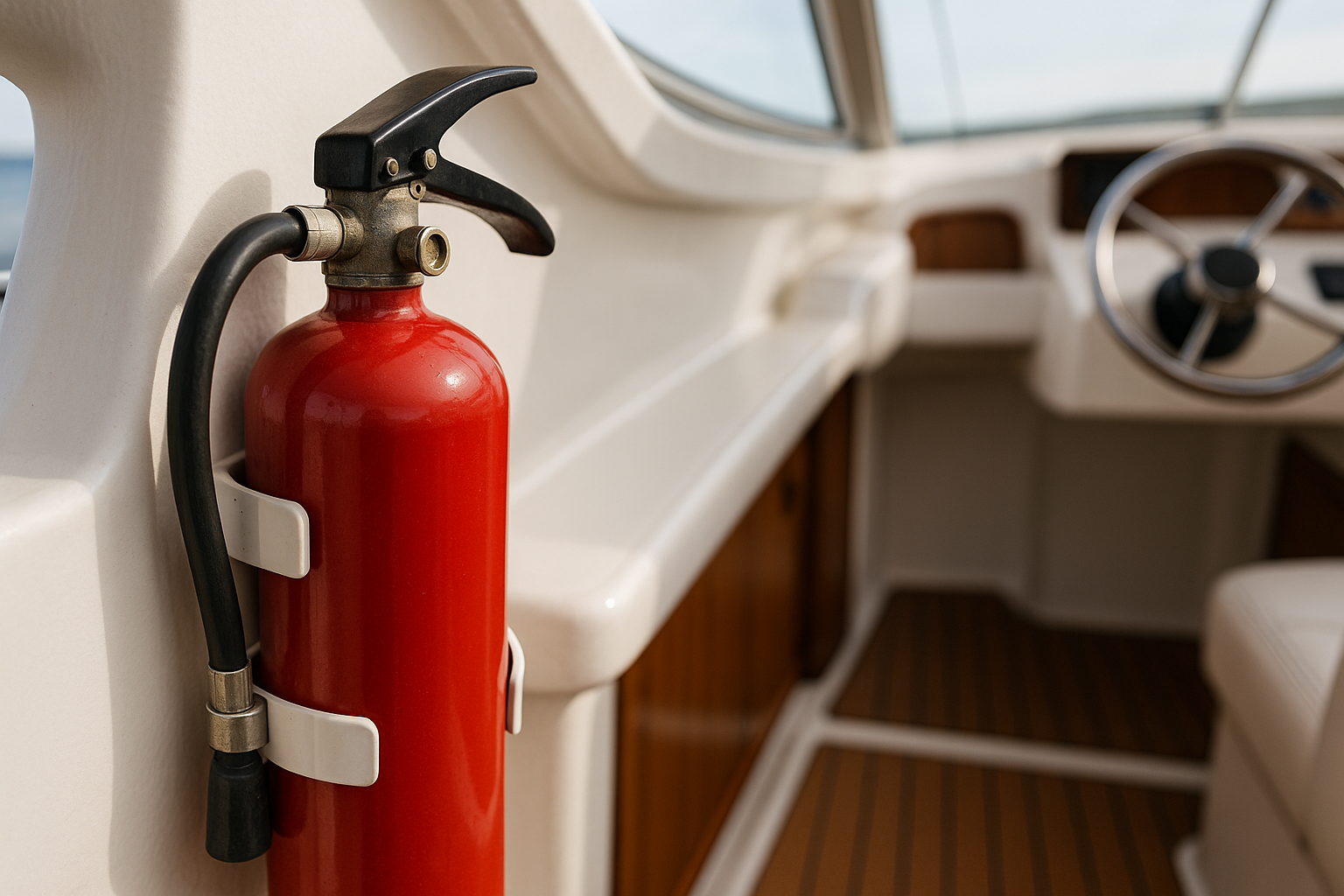

Florida's life jacket kayak law comes down to two rules. Every kayak must carry one wearable, U.S. Coast Guard approved life jacket for each person on board, and every child under 6 must wear one while the kayak is underway. Adults are not required by law to wear theirs, though the Florida Fish and Wildlife Conservation Commission (FWC) strongly advises it.
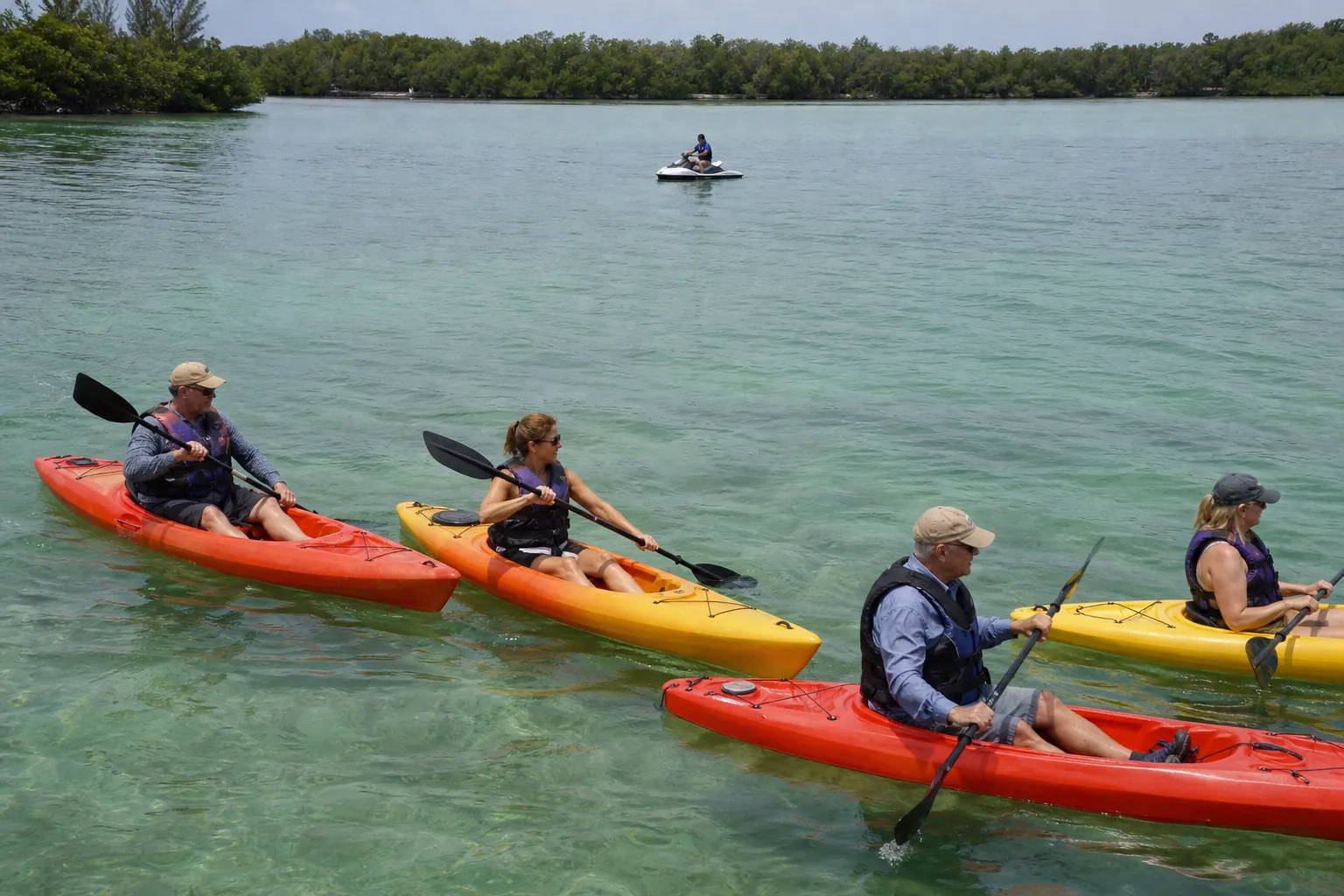
The Florida rules sit in Florida Statute 327.50. Subsection (1)(a) makes every owner and operator carry, store, maintain and use safety equipment as the current Coast Guard rules in the Code of Federal Regulations require. Subsection (1)(b) adds the child rule. FWC's page on human-powered vessels puts the result in plain terms for canoes, kayaks and paddleboards:
- One Coast Guard approved wearable life jacket for each person on board.
- It must be worn by children under 6.
- All others are strongly advised to wear one.
The rest of this guide covers the details that trip paddlers up: what "underway" means on a kayak, why a kayak skips the throwable cushion, when an inflatable vest counts, and what a rental outfit has to hand you.
Why a Kayak Falls Under Boating Law
Florida treats a kayak as a vessel. Section 327.02 defines a human-powered vessel as one powered only by its occupants, including by their hands or feet, oars or paddles. That covers sit-on-top and sit-inside kayaks, canoes and pedal kayaks.
FWC's human-powered vessels page says that under Coast Guard regulations, human-powered canoes, kayaks and paddleboards are classified as vessels, except paddleboards used within swimming, surfing or bathing areas, and that they face the same safety and operational requirements as other watercraft in Florida.
The federal life jacket rules say the same thing from their side. 33 CFR 175.11 applies the life jacket subpart to all recreational vessels propelled or controlled by machinery, sails, oars, paddles, poles or another vessel. A paddle is named in the rule.
So while a paddle kayak never needs the boater education card (our guide on whether you need a boating license for a kayak explains why), the life jacket rules apply from the moment you push off.
Carry One Wearable Life Jacket Per Person
The carriage rule is federal, and Florida adopts it through s. 327.50(1)(a). Under 33 CFR 175.15(a), no one may use a recreational vessel unless at least one wearable life jacket is on board for each person, each one is used as its approval label requires, and each one is used as its owner's manual requires when the label points to the manual.
Three more federal rules decide whether the jacket you carry actually counts:
| Rule | What it means on a kayak | Source |
|---|---|---|
| Readily accessible | The jacket has to be where you can reach it on the water, not packed in a hatch under gear. | 33 CFR 175.19 |
| Size and fit | It must be an appropriate size and fit for the person it is meant for, as marked on its approval label. An adult vest does not count for a small child. | 33 CFR 175.21 |
| Approval number | It must be legibly marked with its Coast Guard approval number. | 33 CFR 175.21 |
| Serviceable | No broken buckles, torn straps, rotted parts, rips that let flotation escape, or foam that is hardened, waterlogged or mildewed. | 33 CFR 175.23 |
FWC's Class A equipment page, which covers vessels under 16 feet plus canoes and kayaks, repeats the same three conditions: approved, serviceable and stored so it is readily accessible. A tandem kayak with two paddlers needs two wearable jackets. A parent paddling with a child needs one sized for the parent and one sized for the child.
The Child Rule: Under 6 Wears It While Underway
This is the one life jacket rule Florida wrote itself. Under s. 327.50(1)(b), a person may not operate a vessel less than 26 feet long unless every person under 6 years of age on board is wearing a Coast Guard approved life jacket, used as its label directs, while the vessel is underway.
The statute defines underway as all times except when the vessel is anchored, moored, made fast to the shore, or aground. On a kayak that means:
- Paddling: underway. The child wears the jacket.
- Drifting while you fish or rest: still underway, because drifting is none of the four exceptions.
- Tied to a dock or a mangrove root: made fast, so the rule pauses.
- Pulled up on a sandbar or beach: aground, so the rule pauses.
The age is under 6, which means a child who has turned 6 is outside the wear rule (the carriage rule still requires a jacket on board that fits them). The rule falls on the operator, the person paddling.
Federal law has a broader rule that you may see quoted elsewhere: 33 CFR 175.15(c) bars operating a recreational vessel underway with a child under 13 aboard unless the child wears a life jacket or is below decks or in an enclosed cabin. 33 CFR 175.25 says that when a state has set its own age by statute, the state requirement applies on that state's waters instead. Florida set its age at under 6, so on Florida waters the under-6 rule is the one that applies.
No Throwable Cushion Under 16 Feet
Bigger boats carry a throwable device, usually a square cushion or a ring, in addition to the wearable jackets. Kayaks mostly skip it.
33 CFR 175.15(b) requires one throwable life jacket only on recreational vessels 16 feet or more in length. Most recreational kayaks are shorter than that, and those carry no throwable at all.
Longer kayaks and canoes have their own exemption. 33 CFR 175.17(a) exempts canoes and kayaks 16 feet or more in length from carrying the additional throwable. A 17-foot touring kayak or an 18-foot canoe still needs one wearable jacket per person and nothing more.
One more federal exemption is worth knowing if you race. Under 33 CFR 175.17(b), racing shells, rowing sculls, racing canoes and racing kayaks are exempt from carrying any of the life jackets in 175.15. Florida's child rule in s. 327.50(1)(b) is written for every vessel under 26 feet and has no racing exception, so a child under 6 aboard still wears one.
Inflatable Life Jackets on a Kayak
Many paddlers prefer a belt pack or suspender style inflatable because it stays cool and does not ride up while paddling. Whether one counts depends on its label.
Florida bans inflatable life jackets in two places, and a paddle kayak is in neither:
- On a personal watercraft, everyone aboard or towed wears a life jacket that is not inflatable under s. 327.39(1).
- A person towed behind a boat on skis or a tube wears a noninflatable life jacket under s. 327.37(2)(b).
For a kayak, the federal rules decide. Under 33 CFR 175.15(a), each jacket must be used as its approval label requires, so an inflatable whose label says it counts only when worn has to be worn to count toward your carriage total. FWC's Class A page tells boaters to read the Coast Guard approval label on each jacket to understand its legal requirements.
An inflatable also has to be in working order. 33 CFR 175.23(c) treats one as serviceable only if it has a properly armed inflation mechanism with a full cartridge and all status indicators showing armed, chambers that hold air, oral inflation tubes that are not blocked or broken, and a manual inflation lanyard or lever that is present and working. A vest with a spent cartridge does not count as a life jacket on board.
For a child under 6, the statute requires a jacket used in accordance with its Coast Guard approval label, so the child's label has to allow that use.
Reading the Label: Old Types and New Levels
The label is where the legal answers live, so it pays to read it before you buy.
Federal rules sort life jackets into two groups. Under 33 CFR 175.13, a jacket marked Type I, II or III, or Type V with Type I, II or III performance, is wearable. One marked Type IV, or Type V with Type IV performance, is throwable. A wearable is not a throwable unless it is marked that way.
FWC's Wear It. For Life! page explains the newer labels being phased in:
- A performance level number. Lower numbers give more mobility and comfort for near shore, calm water use. Higher numbers give more flotation and a better chance of turning a wearer face up, for offshore use where rescue may take longer.
- Warning icons for activities the jacket is not designed for.
- A turning icon showing whether it is designed to turn an unconscious person face up.
- Size information by weight and chest size.
FWC adds that a jacket with the older label can still be used if it is in good condition and right for the activity. Its tip for fit: try the jacket on and fasten every strap, buckle and zipper.
Paddleboards, Pedal Kayaks and Motorized Kayaks
Paddleboards. A stand-up paddleboard is a vessel under the same FWC page, except inside a swimming, surfing or bathing area. Out on open water it carries the same life jacket rules as a kayak: one wearable per person, worn by a child under 6.
Pedal kayaks. Section 327.02 counts a vessel powered by its occupants' feet as human-powered. A pedal kayak with no motor follows every rule above.
Kayaks with a motor. A trolling motor does not change the life jacket rules, which apply to all recreational vessels. It does change other things: FWC says lighting for motorized paddlecraft is the same as for all power-driven vessels, and FWC says a motorized kayak needs a Florida Certificate of Registration and a Certificate of Title unless it is used only on private ponds and lakes. If the motor is 10 horsepower or more, an operator born on or after January 1, 1988 also needs the boater education card and photo ID aboard under s. 327.395.
The rest of the paddler kit sits beside the life jackets. FWC's human-powered vessels page lists a bell, horn or whistle that can be heard for at least one half nautical mile, and a white light from sunset to sunrise or in restricted visibility. For the full equipment list by boat size, see our Florida boat safety equipment checklist.
Renting a Kayak: What the Livery Must Provide
A rental business that advertises and offers vessels for hire is a livery under s. 327.54, and the section puts life jacket duties on it:
- To get or renew its no-cost FWC livery permit, a livery must have enough Coast Guard approved life jackets on site for the capacity of every vessel it rents, under s. 327.54(2).
- It may not knowingly rent a vessel that does not contain the safety equipment required under s. 327.50, under s. 327.54(3)(c).
- It may not knowingly rent a livery vessel other than a human-powered vessel to anyone under 18, under s. 327.54(6). A paddle kayak is human-powered, so that age limit does not reach it.
When you pick up a rental kayak, count the jackets against the people in your group and check that each one fits. A child under 6 needs a child-sized jacket on, before you leave the beach. More on renting any kind of boat is in our guide to Florida boat rental rules.
Enforcement and Why Wearing It Matters
A violation of s. 327.50(1), the section that holds both life jacket rules, is a noncriminal infraction under s. 327.73(1)(m).
An officer cannot stop you just to count life jackets. Under s. 327.56, an officer may not board a vessel or make a vessel stop without probable cause to believe a violation of the chapter has occurred or is occurring, and may not stop a vessel for the sole purpose of a safety equipment inspection. The same section makes a safety equipment violation a secondary offense. A child under 6 paddling without a jacket on is a violation an officer can see from another boat.
The legal minimum is a low bar. FWC's Wear It. For Life! page reports that over 60% of boating fatalities in Florida are caused by people falling overboard and drowning, and that 80 percent of drowning victims were not wearing a life jacket. FWC's safety tips for paddlers start with: always wear a life jacket. It also advises a brightly colored jacket and clothing, because a low kayak is hard for powerboat operators to see in chop, fog or glare.
If you also run powerboats or ride personal watercraft, the boater education card covers those boats. Boat Skill is preparing the Florida temporary boating certificate, the 90-day proof that s. 327.395 accepts and that renters call the jet ski test, with unlimited free retakes. Enrollment opens soon.
Get notified when Boat Skill enrollment opens
For the life jacket rules on every kind of boat, see our Florida life jacket requirements guide.
Sources
- Florida Statutes s. 327.50: Vessel safety regulations; equipment and lighting requirements
- Florida Statutes s. 327.02: Definitions
- Florida Statutes s. 327.39: Personal watercraft regulated
- Florida Statutes s. 327.37: Water skis, parasails, aquaplanes, kiteboarding, kitesurfing, and moored ballooning regulated
- Florida Statutes s. 327.54: Liveries; safety regulations
- Florida Statutes s. 327.56: Safety and marine sanitation equipment inspections
- Florida Statutes s. 327.73: Noncriminal infractions
- Florida Statutes s. 327.395: Boating safety education
- 33 CFR Part 175, Subpart B: Personal Flotation Devices
- FWC: Human-Powered Vessels (Canoes/Kayaks/Paddleboards)
- FWC: Vessels under 16 feet (Class A) equipment
- FWC: Wear It. For Life!
Common questions
Is it a law to wear a life jacket in a kayak in Florida?
Only for children under 6, who must wear a Coast Guard approved life jacket while the kayak is underway under Florida Statute 327.50(1)(b). Adults must carry a wearable life jacket on board but are not required by law to wear it. FWC strongly advises everyone to wear one.
How many life jackets does a kayak need in Florida?
One wearable, Coast Guard approved life jacket for each person on board. A solo kayak needs one, a tandem needs two. Each must fit its wearer, be in serviceable condition and be readily accessible.
Does a kayak need a throwable cushion in Florida?
No. Federal rule 33 CFR 175.15(b) requires a throwable only on vessels 16 feet or longer, and 33 CFR 175.17(a) exempts canoes and kayaks of 16 feet or more from that throwable. Florida follows those federal rules under s. 327.50(1)(a).
What does underway mean for the child life jacket rule?
Florida Statute 327.50(1)(b) defines underway as all times except when the vessel is anchored, moored, made fast to the shore or aground. A drifting kayak is underway. A kayak tied to a dock or pulled up on a sandbar is not.
Can I use an inflatable life jacket on a kayak in Florida?
Yes, if its Coast Guard approval label allows that use and it is serviceable: armed with a full cartridge, status indicators showing armed and chambers that hold air. If the label says it counts only when worn, you must wear it. Florida's inflatable bans apply to personal watercraft and to people being towed.
Do paddleboards need life jackets in Florida?
Yes, outside swimming, surfing or bathing areas, where FWC says a paddleboard is not classified as a vessel. On open water a paddleboard carries one wearable life jacket per person, and a child under 6 aboard must wear one.
Does the federal under-13 life jacket rule apply in Florida?
No. 33 CFR 175.25 says that when a state sets its own age for children to wear life jackets by statute, the state rule applies on its waters instead of the federal under-13 rule. Florida's age is under 6, on vessels under 26 feet while underway.
What happens if I am caught without a life jacket on a kayak?
A violation of Florida Statute 327.50(1) is a noncriminal infraction under s. 327.73(1)(m). An officer needs probable cause of a violation to stop a vessel and may not stop one only to inspect safety equipment, under s. 327.56.