

The Short Version
Florida boat safety equipment requirements start with one sentence in Florida Statute 327.50: the owner and the operator of every vessel must carry, store, maintain and use safety equipment that matches current U.S. Coast Guard requirements in the Code of Federal Regulations, unless the FWC expressly exempts it. Florida then adds its own rules on top, such as the life jacket rule for young children.
What has to be aboard depends mostly on your boat's length, whether it has an engine, and whether you run on coastal waters. For a typical motorboat the core list is:
- A wearable life jacket for every person aboard, in the right size.
- A throwable flotation device if the boat is 16 feet or longer.
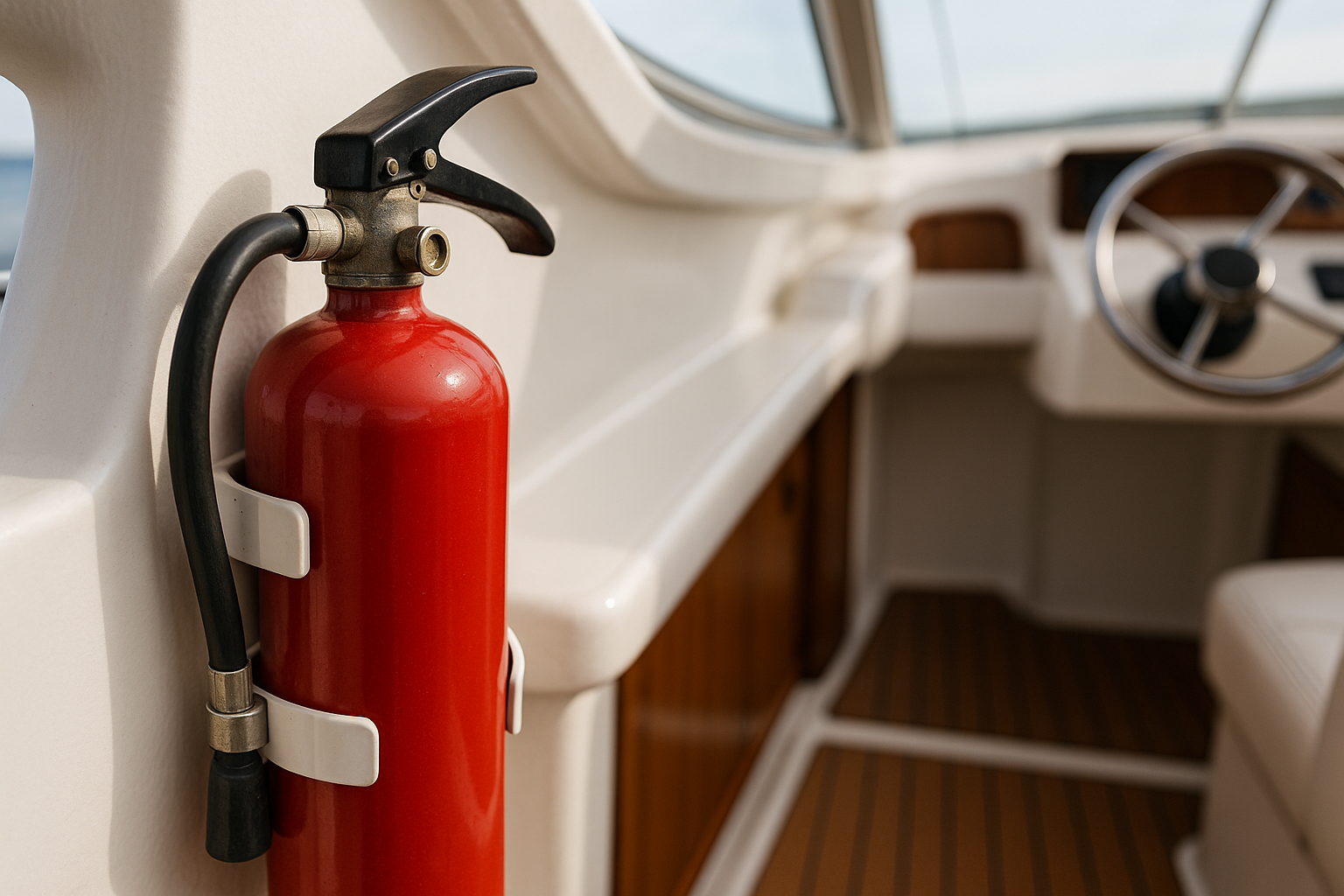
- A marine fire extinguisher when the boat's build can trap fuel vapors.
- Visual distress signals on coastal waters.
- A whistle, horn or bell.
- Working navigation lights for sunset to sunrise and poor visibility.
- A backfire flame arrestor and ventilation on gasoline inboard engines.
The FWC equipment page splits these rules into four length classes, and the rest of this checklist follows the same split. Missing gear is a noncriminal infraction under section 327.73, covered near the end.
Florida Boat Classes by Length
The FWC sorts recreational boats into four classes on its equipment pages:
| Class | Length | FWC checklist |
|---|---|---|
| Class A | Less than 16 feet, plus canoes and kayaks | Vessels under 16 feet |
| Class 1 | 16 to less than 26 feet | Vessels 16 to 26 feet |
| Class 2 | 26 to less than 40 feet | Vessels 26 to 40 feet |
| Class 3 | 40 to less than 65 feet | Vessels 40 to 65 feet |
Length matters in three places: the throwable device starts at 16 feet, the number of fire extinguishers steps up at 26 and 40 feet, and visual distress signal rules change at 16 feet. The Florida child life jacket rule applies on boats under 26 feet. Measure your boat before you shop, and check its registration paperwork if you are unsure. Our Florida boat registration guide explains what that paperwork covers.
Life Jackets: The Rule Every Boat Shares
Every recreational vessel, from a kayak to a 60-foot cruiser, must carry one wearable life jacket (PFD) for each person on board and for anyone being towed on skis or a tube. The FWC's Class A checklist says each one must carry a U.S. Coast Guard approval label, be in serviceable condition, and be stored so it is readily accessible. Federal rule 33 CFR 175.21 adds that each PFD must be the right size and fit for the person who will wear it, as marked on its label, and legibly marked with its approval number.
"Serviceable" has a federal definition in 33 CFR 175.23. A life jacket fails if its buckles or straps are broken or torn, if its fabric has rips that could let flotation escape, or if its foam is hardened, waterlogged, oil-soaked or mildewed. An inflatable must have a full cartridge, an armed inflation mechanism and working status indicators.
Florida adds three wear rules:
- Children under 6: under section 327.50(1)(b), every person under 6 must wear a life jacket while a vessel under 26 feet is underway. Underway means any time the boat is not anchored, moored, made fast to shore or aground.
- Personal watercraft: under section 327.39(1), everyone riding on or towed behind a jet ski must wear a life jacket that is not inflatable.
- Water skiers: the FWC regulations page says anyone skiing or aquaplaning must wear a non-inflatable wearable life jacket.
Our Florida life jacket requirements guide covers life jacket types and sizing in more depth.
Throwable Devices for Boats 16 Feet and Longer
Once a boat reaches 16 feet, the FWC's Class 1 checklist requires one throwable (Type IV) device in addition to the wearable life jackets. Under 33 CFR 175.13, a device marked Type IV, or Type V with Type IV performance, counts as throwable. Federal rule 33 CFR 175.19 says the throwable has to be immediately available, so keep it where you can grab it and toss it in one motion, never buried in a locker under the anchor line.
Canoes and kayaks 16 feet or longer are exempt from the throwable requirement under 33 CFR 175.17. They still need a wearable life jacket for each person.
Fire Extinguishers by Boat Length
The FWC checklists require one marine-rated 5-B (B-I) fire extinguisher on recreational motorboats, with one exception: an outboard-powered boat under 26 feet that is built so fuel vapors cannot collect. According to the FWC Class A checklist, you must carry an extinguisher if your boat has a built-in fuel tank, an inboard engine, compartments where portable fuel tanks may be stored, or open areas between the hull and deck where flammable gases could build up. Boats with no motor are exempt.
| Boat length | Portable extinguishers required (no fixed system) |
|---|---|
| Under 26 feet | One 5-B |
| 26 to less than 40 feet | Two 5-B, or one 20-B |
| 40 to 65 feet | Three 5-B, or two 20-B, or one 5-B plus one 20-B |
Sources: the FWC checklists for 26 to 40 feet and 40 to 65 feet, and the table in 33 CFR 175.320. A fixed extinguishing system in the engine space can count in place of one 5-B unit.
Federal rule 33 CFR 175.310 also sets the condition test. Each extinguisher must be readily accessible, unexpired, and show no sign of earlier use. If it has a gauge, the needle must sit in the operable range. The lock pin must be in place, the nozzle clear, and the body free of significant corrosion or damage. Boats built in model year 2017 or earlier may keep older, smaller-rated extinguishers that were already installed as long as they stay in good condition, but any extinguisher installed after August 22, 2016 must meet the current rules, per 33 CFR 175.380. Our boat fire extinguisher guide walks through placement and inspection.
Visual Distress Signals on Coastal Waters
Visual distress signals are required only on the high seas and coastal waters. The FWC defines coastal waters as the Atlantic Ocean, the Gulf of America, and the bays, sounds, harbors, rivers and inlets whose entrance is more than 2 miles wide, up to the point where the shorelines narrow to 2 miles.
The rule depends on length, per the FWC regulations page:
- Under 16 feet: at least 3 signals suitable for night use, carried from sunset to sunrise.
- 16 feet and longer: at least 3 day signals and 3 night signals, or 3 signals that work for both, carried at all times.
Federal rule 33 CFR 175.130 lists what counts. One electric distress light meets the night requirement. One orange distress flag meets the day requirement. Three hand-held red flares meet both. Flares have to be readily accessible, legibly marked, and within the service-life date printed on them (33 CFR 175.120 to 175.128). Manually propelled boats, open sailboats under 26 feet with no motor, and boats in an organized regatta or parade only need night signals between sunset and sunrise (33 CFR 175.115).
Signals are for real emergencies only. Federal rule 33 CFR 175.140 bars showing a distress signal unless the people aboard need help because of immediate or potential danger.
Sound Signals, Lights and Engine Gear
Sound-producing device. The FWC checklists say every vessel under 12 meters (39.4 feet) must carry an efficient sound-producing device, such as a whistle, horn or bell. It needs no particular specification as long as it can make the signals the navigation rules call for. The FWC regulations page gives a referee's whistle as an example.
Navigation lights. Section 327.50(2) bars operating a vessel without serviceable lights and shapes required by the navigation rules. The FWC says recreational boats must show navigation lights between sunset and sunrise and during reduced visibility such as fog, rain or haze, and points to Coast Guard Navigation Rules 20 through 25 for each type of boat. Section 327.50(3) bans sirens and flashing, occulting or revolving lights except where the navigation rules allow them. Our night navigation lights guide shows the common light setups.
Backfire flame arrestor. Gasoline engines installed after April 25, 1940, except outboard motors, need an effective means of controlling backfire flame, and the arrestor must carry Coast Guard approval, per the FWC Class 1 checklist.
Ventilation. Boats built after August 1, 1980 need at least two ventilator ducts for every closed compartment with a gasoline engine or gasoline tank, with an exception for permanently installed tanks that vent outside the boat and have no unprotected electrical devices. Gasoline engine compartments with a cranking motor also need a powered exhaust blower controlled from the helm. Older gasoline boats need at least two ducts fitted with cowls. Federal rule 33 CFR 175.201 requires the system to be operable on boats built after July 31, 1980.
Muffler. The FWC regulations page says every vessel must have an effective muffling device, and cutouts are prohibited outside regattas and official races.
Engine Cut-Off Switches and Situational Gear
Jet ski lanyards. Under section 327.39(2), anyone operating a personal watercraft fitted with a lanyard-type engine cut-off switch must attach the lanyard to their body, clothing or life jacket. Our Florida jet ski and PWC laws guide covers the other PWC rules, including the ban on riding from half an hour after sunset to half an hour before sunrise.
Instruction boats. Section 327.50(4) requires the operator of a boat used to teach a water sport to use an engine cut-off switch and wear its link whenever a participant is in the water.
The federal cut-off switch law. The FWC notes that a federal law on engine cut-off switch use took effect in April 2021 for navigable waters of the U.S., and that Florida has no matching state law for state and local officers to enforce. Clip in anyway.
Towing a skier. The FWC regulations page says the boat must carry an observer besides the operator, or have and use a wide-angle rear-view mirror.
Diving or snorkeling. When someone is in the water with a mask and snorkel or breathing gear, a divers-down flag shown from a boat must be at least 20 by 24 inches and flown at the boat's highest point, per the same FWC page.
Airboats. The FWC requires a muffler and an international orange flag at least 10 by 12 inches, flown at least 10 feet above the lowest part of the boat.
Gear the FWC Recommends
The FWC's equipment checklists also suggest three items the law does not require:
- An anchor with enough anchor line.
- A dewatering device, such as a bilge pump, in case of flooding.
- An oar, paddle or other backup way to move the boat if the engine fails.
Each one solves a common problem. An anchor holds you off a shoal or a jetty after a breakdown. A pump buys time if a hose or through-hull fails. A paddle gets a small boat back to a dock or out of a channel.
What Happens If Gear Is Missing
Section 327.73 lists violations of section 327.50(1) and (2), covering required safety equipment, lights and shapes, as noncriminal infractions. The civil penalty for those infractions is $100 unless the statute sets another amount. A person who fails to respond to the boating citation also faces a separate charge, a second-degree misdemeanor.
Personal watercraft violations of section 327.39(1), (2), (3) and (5) are noncriminal infractions under the same section, and so is the muffler rule in section 327.65.
A ticket is the small cost. A missing extinguisher or an expired flare matters most on the day you need it.
A Pre-Launch Checklist You Can Use
Run through this list at the ramp before you leave the dock:
- Count heads and count wearable life jackets. Match sizes to people, children first.
- Put a life jacket on every child under 6 if the boat is under 26 feet.
- Check the throwable (16 feet and longer) is within reach of the helm.
- Check each fire extinguisher: gauge in the green, pin in place, nozzle clear, no rust, not expired.
- Heading into coastal waters? Check the distress signals: right number, dates not expired, launcher aboard if your flares need one.
- Test the horn or find the whistle.
- Turn on the navigation lights and walk around the boat to see each one lit.
- Run the blower before starting a gasoline inboard engine.
- On a jet ski, clip the lanyard to your life jacket before you start the engine.
- Pack the anchor, line, bilge pump and paddle.
Equipment rules are one part of what every Florida boater needs to know. Anyone born on or after January 1, 1988 also needs a boating safety education ID card to run a boat of 10 horsepower or more, unless an exemption applies, according to the FWC regulations page. Our Florida boater ID card guide explains how the card works, and our Florida boating safety course guide covers what the course teaches. Required safety equipment is one of the topics in the Boat Skill course, and enrollment opens soon. Until then the notify-me signup holds your spot.