Boat sound signals are a short code built from two kinds of blast on a horn or whistle. A short blast lasts about 1 second and a prolonged blast lasts 4 to 6 seconds, as defined in Rule 32 of the Inland Navigation Rules. Everything else is a pattern of those two sounds.
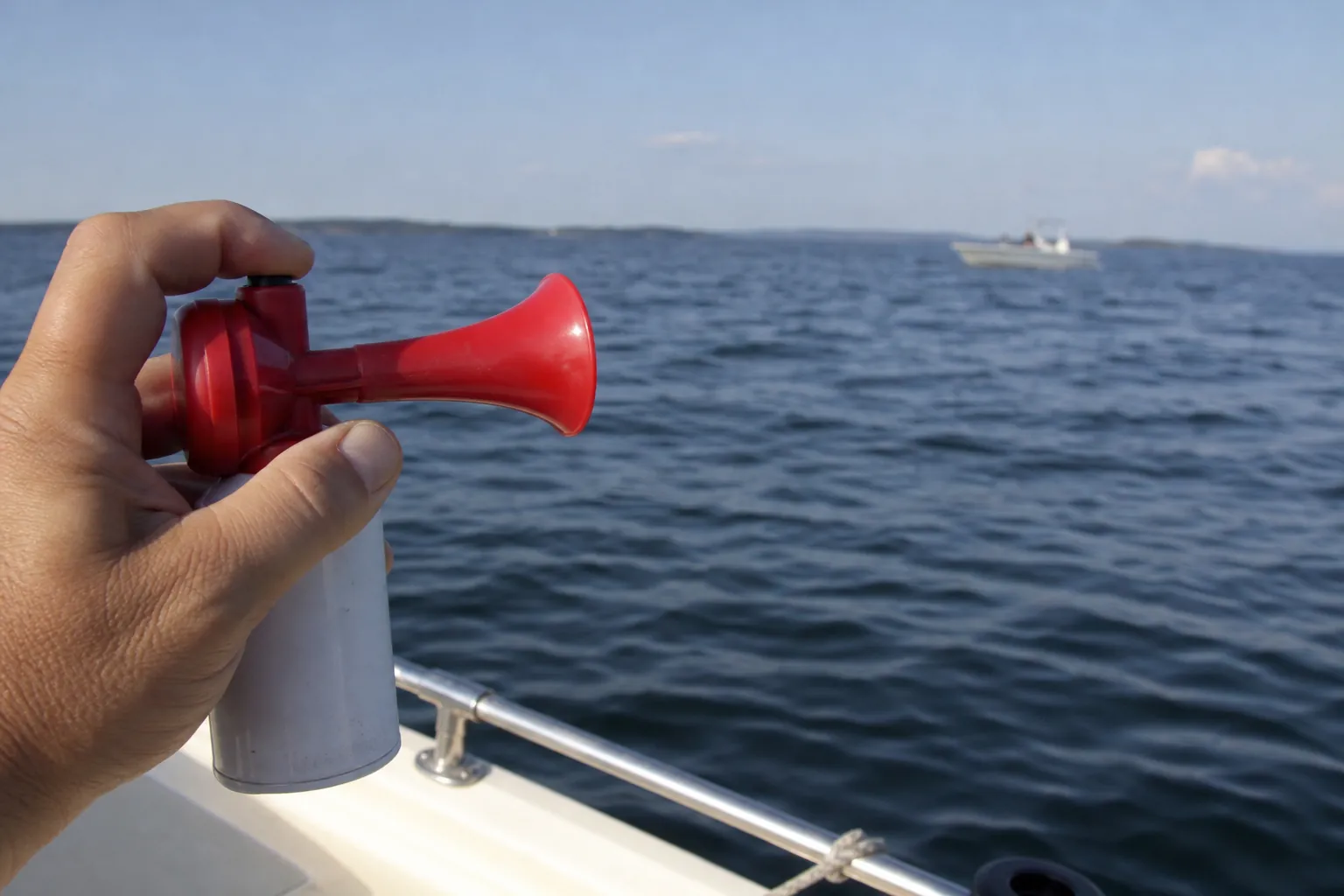
The ones a Florida boater hears most often on inland water:
- One short blast: I intend to leave you on my port side.
- Two short blasts: I intend to leave you on my starboard side.
- Three short blasts: I am operating astern propulsion (backing).
- Five or more short, rapid blasts: danger, or I do not understand what you are doing.
- One prolonged blast: I am leaving a dock or berth, or I am coming up on a bend where I cannot see around.
These are federal rules, and Florida adopts them. Florida Statute 327.33(3) says every person operating a vessel on Florida waters shall comply with the navigation rules, and the same section says fault in boating accidents is decided by those rules. This guide walks through each signal, when you are expected to use it, and what your boat has to carry to make it.
Which Rules Apply on Florida Water
Florida law points to two federal rulebooks. Section 327.02 defines the navigation rules as the International Navigational Rules for waters outside the lines of demarcation in 33 CFR part 80, and the Inland Navigational Rules, published as 33 CFR part 83, for the waters inside those lines.
In practice, the bays, rivers, canals and the Intracoastal Waterway where most Florida recreational boating happens sit inside the lines, so the Inland Rules govern most of what you do. The demarcation lines for each stretch of coast are listed in part 80. Head offshore past them and the International Rules take over, and some meeting and overtaking signals carry different wording there.
Every signal in this guide is taken from the Inland Rules unless it says otherwise. The wider right-of-way picture behind them, including who gives way in a crossing, is in our boat navigation rules and right-of-way guide.
Short and Prolonged Blasts: The Two Building Blocks
Rule 32 defines three terms:
| Term | Meaning under Rule 32 |
|---|---|
| Whistle | Any sound signaling appliance that can produce the prescribed blasts and meets the specifications in Annex III |
| Short blast | A blast of about 1 second |
| Prolonged blast | A blast of 4 to 6 seconds |
The difference between the two is large on purpose. A short blast is a quick tap of the horn button. A prolonged blast is a deliberate hold, long enough that nobody mistakes it for a tap. When you practice, count "one thousand one" for a short blast and hold through "one thousand four" or longer for a prolonged one.
The word "whistle" in the rules covers whatever device you sound the signal on. On a small boat that can be an electric horn, an air horn or a mouth whistle, as the FWC equipment pages explain further down.
Meeting and Crossing Signals: One, Two and Three Short Blasts
Rule 34(a) covers power-driven vessels that are in sight of one another and meeting or crossing within half a mile of each other. When either boat maneuvers as the rules allow or require, it signals the maneuver on its horn:
| Signal | Meaning on inland waters |
|---|---|
| One short blast | I intend to leave you on my port side |
| Two short blasts | I intend to leave you on my starboard side |
| Three short blasts | I am operating astern propulsion |
On inland waters the one and two blast signals are proposals. Under Rule 34(a)(ii), the boat that hears one of them sounds the same signal back if it agrees, and both then take the steps needed for a safe pass. If the second boat doubts the plan is safe, it sounds the danger signal (five or more short blasts) and both boats take precautions until they reach a safe agreement.
Two details matter in real traffic:
- Lights can back up the horn. Rule 34(b) lets a vessel add light signals: one flash, two flashes or three flashes, each about 1 second, on an all-round white or yellow light synchronized with the whistle.
- A radio agreement can stand in for the horn. Rule 34(h) says a vessel that reaches agreement with another in a head-on, crossing or overtaking situation by radiotelephone is not obliged to sound these signals, though it may. If agreement is not reached, the whistle signals are exchanged in a timely manner and they prevail. Our VHF radio basics guide covers the radio side.
Three short blasts mean the engine is in reverse, which tells nearby boats that the stern is about to move toward them. You hear it most around marinas and fuel docks.
Overtaking Signals
Passing a slower boat has its own pair of signals in Rule 34(c). When power-driven vessels are in sight of one another, the boat that wants to pass announces it:
| Signal | Meaning when overtaking |
|---|---|
| One short blast | I intend to overtake you on your starboard side |
| Two short blasts | I intend to overtake you on your port side |
The boat being passed answers with the same signal if it agrees. If it has doubts, it sounds the danger signal instead.
Read the signal in context. Head-on, one short blast proposes the usual port-to-port pass. When overtaking, one short blast means you will pass along the other boat's starboard side, so the same sound describes a different pass.
In a narrow channel, Rule 9(e) adds that the boat being overtaken, if it agrees, sounds the same signal and may, if specifically agreed, take steps to permit a safe pass. The same rule keeps the full duty to keep clear on the overtaking boat. Dredged channels and stretches of the Intracoastal Waterway are where this comes up most, and our Fort Lauderdale Intracoastal Waterway guide covers how passing plays out there.
The Danger Signal: Five or More Short Blasts
If you remember one signal, make it this one. Under Rule 34(d), when vessels in sight of one another are approaching and either one fails to understand the intentions or actions of the other, or doubts that the other is doing enough to avoid a collision, the vessel in doubt shall immediately sound at least five short and rapid blasts. It may add at least five short and rapid flashes of light.
Use it when:
- Another boat is closing on you and you cannot tell which way it will turn.
- You sounded a one or two blast proposal and got no answer, or a different answer.
- A boat is crossing a narrow channel in front of a vessel that can only navigate inside it. Rule 9(d) tells the vessel confined to the channel to use this signal if it is in doubt about the crossing boat's intention.
Sounding the danger signal does not end your duty to act. The boats still have to take precautions until they reach a safe passing agreement, and the right-of-way rules still decide who must keep clear. Slow down, open the distance and be ready to stop.
Leaving the Dock and Rounding Blind Bends
Two situations call for one prolonged blast even when no other boat is in sight.
Leaving a dock or berth. Rule 34(g) says a power-driven vessel leaving a dock or berth shall sound one prolonged blast. Backing out of a slip into a busy fairway is when other boaters most need the warning, because your stern may appear from behind a row of moored boats.
Nearing a bend. Under Rule 34(e), a vessel nearing a bend or an area of a channel where other vessels may be hidden by an obstruction shall sound one prolonged blast. Any approaching vessel within hearing around the bend or behind the obstruction answers with a prolonged blast of its own. Rule 9(f) adds that a vessel nearing such a bend in a narrow channel shall navigate with particular alertness and caution and sound that signal.
Mangrove-lined creeks, winding rivers and residential canals with sharp corners are classic places for this. If you hear a prolonged blast from around a corner, answer it, slow down and keep to the right side of the channel.
Fog and Restricted Visibility Signals
In or near an area of restricted visibility, by day or night, Rule 35 sets signals that tell other boats what kind of vessel you are and what you are doing. The maneuvering signals in Rule 34 are for vessels in sight of one another.
| Vessel | Signal | How often |
|---|---|---|
| Power-driven, making way through the water | One prolonged blast | At intervals of not more than 2 minutes |
| Power-driven, underway but stopped | Two prolonged blasts, about 2 seconds apart | At intervals of not more than 2 minutes |
| Sailing, fishing, towing or pushing, not under command, or restricted in ability to maneuver | One prolonged and two short blasts | At intervals of not more than 2 minutes |
| Last manned vessel of a tow | One prolonged and three short blasts | At intervals of not more than 2 minutes |
| At anchor | Rapid ringing of the bell for about 5 seconds | At intervals of not more than 1 minute |
| Pilot vessel on duty (optional extra) | Four short blasts | With its other signals |
A vessel at anchor may also sound one short, one prolonged and one short blast to warn an approaching vessel of its position. A vessel aground gives the anchor bell signal plus three separate and distinct strokes on the bell before and after the rapid ringing.
Small boats get some relief. Rule 35(j) says a vessel under 12 meters is not obliged to give the signals above, but if it does not, it shall make some other efficient sound signal at intervals of not more than 2 minutes. Rule 35(l) also excuses vessels under 20 meters from the anchor bell when anchored in a special anchorage area designated by the Coast Guard. The lights a boat shows in the same conditions are covered in our boat navigation lights rules guide.
In practice, a recreational boat that keeps moving in fog should sound one prolonged blast at least every 2 minutes, and more often costs nothing. Heavy rain can cut visibility quickly, and our Tampa Bay thunderstorm safety guide covers what to do when one hits.
Drawbridge Signals in Florida
Florida's Atlantic Intracoastal Waterway alone has a long list of drawbridges in 33 CFR 117.261, and the federal drawbridge rules have their own horn code. Under 33 CFR 117.15:
| Who | Signal | Meaning |
|---|---|---|
| Boat | One prolonged blast, then one short blast within 3 seconds | Request to open the draw |
| Boat, during a scheduled closure period for vessels that must be passed through | Five short blasts in rapid succession | Request to open the draw |
| Bridge | One prolonged blast, then one short blast, within 30 seconds of the request | The draw will open now |
| Bridge | Five short blasts in rapid succession, within 30 seconds of the request | The draw cannot open now, or is open and must close promptly |
The rule also says:
- The boat repeats its signal until the drawtender acknowledges it in some way before proceeding.
- Sound signals can come from a whistle, horn, megaphone, hailer or other device loud enough for the drawtender to hear.
- Visual signals and radiotelephone calls are also allowed. A boat can request an opening by raising and lowering a white flag, or a white, amber or green light, vertically.
If the bridge answers with five short blasts, hold well clear and wait. Some bridges open only at set times. For example, section 117.261 lets the Bridge of Lions in St. Augustine open only on the hour and half-hour from 7 a.m. to 6 p.m., with further closures at set times on weekdays. Look up the bridge's own listing in part 117 before you plan around it.
Attention and Distress Signals
Some situations fall outside the maneuvering code.
Getting someone's attention. Rule 36 lets any vessel make light or sound signals to attract attention, as long as they cannot be mistaken for a signal authorized elsewhere in the rules, or point a searchlight in the direction of the danger, as long as it does not interfere with any vessel. A random pattern of honks that happens to match five short blasts or a bend signal sends the wrong message, so pick something distinct.
Distress. The distress signals are listed in Annex IV, 33 CFR 87.01. One of them is a continuous sounding with any fog-signaling apparatus, so holding the horn down without stopping signals that you need help. The same list includes the spoken word "Mayday" on the radio, red flares, orange smoke and slowly raising and lowering outstretched arms. Under section 87.02, using any of these signals for anything other than distress is prohibited.
Sirens. Florida Statute 327.50(3) prohibits sirens on any vessel except as the navigation rules expressly provide.
What Horn or Whistle Your Boat Must Carry
Florida Statute 327.50(1)(a) requires every vessel owner and operator on Florida waters to carry, store, maintain and use safety equipment according to current Coast Guard requirements. For sound signals, that comes down to boat length.
| Boat length | What it must have |
|---|---|
| Under 12 meters (39.4 feet) | An efficient sound-producing device, such as a bell, horn or whistle, that can make the signals the navigation rules require |
| 12 meters or more | A whistle meeting Annex III |
| 20 meters or more | A whistle and a bell |
| 100 meters or more | A whistle, a bell and a gong |
The small-boat line comes from the FWC's equipment pages for vessels under 16 feet and vessels 16 to 26 feet, which say the device need not meet any particular specifications as long as the vessel can produce the signals the navigation rules require. The larger sizes come from Rule 33.
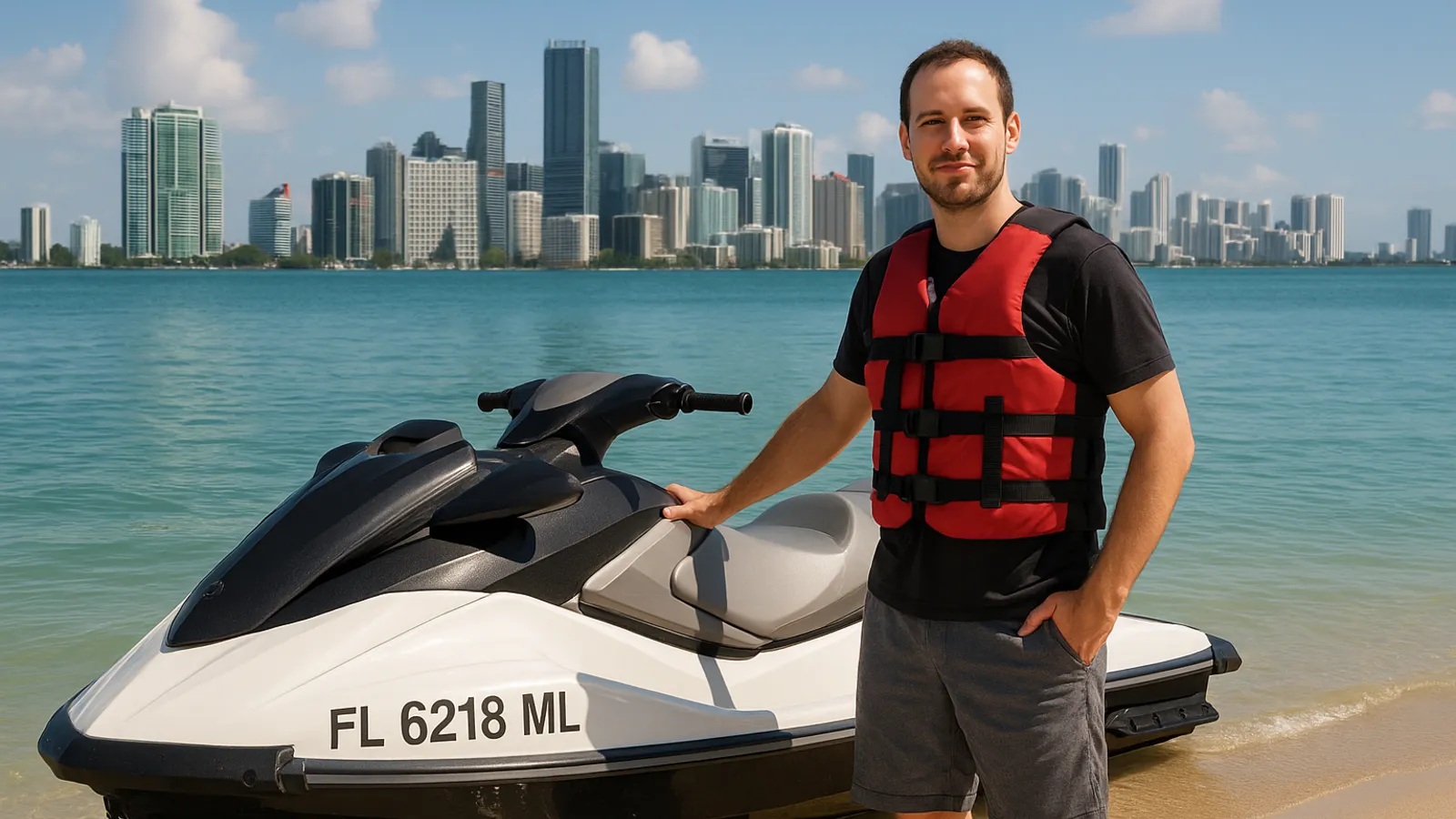
A personal watercraft is a vessel well under 12 meters, so the same small-boat rule applies to it. Whatever you carry, it has to be able to produce a clear 4 to 6 second prolonged blast and five quick short blasts. Keep it where the operator can reach it without letting go of the helm, and test it before you leave the dock. The rest of the gear list is in our Florida boat safety equipment checklist.
Every Signal on One Page
| Signal | Situation | Meaning |
|---|---|---|
| 1 short | Meeting or crossing | I intend to leave you on my port side |
| 2 short | Meeting or crossing | I intend to leave you on my starboard side |
| 3 short | Meeting or crossing | I am operating astern propulsion |
| 1 short | Overtaking | I intend to overtake you on your starboard side |
| 2 short | Overtaking | I intend to overtake you on your port side |
| 5 or more short | Any approach | Danger, or I do not understand your intentions |
| 1 prolonged | Leaving a dock or berth | Power-driven vessel leaving |
| 1 prolonged | Nearing a blind bend | Warning to boats out of sight; answer with 1 prolonged |
| 1 prolonged every 2 minutes at most | Restricted visibility | Power-driven vessel making way |
| 2 prolonged every 2 minutes at most | Restricted visibility | Power-driven vessel stopped |
| 1 prolonged, 2 short | Restricted visibility | Sailing, fishing, towing, not under command or restricted |
| 1 prolonged, 1 short | At a drawbridge | Request to open, or the bridge will open |
| Continuous sounding | Any time | Distress |
Sources for each row are linked in the sections above. On a rental, the operator is responsible for these signals the same way an owner is, and our Florida boat rental rules guide covers the rest of what a renter is expected to know.
Putting Sound Signals to Work
A few habits put the code to use on the water:
- Find the horn before you start the engine. Know where the button is and confirm it sounds.
- Sound one prolonged blast as you back out of the slip. Then look before you commit to the fairway.
- Answer what you hear. A one or two blast proposal on inland water expects the same signal back, or five short blasts if you disagree. Silence leaves the other operator guessing.
- Signal early at bends. Give the prolonged blast before the bend, while there is still room for both boats to slow down.
- Use five short blasts the moment you are unsure. Then act: slow, turn or stop.
- In fog or a downpour, keep sounding. One prolonged blast at least every 2 minutes while you are moving.
Breaking these rules has consequences beyond the risk of a collision. Under section 327.33(3), a navigation rules violation that is not reckless operation is a noncriminal violation, and one that causes a boating accident with serious bodily injury or death is a second degree misdemeanor. How a Florida boating ticket is handled is covered in our Florida boating tickets guide. Sound signals are also part of the navigation rules taught in a Florida boating safety course, the course behind the Boating Safety Education ID Card most Florida boaters think of as a boating license.
Sources
- 33 CFR 83.32: Definitions of short and prolonged blasts (Rule 32)
- 33 CFR 83.33: Equipment for sound signals (Rule 33)
- 33 CFR 83.34: Maneuvering and warning signals (Rule 34)
- 33 CFR 83.35: Sound signals in restricted visibility (Rule 35)
- 33 CFR 83.36: Signals to attract attention (Rule 36)
- 33 CFR 83.09: Narrow channels (Rule 9)
- 33 CFR 117.15: Drawbridge signals
- 33 CFR 117.261: Atlantic Intracoastal Waterway drawbridges, St. Marys River to Key Largo
- 33 CFR 87.01: Distress signals (Annex IV)
- 33 CFR 87.02: Exclusive use of distress signals
- Florida Statute 327.33: Reckless or careless operation; navigation rules
- Florida Statute 327.50: Vessel safety equipment
- Florida Statute 327.02: Definitions (navigation rules)
- FWC: Equipment for vessels under 16 feet
- FWC: Equipment for vessels 16 to 26 feet
Common questions
What does one short blast mean on a boat?
On inland waters, one short blast (about 1 second) from a power-driven vessel meeting or crossing within half a mile means "I intend to leave you on my port side." When overtaking, it means "I intend to overtake you on your starboard side." Both come from Rule 34 of the Inland Navigation Rules.
What does two short blasts mean?
In a meeting or crossing situation on inland waters, two short blasts mean "I intend to leave you on my starboard side." When overtaking, they mean "I intend to overtake you on your port side." The other boat answers with the same signal if it agrees.
What do three short blasts mean?
Three short blasts mean "I am operating astern propulsion," in other words the engine is in reverse and the boat may move backward. You hear it most around marinas, fuel docks and launch ramps.
What do five short blasts mean?
Five or more short, rapid blasts are the danger or doubt signal. Under Rule 34(d), a vessel that does not understand another vessel's intentions, or doubts it is doing enough to avoid a collision, shall sound it immediately. After sounding it, slow down and be ready to stop.
How long is a prolonged blast?
Rule 32 of the Inland Navigation Rules defines a prolonged blast as 4 to 6 seconds and a short blast as about 1 second. The federal drawbridge rule in 33 CFR 117.15 uses the same lengths.
When do I sound one prolonged blast?
A power-driven vessel leaving a dock or berth sounds one prolonged blast, and any vessel nearing a bend or obstruction where other boats may be hidden sounds one as a warning. A boat around the bend answers with a prolonged blast. In restricted visibility, a power-driven vessel making way sounds one prolonged blast at intervals of not more than 2 minutes.
Does a small boat or jet ski need a horn in Florida?
Yes. The FWC says every vessel under 12 meters (39.4 feet) must carry an efficient sound-producing device, such as a bell, horn or whistle, and that it need not meet any particular specifications as long as it can produce the signals the navigation rules require. That includes personal watercraft.
How do I signal a drawbridge to open in Florida?
Under 33 CFR 117.15, sound one prolonged blast followed by one short blast within 3 seconds, and repeat it until the drawtender acknowledges. One prolonged and one short blast back means the bridge will open. Five short blasts back means it cannot open now. You can also call the bridge by radio or use the visual signals in the same rule.