
Boat navigation lights rules in Florida come down to one sentence from the FWC: recreational vessels are required to display navigation lights between sunset and sunrise and during periods of reduced visibility, such as fog, rain or haze (FWC boating regulations). Florida Statute 327.50(2) backs that up: no person shall operate a vessel on Florida waters unless it is equipped with properly serviceable lights and shapes required by the navigation rules.
What you show depends on what you are and what you are doing:
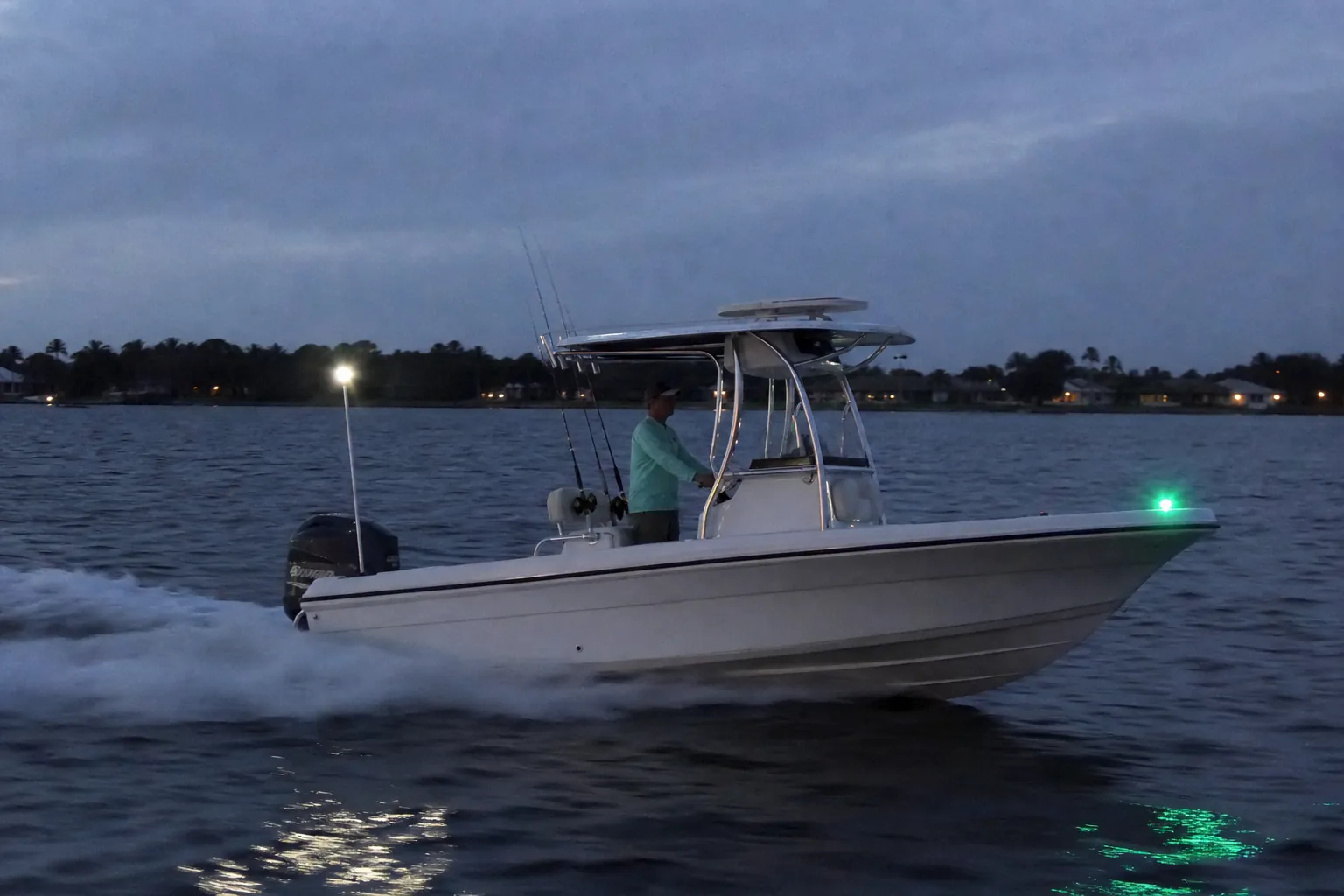
- A powerboat under 12 meters (39.4 feet) that is underway: red and green sidelights plus either a masthead light and a sternlight, or one all-round white light (Rule 23).
- A sailboat under sail: sidelights and a sternlight, with no masthead light (Rule 25).
- A kayak, canoe or rowboat: at minimum, a white light ready at hand to show in time to prevent a collision.
- Any boat at anchor: an all-round white light where it can best be seen (Rule 30), with a narrow exemption for very small boats.
- A jet ski: it may not be operated at all from half an hour after sunset to half an hour before sunrise (section 327.39(3)).
The sections below explain each light, how far it has to be seen, and what a stop by a marine officer can cost you.
Where Florida's Light Rules Come From
Florida does not write its own lighting tables. Section 327.33(3) says each person operating a vessel on Florida waters shall comply with the navigation rules, and section 327.02 defines those rules as the International Navigational Rules for waters outside the lines of demarcation in 33 CFR part 80, and the Inland Navigational Rules in 33 CFR parts 83 to 90 for all waters inside those lines.
The FWC equipment pages for vessels under 16 feet and vessels 16 to 26 feet point boaters to the same place: the U.S. Coast Guard Navigation Rules specify lighting requirements for every description of watercraft, and you should review Rules 20 through 25 for your type of vessel.
So the practical rulebook for most Florida boating is the Inland Rules, Rules 20 to 31, published at 33 CFR 83.20 and following. Every light in this guide comes from those rules. The same rulebook covers right-of-way, which our boat navigation rules and right-of-way guide walks through, and horn signals, covered in our boat sound signals guide.
When You Must Show Navigation Lights
Rule 20 sets the hours:
- Sunset to sunrise. The rules concerning lights shall be complied with from sunset to sunrise.
- Restricted visibility in daylight. The lights, if carried, shall also be shown from sunrise to sunset in restricted visibility. Rule 3 defines restricted visibility as any condition in which visibility is restricted by fog, mist, falling snow, heavy rainstorms, sandstorms or similar causes.
- Any other time you think it is needed. Rule 20 allows lights in all other circumstances when it is deemed necessary.
Rule 20 also limits other lights. From sunset to sunrise, no other lights shall be shown except lights that cannot be mistaken for navigation lights, do not impair their visibility or distinctive character, and do not interfere with keeping a proper lookout. A bright cockpit light or a deck flood that washes out your sidelights, or blinds the person at the helm, works against that rule.
Florida adds one more limit. Section 327.50(3) prohibits sirens or flashing, occulting or revolving lights on any vessel, except as the navigation rules or their annexes expressly provide. Decorative strobes and party lights that flash belong in that category.
The Lights and What Each One Means
Rule 21 defines each light by color and by the arc of the horizon it shines across. The arcs are what let another boater tell, from your lights alone, which way you are pointed.
| Light | Color | Arc it shows | Where it is placed |
|---|---|---|---|
| Masthead light | White | 225 degrees, from dead ahead to 22.5 degrees abaft the beam on each side | Over the fore and aft centerline |
| Sidelights | Green on the starboard (right) side, red on the port (left) side | 112.5 degrees each, from dead ahead to 22.5 degrees abaft the beam on its side | On each side, or combined in one lantern on boats under 20 meters |
| Sternlight | White | 135 degrees, 67.5 degrees from dead astern on each side | As nearly as practicable at the stern |
| All-round light | Any color the rule calls for | 360 degrees | Where it can best be seen |
Put together, the pattern reads like this. If you see a red and a green light together with white above, the boat is pointed at you. A single red or green light with white means you are seeing that boat from one side. A lone white light can mean the boat is moving away from you, or that it is anchored. The full meaning of each combination for who gives way is in our right-of-way guide.
On a boat under 12 meters, Rule 21 lets the masthead light sit as nearly as practicable to the centerline, and a combined red and green bow light must be placed as nearly as practicable to the centerline too. That is why most small powerboats carry one bicolor light on the bow. Pontoons follow the same rules, and our pontoon boat navigation lights guide covers the pontoon setups, biminis and fold-down light poles.
Powerboats Underway: The Lights Most Florida Boaters Need
Most recreational boats in Florida are power-driven and under 12 meters, which the FWC equipment pages give as 39.4 feet. Rule 23 gives a power-driven vessel underway two ways to light up.
The standard set (Rule 23(a)):
- A masthead light forward.
- Sidelights.
- A sternlight.
A second masthead light, set higher and further aft, is required only on vessels 50 meters or longer. A smaller boat may carry one but does not have to.
The small-boat option (Rule 23(d)): a power-driven vessel of less than 12 meters may instead show an all-round white light and sidelights. This is the familiar setup on center consoles, bay boats and bowriders: a red and green bow light plus a white light on a pole at the stern that shines all the way around. How high that pole has to sit above the sidelights, and what a T-top or rod rack does to it, is in our boat pole lights guide.
Either setup is legal for a boat under 12 meters. What matters is that every light works. Under section 327.50(2) the lights must be properly serviceable, so a burned-out bulb or a corroded plug can turn a legal boat into an illegal one at sunset.
"Underway" matters here. Rule 3 says a vessel is underway when it is not at anchor, made fast to the shore or aground. A boat drifting with the engine off is still underway and still shows its running lights.
How Far Your Lights Must Be Seen
Rule 22 sets the minimum range at which each light has to be visible, based on boat length.
| Light | Under 12 meters | 12 to under 50 meters |
|---|---|---|
| Masthead light | 2 miles | 5 miles (3 miles if under 20 meters) |
| Sidelight | 1 mile | 2 miles |
| Sternlight | 2 miles | 2 miles |
| All-round white light | 2 miles | 2 miles |
Rule 20 says the lights must also meet the technical specifications in Annex I, 33 CFR part 84. When you replace a fixture, buy one rated for your boat's length and the range above, and mount it so the boat's own structure, a T-top or an outboard cowling does not block its arc. A light hidden behind a canvas bimini or a fishing tower fails the same test as a light that is off.
Sailboats, Kayaks, Canoes and Paddleboards
Rule 25 covers sailing vessels and vessels under oars.
- Sailboats under sail show sidelights and a sternlight. A sailboat under 20 meters may combine all three in one lantern at or near the top of the mast. A sailboat may add two all-round lights at the masthead, red over green, but not together with the combined masthead lantern.
- Small sailboats under 7 meters (about 23 feet) shall show those lights if practicable. If not, they shall show an all-round white light or have ready at hand an electric torch or lighted lantern showing a white light, shown in time to prevent a collision.
- Vessels under oars, which covers canoes, kayaks and rowboats, may show the sailing lights. If they do not, they shall show an all-round white light or have that white light ready at hand to show in time.
Rule 3 treats a sailboat using its engine as a power-driven vessel, so when motoring it shows the powerboat lights from Rule 23, including a masthead light.
For a paddler, the practical answer is a bright white flashlight or headlamp within reach, switched on early when a boat approaches.
Lights at Anchor
Rule 30 covers anchoring, and it is the rule people forget when they stop for the evening on a sandbar or anchor to watch fireworks.
- The basic rule: a vessel at anchor shows an all-round white light in the fore part and a second, lower all-round white light at or near the stern.
- Boats under 50 meters: may show one all-round white light where it can best be seen instead. For nearly every recreational boat, this is the anchor light.
- Boats under 7 meters: are not required to show anchor lights when anchored somewhere other than in or near a narrow channel, fairway or anchorage, or where other vessels normally navigate.
- Boats under 20 meters in a special anchorage area designated by the Coast Guard are not required to show anchor lights.
On a small powerboat, the all-round white light on the stern pole usually doubles as the anchor light: switch the sidelights off and leave the white light on. If you anchor near a channel or a busy stretch of the Intracoastal Waterway, the under-7-meter exemption does not apply, so keep that light burning. Anglers who drift or anchor after dark will find the drift and anchor light switch, and why fishing lights are off limits for rod and reel boats, in our boat lights for night fishing guide.
A vessel aground under 12 meters is excused from the extra red aground lights, but still shows its anchor light under Rule 30(d) and (f).
Jet Skis After Dark
Personal watercraft have their own Florida rule that overrides the lighting question for most of the night. Under section 327.39(3), a person may not operate a personal watercraft at any time from one-half hour after sunset to one-half hour before sunrise. The FWC puts it plainly on its regulations page: personal watercraft may not be operated during those hours even if navigation lights are used.
That leaves two short windows at each end of the day. The FWC says federal and state laws require navigation lights on a PWC from sunset to a half hour after sunset, and from a half hour before sunrise to sunrise. If your jet ski has no lights, plan to be off the water by sunset. Our Florida jet ski and PWC laws guide covers the other PWC rules, such as the minimum operator age.
What Happens If Your Lights Are Out
Section 327.73(1) lists violations of section 327.50(1) and (2), the safety equipment, lights and shapes rules, as noncriminal infractions. The same section sets the civil penalty for such an infraction at $100, except where the section provides otherwise.
If the problem goes further than a dead bulb and you break the navigation rules themselves, section 327.33(3) and section 327.73 apply:
| Situation | How Florida treats it |
|---|---|
| Lights or required shapes missing or not serviceable | Noncriminal infraction under 327.73(1)(m) |
| Navigation rules violation with no accident, or an accident without serious injury or death | Noncriminal infraction, up to $500 for a first offense, $1,000 for a second and $1,500 for a third or later |
| Navigation rules violation that causes a boating accident with serious bodily injury or death | Second degree misdemeanor, unless it amounts to reckless operation |
Section 327.33(4) also says fault in boating accidents is decided by the navigation rules, so running without proper lights can count against you after a collision as well as at a stop. How a boating citation moves through court is covered in our Florida boating tickets guide, and what to do after a crash is in our boating accident reporting guide.
A Night Light Check Before You Leave the Dock
A short routine keeps you inside the rules:
- Switch every navigation light on at the dock, even on a day trip. A late return or a passing squall can put you on the water in restricted visibility.
- Walk around the boat and look. Red on the left, green on the right, white at the stern or on the pole, each one bright and unobstructed.
- Check the anchor light separately. Turn the sidelights off and confirm the all-round white still works.
- Carry spare bulbs or a spare light, plus a white flashlight that works as a backup under the small-vessel rules.
- Keep cockpit and deck lights low so they do not hide your navigation lights or spoil the helm's night vision, as Rule 20 requires.
- Know your sunset time if you ride a jet ski, and be off the water within half an hour of it.
Lights are one item on the full Florida carry list. The rest, from life jackets to visual distress signals, is in our Florida boat safety equipment checklist. If you rent, the operator is responsible for the lights the same way an owner is, and our Florida boat rental rules guide covers what else to check before you take a rental out.
Learning the Navigation Rules
Navigation lights are part of the navigation rules taught in every Florida boating safety course, the course behind the Boating Safety Education ID Card that most Florida boaters call a boating license. If you boat around North Miami after dark, our North Miami night navigation guide adds local detail.
Boat Skill is preparing an online exam for the Florida temporary boating certificate, the one renters call the jet ski test, and enrollment opens soon. Get notified when Boat Skill enrollment opens. Our boating resources page previews the lesson topics for free.
Sources
- Florida Statute 327.50: Vessel safety regulations; equipment and lighting requirements
- Florida Statute 327.33: Reckless or careless operation; navigation rules
- Florida Statute 327.02: Definitions (navigation rules)
- Florida Statute 327.39: Personal watercraft regulated
- Florida Statute 327.73: Noncriminal infractions
- FWC: Boating regulations, equipment and lighting requirements
- FWC: Equipment for vessels under 16 feet
- FWC: Equipment for vessels 16 to 26 feet
- 33 CFR 83.03: Definitions (Rule 3)
- 33 CFR 83.20: Application of the lights rules (Rule 20)
- 33 CFR 83.21: Definitions of lights (Rule 21)
- 33 CFR 83.22: Visibility of lights (Rule 22)
- 33 CFR 83.23: Power-driven vessels underway (Rule 23)
- 33 CFR 83.25: Sailing vessels and vessels under oars (Rule 25)
- 33 CFR 83.30: Vessels anchored and aground (Rule 30)
Common questions
When are navigation lights required on a boat in Florida?
From sunset to sunrise, and during periods of reduced visibility such as fog, rain or haze, according to the FWC. Rule 20 of the Inland Navigation Rules sets the same hours, and Florida Statute 327.50(2) requires every vessel to be equipped with properly serviceable lights required by the navigation rules.
What navigation lights does a small powerboat need?
A power-driven boat under 12 meters (39.4 feet) that is underway may show either a masthead light, red and green sidelights and a sternlight, or an all-round white light plus red and green sidelights. Both options come from Rule 23 of the Inland Navigation Rules.
Which side is the red light on a boat?
Red is on the port (left) side and green is on the starboard (right) side. Rule 21 defines each sidelight as showing from dead ahead to 22.5 degrees abaft the beam on its own side.
How far away must boat navigation lights be visible?
On a boat under 12 meters, Rule 22 requires a masthead light visible at 2 miles, sidelights at 1 mile, a sternlight at 2 miles and an all-round white light at 2 miles. Longer boats have longer minimum ranges.
Do kayaks and canoes need navigation lights in Florida?
A vessel under oars may show sailing lights, but if it does not, Rule 25 says it shall show an all-round white light or have an electric torch or lighted lantern showing a white light ready at hand, shown in time to prevent a collision.
Do I need an anchor light at night?
Yes, in most cases. Rule 30 lets a boat under 50 meters show one all-round white light where it can best be seen. Boats under 7 meters are excused only when anchored away from narrow channels, fairways, anchorages and places where other vessels normally navigate.
Can I ride a jet ski at night in Florida if it has lights?
No. Florida Statute 327.39(3) bars operating a personal watercraft from one-half hour after sunset to one-half hour before sunrise, and the FWC says this applies even if navigation lights are used. Lights are required in the half hour after sunset and the half hour before sunrise.
What is the fine for no navigation lights in Florida?
Section 327.73 lists violations of the lights and shapes rule in section 327.50(2) as a noncriminal infraction, with a civil penalty of $100 unless the section provides otherwise. A navigation rules violation can carry up to $500 for a first offense, and more if it causes a serious accident.