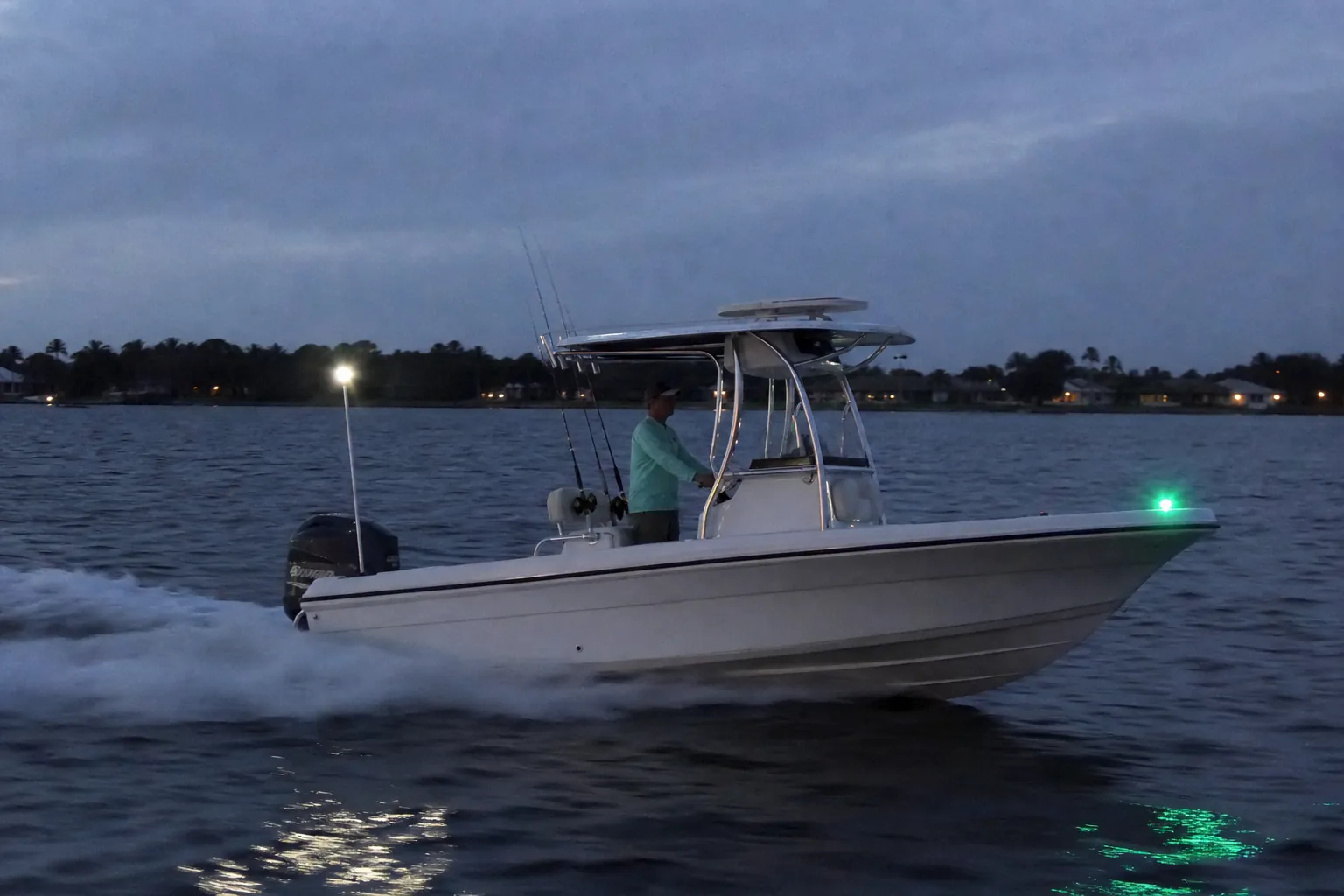

Pontoon boat navigation lights in Florida follow the same rules as any other motorboat, because a pontoon with an outboard is a power-driven vessel under Rule 3 of the Inland Navigation Rules. The FWC says recreational vessels are required to display navigation lights between sunset and sunrise and during periods of reduced visibility, such as fog, rain or haze (FWC boating regulations), and Florida Statute 327.50(2) says no person shall operate a vessel unless it is equipped with properly serviceable lights required by the navigation rules.
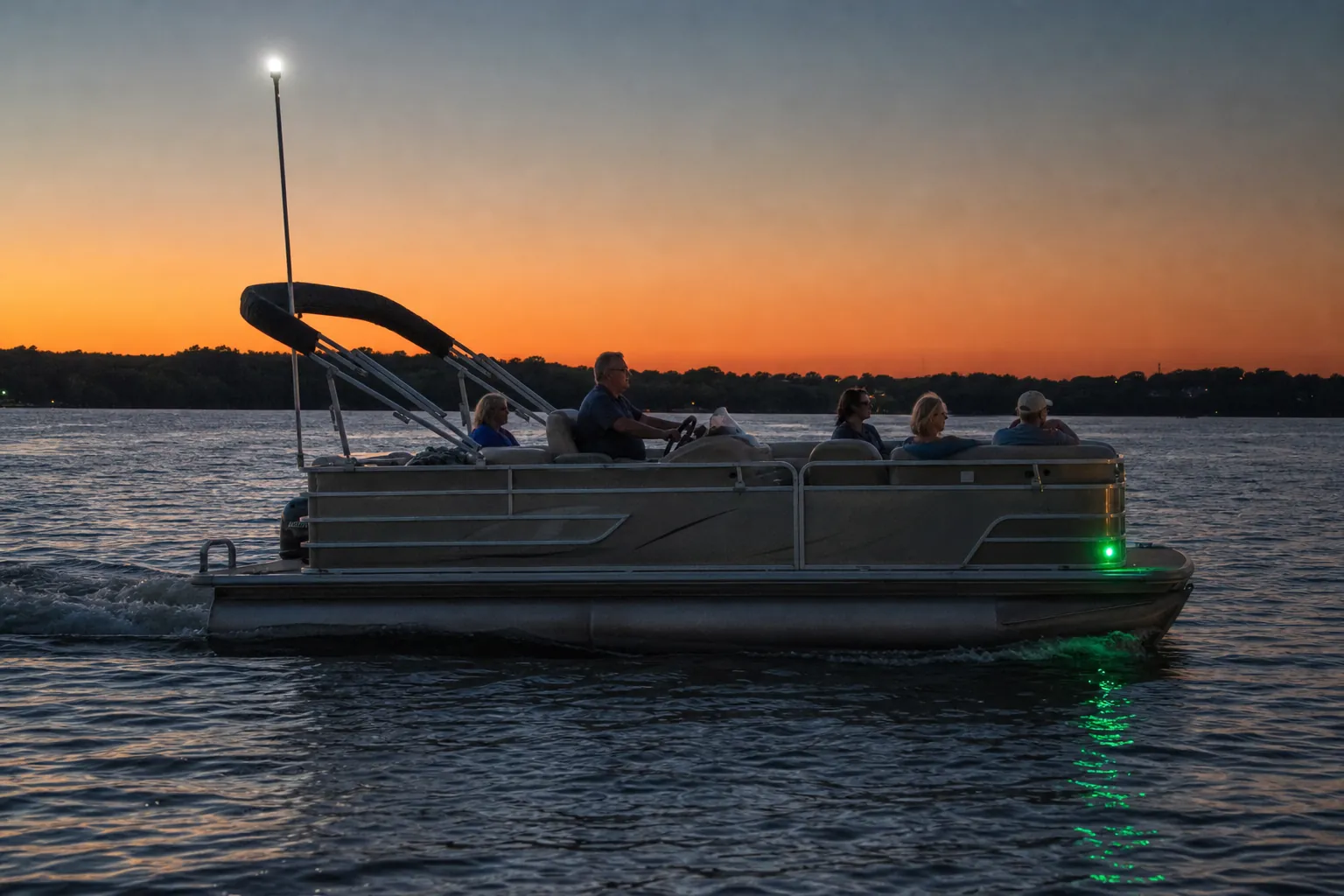
For a pontoon under 12 meters (about 39.4 feet) that means:
- Underway at night: red and green sidelights plus one all-round white light, or red and green sidelights plus a white masthead light and a white sternlight (Rule 23).
- At anchor at night: one all-round white light where it can best be seen (Rule 30).
- Every light unbroken: the all-round white light has to show around the full 360 degrees (Rule 21), which is where pontoon biminis, arches and fold-down poles cause trouble.
- No flashing or revolving lights: section 327.50(3) prohibits them except where the navigation rules allow them.
The sections below walk through each of these on a pontoon deck, from the sunset cruise to the night at the sandbar. For the light rules of every other kind of boat, see our boat navigation lights rules guide.
Why a Pontoon Uses the Powerboat Light Rules
Florida does not write separate light rules for pontoons. Section 327.33(3) says each person operating a vessel on Florida waters shall comply with the navigation rules, and section 327.02 defines those as the International Navigational Rules outside the lines of demarcation and the Inland Navigational Rules in 33 CFR parts 83 to 90 for all waters inside them.
The FWC equipment pages for boats under 16 feet and boats 16 to 26 feet send you to the same place: the Coast Guard Navigation Rules specify lighting requirements for every description of watercraft, and you should review Rules 20 through 25 for your type of vessel.
The type question is short for a pontoon. Rule 3 defines a power-driven vessel as any vessel propelled by machinery, so a pontoon with an outboard or inboard motor takes the powerboat lights in Rule 23. The pontoon hull shape, the open deck and the rails change nothing in the rule. They do change where the lights sit and what gets in their way, which is what most of this guide is about.
When the Lights Have to Be On
Rule 20 sets three times:
- From sunset to sunrise. This is the window for every pontoon sunset cruise, fireworks trip and late ride back from the sandbar.
- In restricted visibility during the day. The lights, if carried, shall also be shown from sunrise to sunset in restricted visibility. Rule 3 defines restricted visibility as any condition where visibility is restricted by fog, mist, falling snow, heavy rainstorms, sandstorms or similar causes. A summer afternoon downpour on a lake counts.
- Any other time you think they are needed. Rule 20 allows the lights in all other circumstances when it is deemed necessary.
The rules for lights apply while you are underway, and "underway" is broader than many pontoon owners expect. Rule 3 says a vessel is underway when it is not at anchor, made fast to the shore or aground. A pontoon drifting with the motor off while the group swims or watches the sky is still underway, so its running lights stay on. Once the anchor is down, the anchor light rules take over, covered below.
The Two Legal Light Setups on a Pontoon
Rule 23 gives a power-driven vessel underway a standard set of lights, and gives boats under 12 meters a second option. A pontoon under 12 meters may use either one.
| Setup | Lights | Where you usually see it on a pontoon | Rule |
|---|---|---|---|
| All-round white plus sidelights | Red and green sidelights forward, one white light that shines all the way around | A combined red and green light at the bow and a white light on a pole near the stern | Rule 23(d), for vessels under 12 meters |
| Masthead, sidelights and sternlight | A white masthead light forward, red and green sidelights, a white sternlight aft | A white light up high that shines forward and to the sides, and a separate white light at the stern that shines aft | Rule 23(a) |
Rule 23(a) also mentions a second masthead light, set aft of and higher than the first. A vessel under 50 meters is not obliged to show it, so a pontoon can leave it off.
To tell which setup your pontoon has, switch the lights on at the dock and walk around it. If the stern light shines forward over the deck as well as behind the boat, you have the all-round white light and the first setup. If one white light shines only aft and another shines only forward, you have the second. Either one is legal as long as all of the lights work and each one shows across its full arc.
A pontoon 12 meters or longer cannot use the all-round option and must use the Rule 23(a) set with longer visibility ranges, covered in the next section.
Where the Lights Sit and What Blocks Them
Each light in Rule 21 is defined by its color and the arc of the horizon it covers. That arc is the part pontoons tend to break.
- Sidelights: green on the starboard (right) side, red on the port (left) side, each showing an unbroken light over 112.5 degrees, from right ahead to 22.5 degrees abaft the beam on its own side. On a vessel under 20 meters the two may be combined in one lantern, and on a vessel under 12 meters that combined lantern goes as nearly as practicable to the fore and aft centerline. So a combined red and green light belongs at the center of the bow.
- Masthead light: white, an unbroken 225 degrees from right ahead to 22.5 degrees abaft the beam on either side, placed as nearly as practicable to the centerline on a vessel under 12 meters.
- Sternlight: white, an unbroken 135 degrees, 67.5 degrees from right aft on each side, placed as nearly as practicable at the stern.
- All-round light: an unbroken light over 360 degrees.
The word that matters is "unbroken." On a pontoon, the things that break the arc are easy to spot once you look for them:
- The bimini top. With the top up, check the all-round white light from the bow. If the canvas or the frame hides it from ahead, the light is not all-round.
- A tower or arch. A ski tow arch or a tall frame near the stern can throw a shadow across part of the circle.
- People and gear. Passengers standing at the stern rail, a cooler stacked on the back deck or a fishing rod holder can block a low-mounted light.
- The bow gate and rails. A sidelight mounted low on the bow fence can be hidden by the rail panels from some angles.
Fold-down light poles. If your pontoon carries the all-round white light on a pole that folds or lifts out for storage and covers, keep the rule in mind: Rule 20 says a vessel's navigation lights may be lowered if necessary to pass under a bridge. Outside that case, the pole goes up at sunset and stays up while you are underway or at anchor. Annex I adds two limits: on a boat under 12 meters the all-round light is carried at least one meter higher than the sidelights, and nothing may hide it across more than 6 degrees (33 CFR 84.02 and 84.05). Our boat pole lights guide covers both.
How bright the lights have to be. Rule 22 sets minimum ranges by length:
| Light | Pontoon under 12 meters | Pontoon 12 to under 20 meters |
|---|---|---|
| Masthead light | 2 miles | 3 miles |
| Sidelights | 1 mile | 2 miles |
| Sternlight | 2 miles | 2 miles |
| All-round white light | 2 miles | 2 miles |
When you replace a fixture, buy one rated for your pontoon's length and these ranges. Rule 20 also says the lights must meet the technical specifications in Annex I, 33 CFR part 84.
Deck Lights, Underglow and Party Lights
Courtesy lights in the floor, lights under the tubes, rope lights along the rails and speaker lights that change color with the music are common add-ons. The rules do not ban extra lighting, but they put two limits on it.
Rule 20 limits what else you show at night. From sunset to sunrise, Rule 20(b) says no other lights shall be shown except lights that cannot be mistaken for the navigation lights, do not impair their visibility or distinctive character, and do not interfere with keeping a proper lookout. In practice:
- Red or green accent lights near the bow can be confused with sidelights by a boater looking at you from a distance.
- Bright white lights along the rail can wash out your all-round white light or make the boat's direction hard to read.
- Any light that shines into the operator's eyes works against the lookout the helm has to keep.
Florida bans flashing and revolving lights. Section 327.50(3) prohibits sirens or flashing, occulting or revolving lights on any vessel, except as expressly provided in the navigation rules or their annexes. Light shows that strobe, chase or flash in time with music fall into that category.
A simple habit covers both limits: when the pontoon is moving after dark, switch the accent and party lighting off, keep the floor courtesy lights low, and leave only the navigation lights shining outward.
Anchored at the Sandbar or the Sunset Spot
When the pontoon stops for the evening, Rule 30 sets the light for it.
- The general rule: a vessel at anchor shows an all-round white light in the fore part and a second, lower all-round white light at or near the stern.
- Vessels under 50 meters, which covers every recreational pontoon, may instead show one all-round white light where it can best be seen. On a pontoon with the Rule 23(d) setup, that is usually the same white light on the stern pole: turn the sidelights off and leave the white light on. Fishing from the pontoon after dark? Our boat lights for night fishing guide explains why a drifting boat keeps its sidelights on.
- Vessels under 7 meters (about 23 feet) are not required to show the anchor light when anchored somewhere other than in or near a narrow channel, fairway or anchorage, or where other vessels normally navigate.
- Vessels under 20 meters anchored in a special anchorage area designated by the Coast Guard are not required to show anchor lights.
The under-7-meter exemption is narrow. A popular sandbar near a channel, a busy stretch of the Intracoastal Waterway or a crowded fireworks anchorage is exactly the kind of place where other vessels normally navigate, so the light stays on. If your pontoon has the Rule 23(a) setup with a sternlight that only shines aft, check that you have a white light that can show all the way around once you anchor.
Running aground is treated the same way for small boats. A vessel aground shows its anchor light, and Rule 30(f) excuses vessels under 12 meters from the extra red aground lights.
Who Can Drive the Pontoon After Dark
The person at the helm on a night cruise is the operator, and Florida's operator rules apply at night exactly as they do by day.
Section 327.395 says a person born on or after January 1, 1988 may not operate a vessel powered by a motor of 10 horsepower or more unless they have photographic identification and the Florida boating safety identification card, or one of the other documents the statute lists, aboard the vessel. Check the horsepower rating on your motor against that line. Our guide to driving a pontoon in Florida covers who needs the card and the rental exceptions, and our Florida boat rental rules guide covers what to check before you take out a rented pontoon.
Families often take pontoons out for sunsets. Section 327.50(1)(b) says a person may not operate a vessel under 26 feet unless every person under 6 years of age aboard is wearing a personal flotation device while the vessel is underway, and the statute counts a drifting boat as underway too. The rest of the carry list is in our Florida boat safety equipment checklist.
Fines for Pontoon Light Violations
Dead or missing lights are a ticket in Florida. Section 327.73(1)(m) lists violations of section 327.50(1) and (2), the safety equipment, lights and shapes rules, as noncriminal infractions, and the same section sets the civil penalty for such an infraction at $100 unless it provides otherwise.
Breaking the navigation rules themselves is handled under section 327.33(3):
| Situation | How Florida treats it |
|---|---|
| Lights not serviceable or missing | Noncriminal infraction under 327.73(1)(m), $100 civil penalty |
| Navigation rules violation with no accident, or an accident without serious bodily injury or death | Noncriminal infraction, up to $500 for a first offense, $1,000 for a second and $1,500 for a third or later |
| Navigation rules violation that causes an accident with serious bodily injury or death, short of reckless operation | Second degree misdemeanor |
Section 327.33(4) adds that fault in boating accidents is determined according to the navigation rules. A pontoon that was hit at night while its all-round light was hidden behind the bimini can share the fault. How a citation moves through court is in our Florida boating tickets guide.
Reading Other Boats From the Pontoon Helm
Showing the right lights is half the job. The other half is reading the lights coming at you. A red and green light together means a boat is pointed at you, a single red or green light means you are seeing it from one side, and a lone white light can mean a boat moving away or one at anchor. Rule 7 adds the test every helm should use: risk of collision is deemed to exist if the compass bearing of an approaching vessel does not appreciably change.
When your pontoon is the one that has to keep clear, Rule 16 asks for early and substantial action to keep well clear, which on a dark night means slowing down or turning well before the other boat is close. The full crossing, meeting and overtaking rules are in our right-of-way guide, and the horn signals that go with them are in our boat sound signals guide.
A Pontoon Night Light Check
Run through this before any trip that could end after sunset:
- Raise the light pole and lock it in place before you leave the dock.
- Switch on the navigation lights and walk the deck: red on the left at the bow, green on the right, white on the stern pole or at the stern.
- Put the bimini in the position you will run with and check the white light from the bow and both sides. If the canvas hides it, move the top or the light.
- Check the anchor light by turning the sidelights off and confirming the white light still shows all the way around.
- Turn off strobing or color-changing deck lights for the ride and keep courtesy lights low.
- Pack a spare bulb or spare light and a white flashlight, so a failed fixture does not leave you dark far from the ramp.
- Check the operator's card and photo ID if the person at the helm was born on or after January 1, 1988.
If you tow the pontoon home, the trailer has its own set of road lights, covered in our Florida boat trailer laws guide.
Learning the Navigation Rules
Navigation lights are part of the navigation rules taught in every Florida boating safety course, the course behind the Boating Safety Education ID Card that most Florida boaters call a boating license.
You can preview lesson topics for free on our boating resources page.
Get notified when Boat Skill enrollment opens
Sources
- Florida Statute 327.50: Vessel safety regulations; equipment and lighting requirements
- Florida Statute 327.33: Reckless or careless operation; navigation rules
- Florida Statute 327.02: Definitions (navigation rules)
- Florida Statute 327.395: Boating safety education
- Florida Statute 327.73: Noncriminal infractions
- FWC: Boating regulations, equipment and lighting requirements
- FWC: Equipment for vessels under 16 feet
- FWC: Equipment for vessels 16 to 26 feet
- 33 CFR 83.16: Action by give-way vessel (Rule 16)
- 33 CFR part 84: Annex I, positioning and technical details of lights and shapes
- 33 CFR 83.03: Definitions (Rule 3)
- 33 CFR 83.07: Risk of collision (Rule 7)
- 33 CFR 83.20: Application of the lights rules (Rule 20)
- 33 CFR 83.21: Definitions of lights (Rule 21)
- 33 CFR 83.22: Visibility of lights (Rule 22)
- 33 CFR 83.23: Power-driven vessels underway (Rule 23)
- 33 CFR 83.30: Vessels anchored and aground (Rule 30)
Common questions
What navigation lights does a pontoon boat need at night in Florida?
A pontoon under 12 meters (about 39.4 feet) that is underway may show red and green sidelights plus one all-round white light, or red and green sidelights plus a white masthead light and a white sternlight. Both options come from Rule 23 of the Inland Navigation Rules, which Florida Statute 327.33(3) requires every operator to follow.
When do pontoon navigation lights have to be on?
From sunset to sunrise, and during the day in restricted visibility such as fog, mist or heavy rain. The FWC says recreational vessels must display navigation lights between sunset and sunrise and during periods of reduced visibility, and Rule 20 sets the same hours.
Can my pontoon bimini top block the stern light?
It can, and that makes the light fail the rule. Rule 21 defines an all-round light as an unbroken light over 360 degrees. If the bimini, an arch or gear on the back deck hides the white light from any direction, check it with the top up and move the top or the light.
Can I fold down the light pole on my pontoon while underway?
Only to pass under a bridge. Rule 20 says navigation lights may be lowered if necessary to pass under a bridge. From sunset to sunrise and in restricted visibility the pole should be up whenever the pontoon is underway or at anchor.
Does a pontoon need an anchor light at the sandbar?
In most cases, yes. Rule 30 lets a vessel under 50 meters show one all-round white light where it can best be seen. Vessels under 7 meters are excused only when anchored away from narrow channels, fairways, anchorages and places where other vessels normally navigate.
Are LED underglow or party lights legal on a pontoon?
Extra lights are allowed only if they cannot be mistaken for navigation lights, do not impair them and do not interfere with keeping a lookout, under Rule 20. Florida Statute 327.50(3) also prohibits flashing, occulting or revolving lights on any vessel except as the navigation rules provide, so strobing or flashing light shows are out.
What is the fine for no navigation lights on a pontoon in Florida?
Section 327.73(1)(m) makes a violation of the lights rule in section 327.50(2) a noncriminal infraction, and the section sets the civil penalty at $100 unless it provides otherwise. A navigation rules violation under section 327.33(3)(b) can carry up to $500 for a first offense.
Do I need a boating safety card to drive a pontoon at night?
If you were born on or after January 1, 1988 and the pontoon's motor is 10 horsepower or more, Florida Statute 327.395 requires you to carry photo ID and the Florida boating safety identification card or another document the statute accepts, day or night.