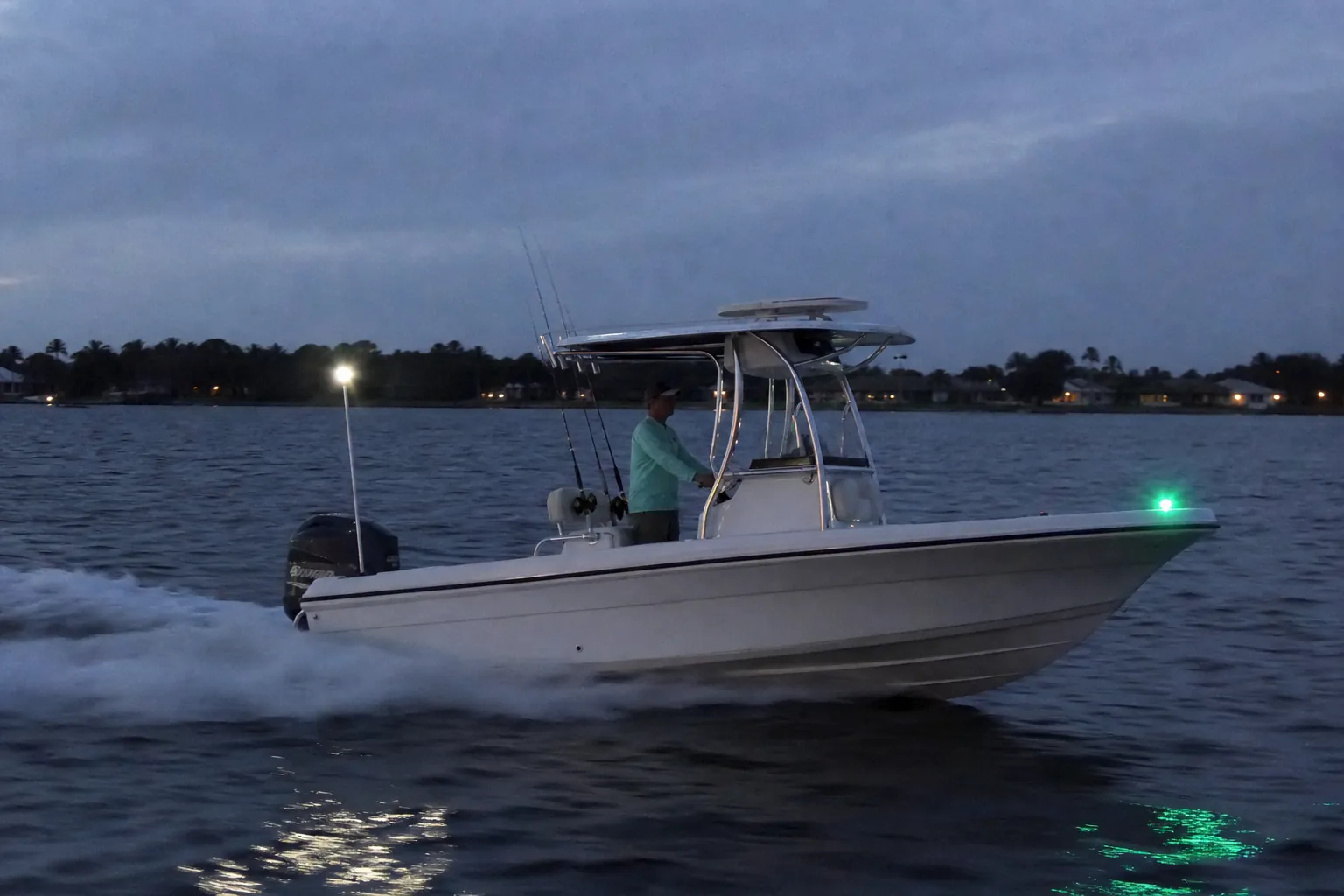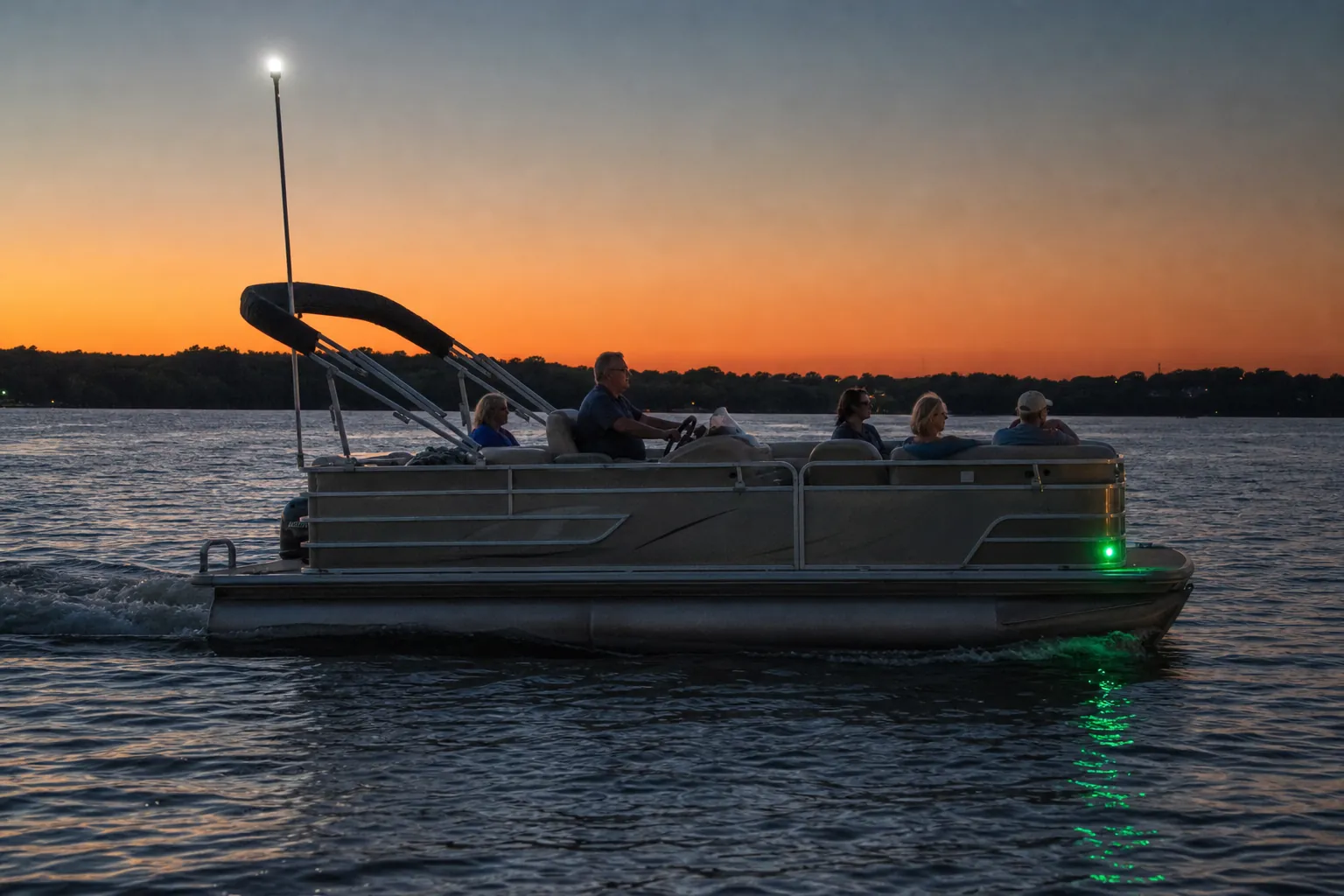

A boat pole light is the white light on a pole near the stern that shines in every direction. The navigation rules call it an all-round light: a light showing an unbroken light over an arc of the horizon of 360 degrees (Rule 21(e)). Florida makes those rules the law on its waters: section 327.33(3) says each person operating a vessel on the waters of this state shall comply with the navigation rules, and section 327.50(2) bars operating a vessel without properly serviceable lights and shapes required by those rules.
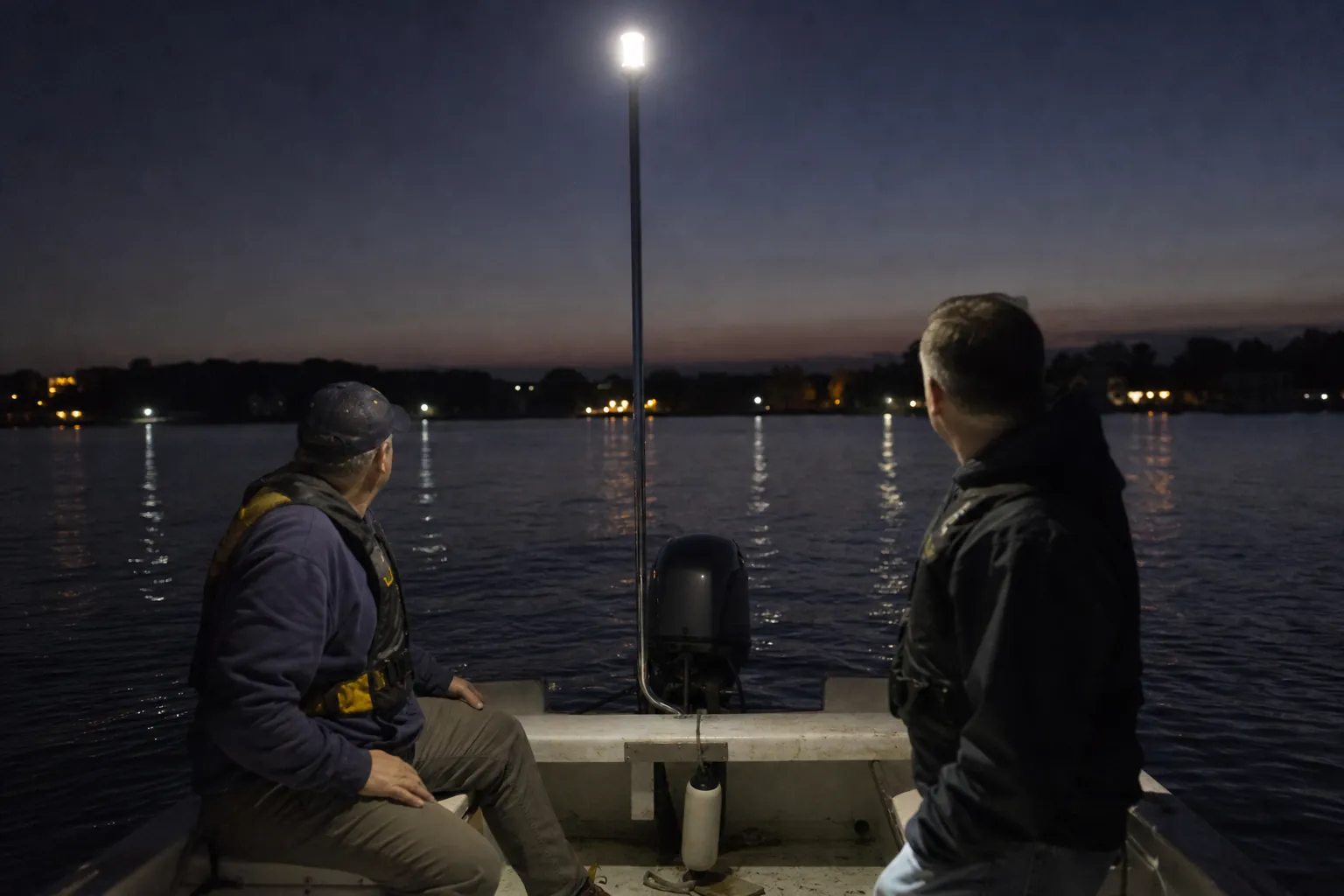
On a powerboat under 12 meters (about 39.4 feet), the pole light does two jobs:
- Underway at night: the all-round white light plus red and green sidelights can replace the separate masthead light and sternlight (Rule 23(d)).
- At anchor at night: one all-round white light where it can best be seen is enough on a boat under 50 meters (Rule 30(b)).
Three details decide whether your pole light is legal: it has to sit at least one meter higher than the sidelights (33 CFR 84.02(d)), it has to be visible for 2 miles (Rule 22(c)), and nothing on the boat can block it within a sector of more than 6 degrees (33 CFR 84.15(b)). This guide covers the pole light itself. For the full set of lights every kind of boat shows, read our boat navigation lights rules guide.
Which Rules Apply on Florida Water
Florida does not write its own light rules. Section 327.02 defines "navigation rules" two ways: on waters outside the lines of demarcation in 33 CFR part 80, the International Navigational Rules; on all waters inside those lines, the Inland Navigational Rules in 33 CFR parts 83 to 90. The Inland rules are the ones quoted in this guide. The lines themselves are drawn in 33 CFR part 80, so if you fish or cruise offshore past them, check the International rules for your boat.
The FWC points boaters to the same text. Its equipment pages for boats under 16 feet and boats 16 to 26 feet say recreational vessels are required to display navigation lights between sunset and sunrise and during periods of reduced visibility such as fog, rain or haze, and tell you to review Coast Guard Navigation Rules 20 through 25 for your type of vessel.
Rule 20 sets the hours: the light rules apply from sunset to sunrise, and the lights shall also be shown from sunrise to sunset in restricted visibility. A pole light that lives in a rod holder all day has to be up and on before the sun goes down.
Job One: The White Light While Underway
The standard setup for a power-driven vessel underway in Rule 23(a) is a masthead light forward, sidelights and a sternlight. A masthead light is white and shows over 225 degrees, from dead ahead to 22.5 degrees abaft the beam on each side. A sternlight is white and shows over 135 degrees aft (Rule 21). Together the two white lights cover the full circle.
Rule 23(d) gives small boats a shortcut: a power-driven vessel of less than 12 meters may, in lieu of those lights, exhibit an all-round white light and sidelights. That one pole light covers both white sectors at once, which is why a stern pole plus a bow light with red and green lenses is a common setup on small powerboats.
Two limits come with the shortcut:
- Length. It only applies under 12 meters. A powerboat of 12 meters or more shows a separate masthead light and sternlight, and on a boat of 12 to 20 meters the masthead light has to sit at least 2.5 meters above the gunwale (33 CFR 84.02(c)).
- Power-driven only. Rule 3 defines a power-driven vessel as any vessel propelled by machinery. A sailboat under sail alone shows sidelights and a sternlight under Rule 25, and it counts as a sailing vessel only while its engine is not being used. Motor-sailing puts it back under the powerboat rules, pole light included if it is under 12 meters.
Job Two: The Anchor Light
Rule 30(a) gives a vessel at anchor two all-round white lights, one forward and a lower one at the stern. Rule 30(b) lets a vessel of less than 50 meters show one all-round white light where it can best be seen instead. On a small boat that is the same pole light you run with: switch the sidelights off and leave the white light burning.
Why the sidelights go off: red and green tell other boats you are underway and which way you are pointed. A boat swinging on its anchor line is not underway, and Rule 3(i) defines underway as not at anchor, made fast to the shore or aground. Leaving the bow light on at anchor tells approaching boats something false about you. The reverse mistake shows up on a night drift, and our boat lights for night fishing guide explains why a drifting boat keeps its sidelights on.
There are two exemptions worth knowing:
- Under 7 meters, out of the way. Rule 30(e) says a vessel of less than 7 meters at anchor, not in or near a narrow channel, fairway, anchorage, or where other vessels normally navigate, is not required to show anchor lights. In Florida that last phrase covers a lot of water, so a small boat in a busy bay or near a channel should keep the pole light on.
- Special anchorage areas. Rule 30(g) says a vessel of less than 20 meters at anchor in a special anchorage area designated by the Coast Guard is not required to show anchor lights.
For a night on the hook at a sandbar with a pontoon, our pontoon boat navigation lights guide walks through the deck lights and party lights that cause trouble there.
How High the Pole Has to Be
Height is where most homemade and replacement pole setups go wrong. 33 CFR 84.02(d) says the masthead light, or the all-round light described in Rule 23(d), of a power-driven vessel of less than 12 meters shall be carried at least one meter higher than the sidelights. One meter is about 39.4 inches.
The rule measures from the sidelights, not from the deck or the waterline. To check your boat:
- Measure the height of the bow light (or the sidelights, if they sit on the hull sides) above a fixed reference, such as the dock or the gunwale.
- Measure the height of the pole light lens above the same reference with the pole locked in its running position.
- Subtract. The difference has to be at least one meter.
On many boats the bow light sits low on the bow rail and the pole is plenty tall. On boats with a raised casting deck or a bow light mounted high on a T-top leg, a short pole can fall under the line. The sidelights also have a floor of their own: 84.02(g) says a power-driven vessel's sidelights shall not be so low as to be interfered with by deck lights.
The extra height is there so other boats see the white light above the colored ones. From a distance, a white light over a red or green light reads as a powerboat underway. A white light at the same height as the sidelights is harder to read.
What Can Block the Light
An all-round light has to be all-round. 33 CFR 84.15(b)(i) says all-round lights shall be so located as not to be obscured by masts, topmasts or structures within angular sectors of more than 6 degrees. The common blockers on a Florida boat:
- T-tops, hardtops and biminis. If the canopy is taller than the pole, it blocks the light ahead of the boat.
- Outboards tilted up. A trimmed-up engine cowling next to a short stern pole can block part of the circle astern.
- Rod racks, outriggers and antennas. Every tube near the lens takes a slice out of the circle.
- People. An angler standing beside a short pole blocks it for everyone on that bearing.
If one light cannot clear every structure, 84.15(b)(ii) allows two all-round lights suitably positioned or screened so they appear, as far as practicable, as one light at a distance of one nautical mile. The note to that paragraph says two unscreened all-round lights 1.28 meters apart or less will appear as one light to the naked eye at one nautical mile.
Anchor lights get some slack. The same paragraph says anchor lights need not be placed at an impracticable height above the hull, so the obstruction limit is applied with the boat's size in mind. Visibility still applies: Rule 22(c) sets a 2 mile minimum range for a white all-round light on a vessel under 12 meters, and a dim or dirty lens works against you whether you are underway or anchored.
Glare at the Helm
A bright white light just behind the console can wreck your night vision. The rules deal with this. 33 CFR 84.05(b) says that on a power-driven vessel of less than 12 meters constructed after July 31, 1983, the masthead light, or the all-round light described in Rule 23(d), shall be screened to prevent direct illumination of the vessel forward of the operator's position.
In plain words, the pole light should light up the water around you, not your windshield and console. A shade on the forward side of the lens is one way to do that. If you replace the lens or the whole fixture, keep that screening.
Lookout is the reason it matters. Rule 5 says every vessel shall at all times maintain a proper look-out by sight and hearing. Rule 20(b) also bars any other lights at night that impair the visibility or distinctive character of the navigation lights or interfere with keeping a proper lookout. Bright cockpit floods and LED strips pointed at the helm can fail that test as easily as an unscreened pole light.
Removable Poles, Bridges and Storage
Most small-boat pole lights pull out of a socket so they do not get snapped off in the garage, on the trailer or under a cover. That is fine, as long as the pole is in its socket and lit whenever the rules call for it. Section 327.50(2) is about operating with serviceable lights, and a pole sitting in a console locker after sunset does not help.
The rules give you one reason to drop it while underway: Rule 20(f) says a vessel's navigation lights and shapes may be lowered if necessary to pass under a bridge. Lower the pole for the bridge and put it back once you are through.
Things worth checking on a removable pole:
- The socket contacts are clean and dry. Corroded contacts can make a pole light flicker.
- The pole locks in at its full height, so it stays one meter above the sidelights.
- The lens is clear, uncracked and free of salt crust.
- You carry a spare bulb or a spare pole if the fixture is old.
Flicker matters for a legal reason too. Section 327.50(3) prohibits flashing, occulting or revolving lights on any vessel except where the navigation rules allow them. A loose pole that blinks on and off over every wave is a problem to fix before dark.
Kayaks, Canoes and Small Sailboats
Paddlers often ask whether they need a pole light. The answer sits in Rule 25(d):
- A vessel under oars may show the sailing vessel lights, but if it does not, it shall exhibit an all-round white light or have ready at hand an electric torch or lighted lantern showing a white light, exhibited in sufficient time to prevent collision.
- A sailing vessel under 7 meters shall, if practicable, show sidelights and a sternlight, but if it does not, it shall show an all-round white light or have a white torch or lantern ready in the same way.
That is why many night paddlers and kayak anglers mount a short white pole light behind the seat. It covers the all-round white option without anyone having to grab a flashlight in time. A kayak with an electric trolling motor is a different case: Rule 3 counts any vessel propelled by machinery as power-driven.
Fines and Tickets for Pole Light Problems
Florida treats light violations as noncriminal infractions unless something worse happens. Section 327.73(1) lists violations of section 327.50(1) and (2), relating to required safety equipment, lights and shapes, and violations of section 327.33(3)(b), relating to the navigation rules, as noncriminal infractions. The same section sets the civil penalty for such an infraction at $100, except as otherwise provided.
The stakes rise after a crash. Section 327.33(3)(a) says a person who violates the navigation rules where the violation results in a boating accident causing serious bodily injury or death, but does not amount to reckless operation, commits a misdemeanor of the second degree. Section 327.33(4) adds that fault in boating accidents shall be determined according to the navigation rules, so a missing or blocked pole light can weigh on who is at fault.
For how a boating ticket moves through court, read our Florida boating ticket guide.
A Pole Light Check Before Sunset
Run this at the dock, before you need the light:
- Seat the pole in its socket, lock it and switch on the navigation lights.
- Walk all the way around the boat, or look from the dock at several angles, and make sure the white light is visible from every side.
- Check that the pole light sits at least one meter above the bow light.
- Look for anything that cuts into the circle: T-top, bimini, rods, antennas, the tilted motor.
- Stand at the helm and check for glare. The forward screen should keep the light off the console.
- Switch to anchor mode and confirm the sidelights go off while the white light stays on.
- Tap the pole and watch for flicker.
The same check belongs on any boat you rent. Our Florida boat safety equipment checklist covers the rest of the gear by boat length.
Learning the Navigation Rules
Navigation lights are part of the navigation rules taught in every Florida boating safety course, the course behind the Boating Safety Education ID Card that most Florida boaters call a boating license. Under section 327.395, a person born on or after January 1, 1988 may not operate a vessel powered by a motor of 10 horsepower or greater without the card or another document that section allows.
Boat Skill is preparing an online exam for the Florida temporary boating certificate, the one renters call the jet ski test, and enrollment opens soon. Get notified when Boat Skill enrollment opens. Our boating resources page previews the lesson topics for free.
Sources
- Florida Statute 327.33: Reckless or careless operation of vessel (navigation rules)
- Florida Statute 327.50: Vessel safety regulations; equipment and lighting requirements
- Florida Statute 327.02: Definitions (navigation rules)
- Florida Statute 327.73: Noncriminal infractions
- Florida Statute 327.395: Boating safety education
- FWC: Equipment requirements, vessels under 16 feet
- FWC: Equipment requirements, vessels 16 to 26 feet
- 33 CFR 83.03: Definitions (Rule 3)
- 33 CFR 83.05: Look-out (Rule 5)
- 33 CFR 83.20: Application of the light rules (Rule 20)
- 33 CFR 83.21: Light definitions (Rule 21)
- 33 CFR 83.22: Visibility of lights (Rule 22)
- 33 CFR 83.23: Power-driven vessels underway (Rule 23)
- 33 CFR 83.25: Sailing vessels and vessels under oars (Rule 25)
- 33 CFR 83.30: Vessels anchored and aground (Rule 30)
- 33 CFR 84.02: Vertical positioning and spacing of lights
- 33 CFR 84.05: Screens
- 33 CFR 84.15: Horizontal sectors
Common questions
What is a boat pole light?
It is the white all-round light on a pole, usually near the stern, that shows an unbroken light over 360 degrees. On a powerboat under 12 meters it can stand in for the masthead light and sternlight while underway, and it serves as the anchor light when the sidelights are off.
Is a pole light legal instead of a masthead light and stern light in Florida?
Yes, on a power-driven vessel of less than 12 meters. Rule 23(d) of the Inland Navigation Rules lets it exhibit an all-round white light and sidelights in lieu of a masthead light and sternlight, and Florida section 327.33(3) requires operators to follow the navigation rules.
How high does a boat pole light need to be?
On a power-driven vessel under 12 meters, the all-round white light has to be carried at least one meter, about 39.4 inches, higher than the sidelights under 33 CFR 84.02(d). Measure from the sidelights, not from the deck.
How far away must a pole light be visible?
Rule 22(c) sets a minimum range of 2 miles for a white all-round light on a vessel of less than 12 meters.
Can my T-top or bimini block the pole light?
Only within narrow limits. Under 33 CFR 84.15(b), all-round lights shall not be obscured by masts or structures within angular sectors of more than 6 degrees. If one light cannot clear the canopy, the rule allows two all-round lights positioned or screened to appear as one light at one nautical mile.
Do I leave the pole light on at anchor?
Yes, and switch the sidelights off. Rule 30(b) lets a vessel under 50 meters show one all-round white light where it can best be seen at anchor. A vessel under 7 meters anchored away from channels, fairways, anchorages and places other vessels normally navigate is not required to show it.
Can I take the pole light down to go under a bridge?
Yes. Rule 20(f) says a vessel's navigation lights may be lowered if necessary to pass under a bridge. Put the pole back up once you are clear.
What is the fine for a broken pole light in Florida?
Operating without serviceable lights required by the navigation rules violates section 327.50(2), which section 327.73 lists as a noncriminal infraction. The civil penalty for such an infraction is $100 unless another provision of that section applies.