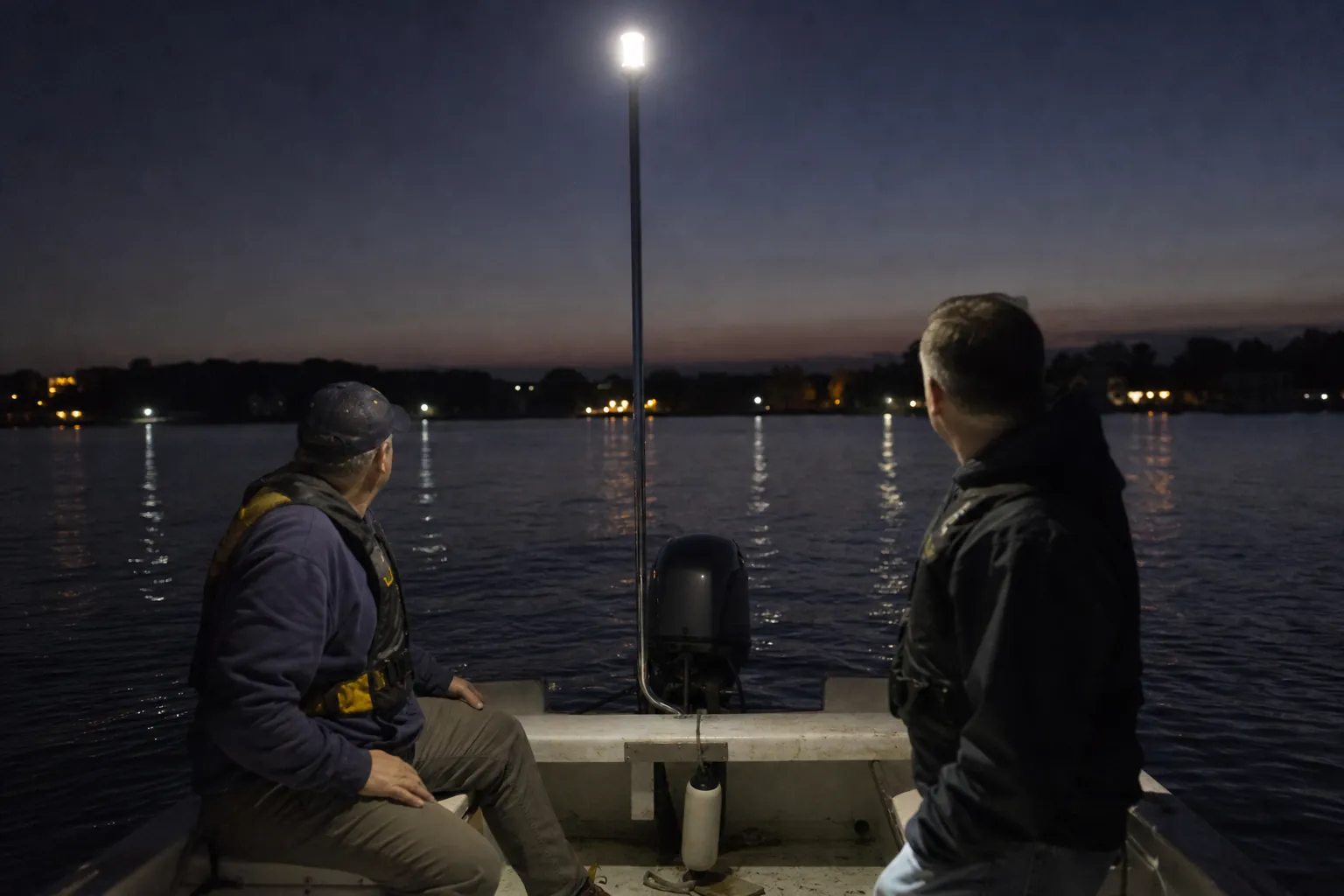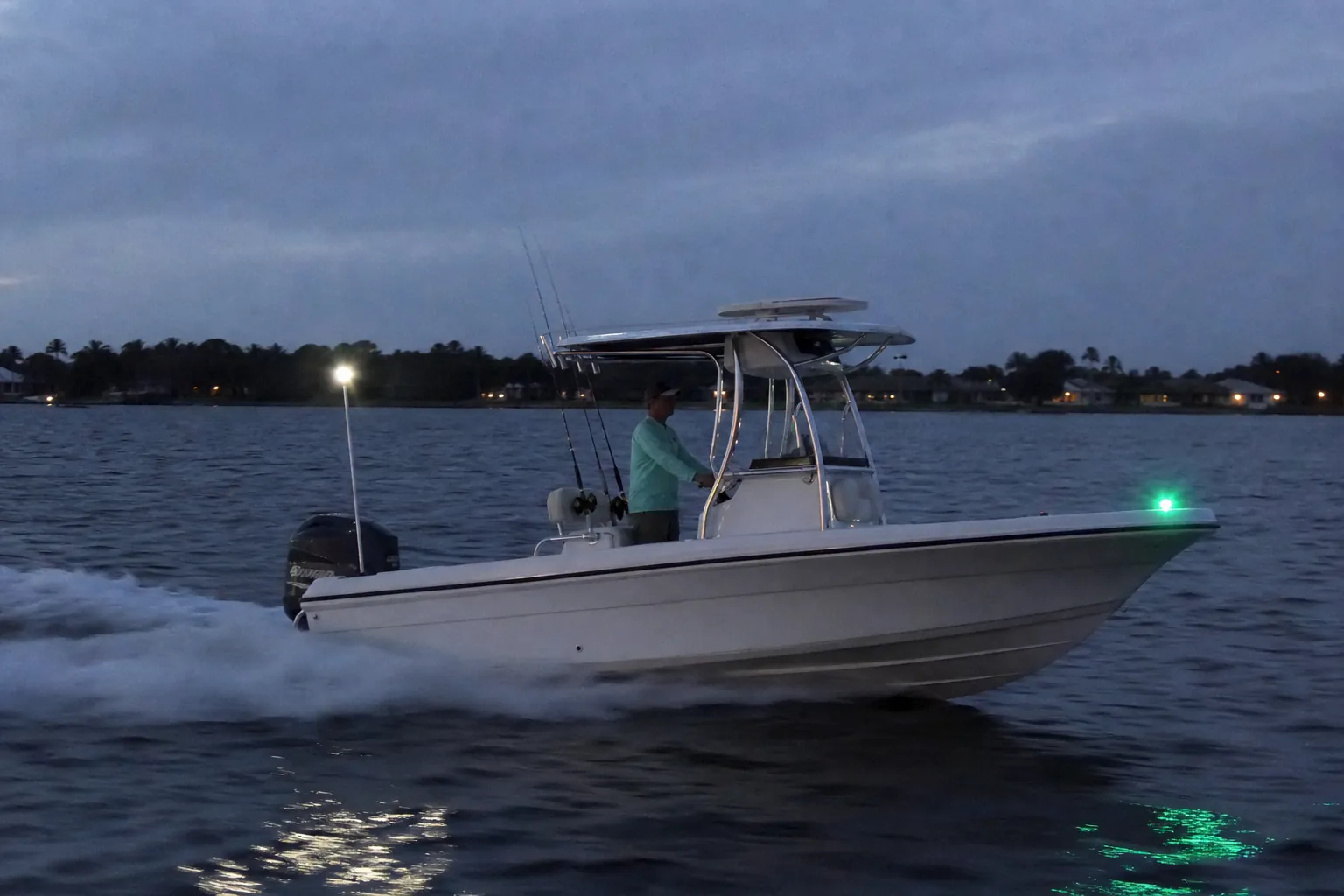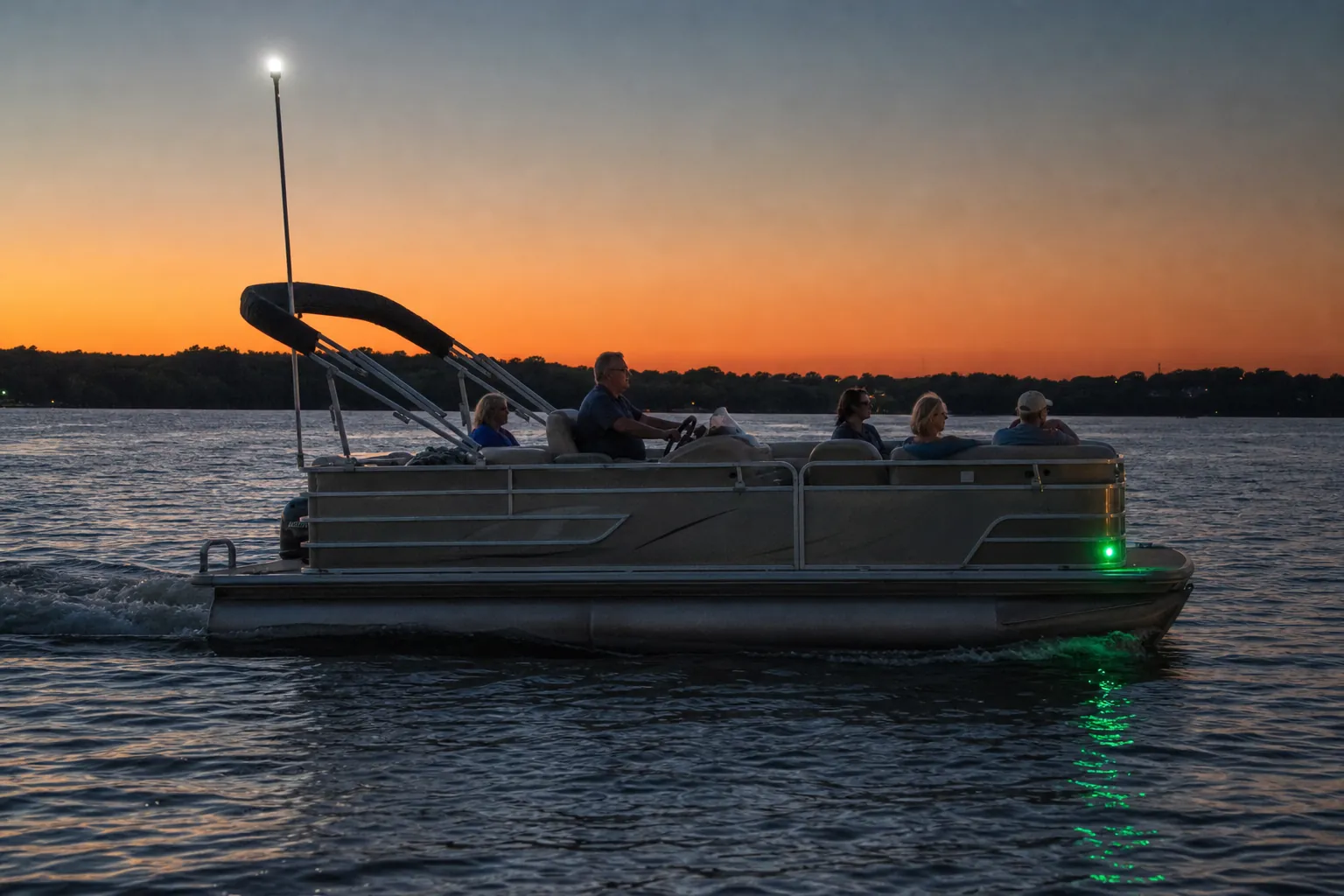

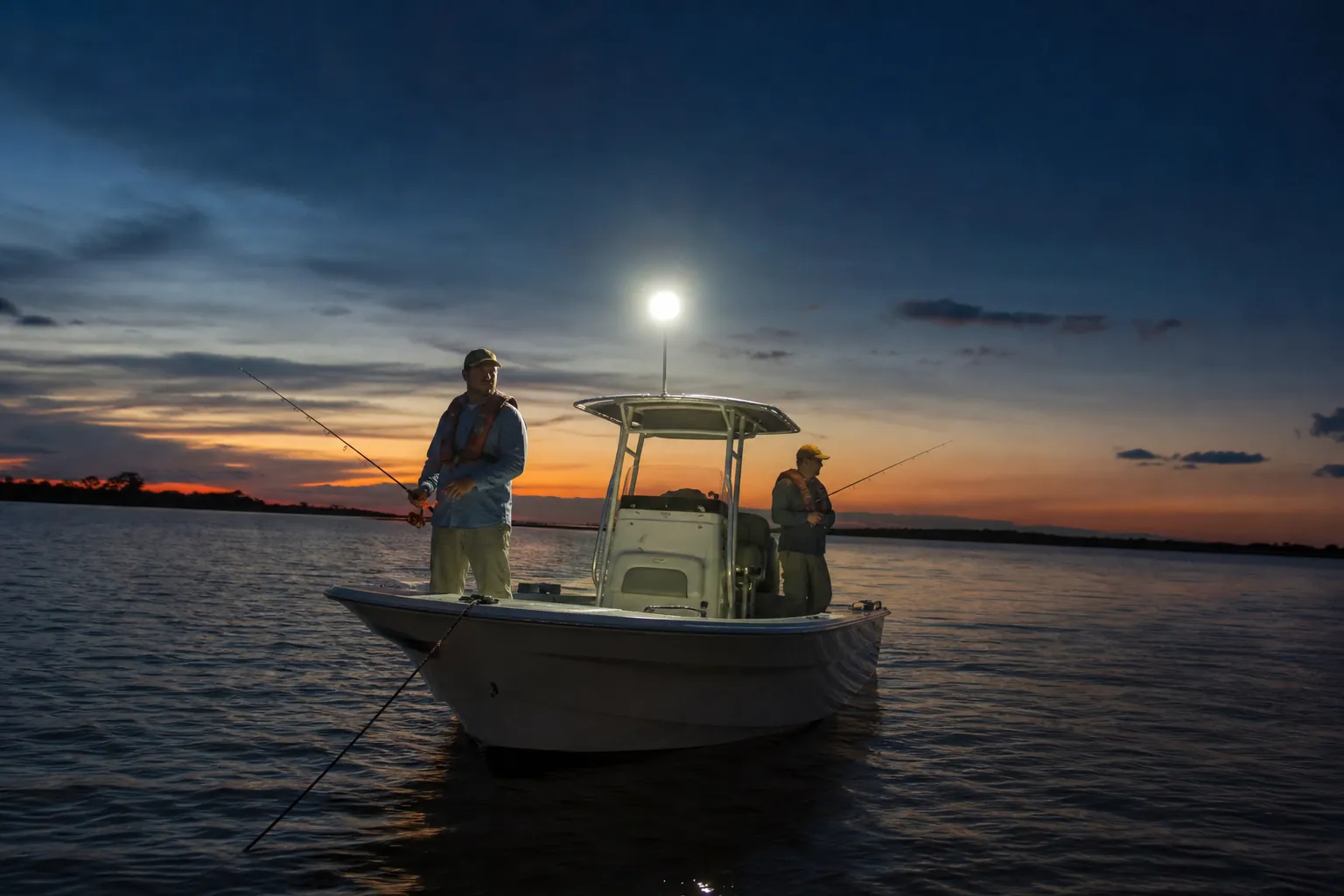
A recreational boat fishing at night in Florida shows the same navigation lights as any other boat of its size. What changes the lights is whether the boat is anchored. Florida law requires every operator to follow the navigation rules (section 327.33(3)) and to have properly serviceable lights and shapes those rules require (section 327.50(2)). For a powerboat under 12 meters (about 39.4 feet) on inland waters:
| What the boat is doing | Lights to show | Rule |
|---|---|---|
| Running to the spot, trolling or drifting | Red and green sidelights plus an all-round white light (or masthead light plus sternlight) | Rule 23 |
| Anchored | One all-round white light where it can best be seen, sidelights off | Rule 30 |
| Anchored under 7 meters, well away from channels and traffic | Anchor light not required | Rule 30(e) |
The red-over-white and green-over-white fishing lights you may have seen on commercial boats are for vessels whose gear restricts their maneuverability. A rod and reel or trolling lines do not qualify, so a recreational angler should not show them. The rest of this guide explains why, and how to light the cockpit without blinding other boaters.
When the Night Rules Start
Rule 20 says the light rules shall be complied with from sunset to sunrise, and the lights shall also be shown in restricted visibility during the day. The FWC equipment pages for boats under 16 feet and boats 16 to 26 feet put it the same way: recreational vessels are required to display navigation lights between sunset and sunrise and during periods of reduced visibility such as fog, rain or haze.
That covers the whole night trip: the run out before dark if the sun sets on the way, the hours on the spot, and the ride home before sunrise. Florida law points to two rule books. Section 327.02 applies the International Navigational Rules outside the lines of demarcation in 33 CFR part 80 and the Inland Navigational Rules in 33 CFR parts 83 to 90 inside them. The Inland rules are quoted here. If you fish offshore past the demarcation lines, check the International rules for your boat.
Drifting Counts as Underway
Many night anglers shut the engine off and drift a flat, a bridge line or a channel edge. It is easy to think of that as stopped. The rules do not. Rule 3(i) says a vessel is underway when it is not at anchor, made fast to the shore, or aground. A drifting boat is none of those, so it is underway, and Florida uses the same idea in section 327.50(1)(b), which defines underway as at all times except when a vessel is anchored, moored, made fast to the shore, or aground.
A drifting powerboat keeps its underway lights on. Under Rule 23(a), that means a masthead light forward, sidelights and a sternlight. Rule 23(d) lets a power-driven vessel under 12 meters show an all-round white light and sidelights instead. On most center consoles and bay boats that is the bow light and the white light on the stern pole.
The red and green matter more on a drift than you might expect. They tell an approaching boat which way you are pointed. If you switch to anchor mode while drifting, other boaters see a single white light and may read you as a boat sitting on its anchor, when in fact you are moving with the current or the wind. The pole light itself, and how high it has to sit above the sidelights, is covered in our boat pole lights guide.
Anchored on the Spot
Once the anchor is down and holding, Rule 30 applies. Rule 30(a) gives a vessel at anchor an all-round white light forward and a lower one at the stern, and Rule 30(b) lets a vessel of less than 50 meters show one all-round white light where it can best be seen instead. On a small fishing boat, that is the pole light with the sidelights switched off.
The small-boat exemption is narrow. Rule 30(e) says a vessel of less than 7 meters at anchor is not required to show anchor lights only when it is not in or near a narrow channel, fairway, anchorage, or where other vessels normally navigate. If you fish a channel edge, a bridge or anywhere boats pass, the exemption does not apply, so keep the anchor light on whatever your length.
Our boat navigation lights rules guide covers the anchor light rules for every boat type, and our pontoon boat navigation lights guide covers anchoring a pontoon at the sandbar after dark.
Why Fishing Lights Are Not for Rod and Reel
Rule 26 sets special lights for a vessel engaged in fishing:
- Trawling (dragging a dredge net or other apparatus through the water): two all-round lights in a vertical line, green over white, plus sidelights and a sternlight when making way.
- Fishing other than trawling: two all-round lights in a vertical line, red over white, plus sidelights and a sternlight when making way, and an extra all-round white light in the direction of any outlying gear extending more than 150 meters from the vessel.
The definition decides who may use them. Rule 3(d) says a vessel engaged in fishing means any vessel fishing with nets, lines, trawls, or other fishing apparatus which restricts maneuverability, but does not include a vessel fishing with trolling lines or other fishing apparatus which do not restrict maneuverability. Rod and reel gear and trolling lines leave the boat free to maneuver, so a recreational boat fishing that way is not engaged in fishing under the rules.
Rule 26(e) closes the door: a vessel when not engaged in fishing shall not exhibit the lights or shapes in Rule 26, but only those prescribed for a vessel of her length. Showing red over white on a recreational boat tells other vessels your gear restricts your maneuverability, and it can also change who keeps clear. Rule 18 says a power-driven vessel underway shall keep out of the way of a vessel engaged in fishing. A recreational angler does not get that priority, and should never claim it with lights.
Deck Lights, Fish Lights and Spotlights
Night fishing needs light in the cockpit for rigging, gaffing and unhooking. The rules allow it within limits. Rule 20(b) says that from sunset to sunrise no other lights shall be exhibited except lights that cannot be mistaken for the lights in the rules, or do not impair their visibility or distinctive character, or interfere with the keeping of a proper lookout.
What that means on a fishing boat:
- Cockpit and deck lights: aim them down at the deck. A floodlight that lights up the water ahead of you, or washes out your own sidelights, works against the rule. 33 CFR 84.02(g) says a power-driven vessel's sidelights shall not be so low as to be interfered with by deck lights.
- Underwater and fish-attracting lights: keep them steady. Section 327.50(3) prohibits flashing, occulting or revolving lights on any vessel except where the navigation rules allow them, so strobe or color-cycling modes are out.
- Red and green accent lights: avoid colored lights that could be read as sidelights from a distance. Those are the lights Rule 20(b) is aimed at.
- Anchor deck lighting: Rule 30(c) says a vessel at anchor may also use the available working or equivalent lights to illuminate her decks.
A handheld spotlight is useful for finding markers and crab trap floats, and it has its own rule. Rule 36 lets any vessel direct the beam of her searchlight in the direction of a danger to attract attention, in such a way as not to embarrass any vessel. Keep the beam off other boats' helms.
Keeping a Lookout With Lines in the Water
Night fishing splits attention. The person watching a rod tip is not watching the water. Rule 5 says every vessel shall at all times maintain a proper look-out by sight and hearing as well as by all available means appropriate in the prevailing circumstances. On a drift that means someone checks around the boat regularly, including astern where the current is carrying you.
Reading other boats' lights helps you decide fast:
- Red and green both visible with white above: a powerboat is pointed straight at you.
- Only red, or only green, with white: a boat crossing your view. Red is its port side, green its starboard (Rule 21(b)).
- Red over white: a vessel engaged in fishing other than trawling, which may have gear out (Rule 26(c)).
- Green over white: a vessel trawling (Rule 26(b)).
- A single white light: an anchored boat, a small boat underway seen from behind, or a paddler.
Rule 7(a) adds that if there is any doubt about risk of collision, the risk shall be deemed to exist. Rule 7(d) says risk exists if the compass bearing of an approaching vessel does not appreciably change. A light that stays on the same bearing as it grows brighter is coming for you.
Kayaks, Jet Skis and Small Boats
The rules change by craft, and plenty of night anglers fish from something smaller than a center console:
- Kayaks and canoes under paddle: Rule 25(d)(ii) says a vessel under oars may show sailing vessel lights, but if it does not, it shall exhibit an all-round white light or have ready at hand an electric torch or lighted lantern showing a white light, exhibited in sufficient time to prevent collision. A kayak with a motor is a power-driven vessel under Rule 3.
- Jet skis: the FWC boating regulations page says personal watercraft may not be operated from a half hour after sunset to a half hour before sunrise, even if navigation lights are used. A jet ski is not a night fishing platform in Florida. Daytime jet ski fishing rules are in our Destin jet ski fishing guide.
- Small skiffs under 7 meters: they still show underway lights while drifting. The only small-boat break is the anchor light exemption in Rule 30(e), and only away from channels and traffic.
Visibility ranges are set by length. Rule 22(c) says on a vessel under 12 meters a sidelight shall be visible at 1 mile and an all-round white light at 2 miles. A salt-crusted lens can cut that range, so wipe the lenses before you leave.
Distress Signals for Night Trips
Night trips add a gear rule many daytime anglers have never had to think about. The FWC boating regulations page says vessels less than 16 feet in length are required to carry at least 3 visual distress signals for nighttime use when on coastal waters from sunset to sunrise. Vessels 16 feet or longer must carry at least 3 daytime and 3 nighttime visual distress signals, or 3 combination day and night signals, at all times on coastal waters.
The same page repeats the flashing light ban: the use of sirens or flashing, occulting or revolving lights is prohibited except where expressly allowed by law. Keep strobe-type lights for a real emergency.
For the full list of required gear by boat length, see our Florida boat safety equipment checklist.
Fines for Light Violations
Section 327.73(1) lists violations of section 327.50(1) and (2), relating to required safety equipment, lights and shapes, as noncriminal infractions, along with violations of the navigation rules under section 327.33(3)(b) that do not result in an accident or result in one without serious injury. The civil penalty for such an infraction is $100, except as otherwise provided in that section.
After a collision the stakes are higher. Section 327.33(3)(a) makes a navigation rules violation that results in a boating accident causing serious bodily injury or death, but is not reckless operation, a misdemeanor of the second degree. Section 327.33(4) says fault in boating accidents is determined according to the navigation rules, so the lights you showed on that drift can decide who is at fault.
Our Florida boating ticket guide explains how a boating citation is handled.
A Night Fishing Light Check
Run through this at the dock or the ramp before dark:
- Switch on the navigation lights and confirm red is on the left, green on the right and the white light shows all the way around.
- Switch to anchor mode and confirm only the all-round white light stays on.
- Turn on the deck and cockpit lights and look from the bow: the sidelights should still stand out.
- Set any underwater or fish lights to a steady mode.
- Put the spotlight where the helm can reach it.
- Check the visual distress signals if you are headed to coastal waters.
- Agree who keeps the lookout while lines are in the water.
On the water, remember the switch: lights on underway while you run or drift, anchor light when the hook is down.
Learning the Navigation Rules
Navigation lights are part of the navigation rules taught in every Florida boating safety course, the course behind the Boating Safety Education ID Card that most Florida boaters call a boating license. Under section 327.395, a person born on or after January 1, 1988 may not operate a vessel powered by a motor of 10 horsepower or greater without the card or another document that section allows.
Boat Skill is preparing an online exam for the Florida temporary boating certificate, the one renters call the jet ski test, and enrollment opens soon. Get notified when Boat Skill enrollment opens. Our boating resources page previews the lesson topics for free.
Sources
- Florida Statute 327.33: Reckless or careless operation of vessel (navigation rules)
- Florida Statute 327.50: Vessel safety regulations; equipment and lighting requirements
- Florida Statute 327.02: Definitions (navigation rules)
- Florida Statute 327.73: Noncriminal infractions
- Florida Statute 327.395: Boating safety education
- FWC: Boating regulations
- FWC: Equipment requirements, vessels under 16 feet
- FWC: Equipment requirements, vessels 16 to 26 feet
- 33 CFR 83.03: Definitions (Rule 3)
- 33 CFR 83.05: Look-out (Rule 5)
- 33 CFR 83.07: Risk of collision (Rule 7)
- 33 CFR 83.18: Responsibilities between vessels (Rule 18)
- 33 CFR 83.20: Application of the light rules (Rule 20)
- 33 CFR 83.21: Light definitions (Rule 21)
- 33 CFR 83.22: Visibility of lights (Rule 22)
- 33 CFR 83.23: Power-driven vessels underway (Rule 23)
- 33 CFR 83.25: Sailing vessels and vessels under oars (Rule 25)
- 33 CFR 83.26: Fishing vessels (Rule 26)
- 33 CFR 83.30: Vessels anchored and aground (Rule 30)
- 33 CFR 83.36: Signals to attract attention (Rule 36)
- 33 CFR 84.02: Vertical positioning and spacing of lights
Common questions
What lights do I need for night fishing on a boat in Florida?
The same navigation lights as any boat your size. A powerboat under 12 meters drifting or running shows red and green sidelights plus an all-round white light, or a masthead light and sternlight. At anchor it shows one all-round white light with the sidelights off.
Do I keep my navigation lights on while drifting at night?
Yes. Rule 3(i) says a vessel is underway when it is not at anchor, made fast to the shore or aground, so a drifting boat is underway and keeps its sidelights and white light on.
Can I show red over white fishing lights on my recreational boat?
No. Rule 26 lights are for vessels whose fishing gear restricts their maneuverability. Rule 3(d) excludes trolling lines and gear that does not restrict maneuverability, and Rule 26(e) says a vessel not engaged in fishing shall not show those lights.
Do I need an anchor light if I anchor to fish at night?
Yes, in most places. A vessel under 7 meters is exempt only when it is not in or near a narrow channel, fairway, anchorage or where other vessels normally navigate, under Rule 30(e). Everywhere else, show one all-round white light.
Are underwater fishing lights legal on a boat in Florida?
Steady lights that do not get mistaken for navigation lights or interfere with the lookout are allowed under Rule 20(b). Section 327.50(3) prohibits flashing, occulting or revolving lights except where the navigation rules allow them, so avoid strobe modes.
Can I use a spotlight while night fishing?
Yes, with care. Rule 36 lets a vessel direct its searchlight toward a danger to attract attention, in a way that does not embarrass any vessel. Keep the beam off other boats' helms.
Can I fish from a jet ski at night in Florida?
No. The FWC says personal watercraft may not be operated from a half hour after sunset to a half hour before sunrise, even if navigation lights are used.
What is the fine for no lights while night fishing in Florida?
Operating without the lights the navigation rules require violates section 327.50(2), a noncriminal infraction under section 327.73. The civil penalty is $100 unless another provision of that section applies.