
Florida boat trailer laws live mostly in the state traffic code, chapter 316 of the Florida Statutes, with registration in chapter 320 and titles in chapter 319. A boat trailer counts as a motor vehicle under the registration law, so it needs its own registration and plate, separate from the boat. Here is what applies to a typical trailer towed behind a pickup or SUV:
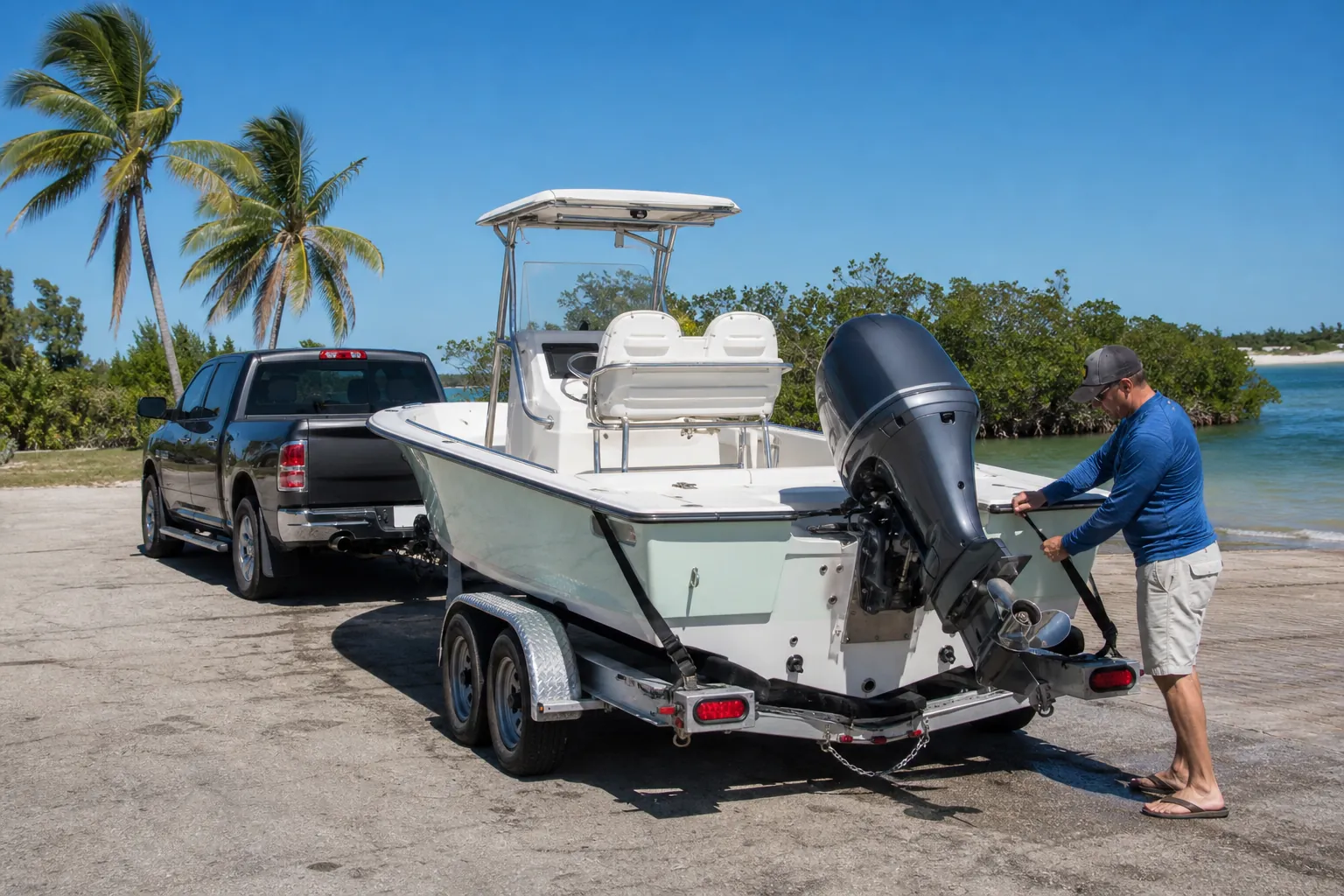
- Registration and plate: required for use on Florida roads, with a yearly license tax set by weight in section 320.08.
- Title: only for trailers with a net weight of 2,000 pounds or more, under section 319.20.
- Lights: two red taillamps, a white plate light, stop lamps and turn signals, plus reflectors, under sections 316.221, 316.222 and 316.2225.
- Brakes: brakes on all wheels once the trailer's gross weight passes 3,000 pounds, with a breakaway system, under section 316.261.
- Hitch and chains: safety chains or cables from the trailer to the tow vehicle whenever you tow with a rear hitch, under section 316.530.
- Size: 102 inches wide at most, 13 feet 6 inches high, and 65 feet for the whole rig, under section 316.515.
The boat on the trailer has its own registration and numbering rules, covered in our Florida boat registration guide. This guide covers the trailer and the trip to the ramp.
Registering a Boat Trailer and Its Plate
Section 320.01(1)(a) of the Florida Statutes lists trailers in its definition of a motor vehicle, and section 320.02 requires the owner of a motor vehicle driven on Florida roads to register it with the Department of Highway Safety and Motor Vehicles (FLHSMV) or its agent, usually the county tax collector. The same section says a vehicle that is not used on the roads during the registration period does not need a registration, which covers a trailer that sits parked on private land.
The yearly license tax for a private boat trailer is set in section 320.08(7):
| Trailer for private use | License tax |
|---|---|
| 500 pounds or less | $6.75 flat per year |
| Net weight over 500 pounds | $3.50 flat plus $1 per 100 pounds (cwt) |
So a trailer with a net weight of 1,200 pounds carries a base tax of $3.50 plus 12 times $1, or $15.50. The FLHSMV fees page lists the same trailer amounts and notes that they are the base vehicle tax only, with other statutory fees added, so expect the total at the counter to be higher.
Two more rules apply once the plate is on:
- Where the plate goes. Section 316.605 puts the plate on the rear, securely fastened so it cannot swing, no higher than 60 inches and no lower than 12 inches from the ground, and no more than 24 inches left or right of the centerline. The plate and its decal have to be clean and readable from 100 feet.
- Carry the registration. Section 320.0605 requires the registration certificate, or an official or electronic copy, to be with the driver or in the vehicle it was issued for, and shown to an officer on request.
Buying from a dealer? The FLHSMV license plates and registration page lists a 30-day temporary plate that a vessel trailer dealer can issue when it sells a vessel trailer.
When a Boat Trailer Needs a Title
Titles follow weight. Section 319.20 says the title chapter does not apply to any trailer or semitrailer with a net weight of less than 2,000 pounds. The FLHSMV liens and titles page says the same thing in plain terms: most vehicles must be titled, except mopeds, motorized bicycles and trailers weighing less than 2,000 pounds.
A trailer at 2,000 pounds net or heavier needs a Florida title in the owner's name. FLHSMV says that at minimum you bring:
- Proof of identity, such as a current driver license, state ID card or passport.
- Proof of ownership, such as the manufacturer's certificate of origin or an out-of-state title.
- A completed Application for Certificate of Title With/Without Registration, HSMV form 82040.
- Payment for sales tax and the title fee.
You apply when you buy the trailer, when you bring it in from another state, or when ownership changes. Section 319.23 also says the vehicle identification number does not have to be verified for a trailer or semitrailer with a net weight under 2,000 pounds, which saves light-trailer owners an inspection step.
Lights and Reflectors Every Boat Trailer Needs
Lighting is where most trailer stops start, because dunking a trailer at the ramp is hard on bulbs and wiring. The rules, by section:
- Taillamps. Section 316.221 requires every trailer to have at least two taillamps on the rear that show red and are plainly visible from 1,000 feet. On a combination, only the rearmost vehicle's taillamps have to be seen from that distance.
- Plate light. The same section requires a white light that makes the rear plate readable from 50 feet, wired to come on with the headlamps.
- Stop lamps and turn signals. Section 316.222 requires every trailer to have two or more stop lamps and electric turn signal lamps. Under section 316.234, stop lamps show red or amber, come on with the foot brake, and must be visible from at least 300 feet in normal sunlight. Rear turn signals flash red or amber and must be visible from 300 feet on a vehicle under 80 inches wide, or 500 feet on one 80 inches or wider.
- Reflectors. Section 316.2225 sets reflectors by gross weight, shown in the table below. Section 316.225 mounts required reflectors between 24 and 60 inches above the ground, and section 316.226 requires them to be visible at night from 600 feet to 100 feet in low-beam headlights.
- Colors. Section 316.224 makes lamps and reflectors on the front, or on the sides near the front, amber, and those on the rear, or on the sides near the rear, red. The plate light is white.
| Trailer gross weight | Extra equipment under section 316.2225 |
|---|---|
| 3,000 pounds or less | Two rear reflectors, one on each side. If the trailer or the boat hides the tow vehicle's stop light, one stop light on the trailer |
| Over 3,000 pounds | Front: two clearance lamps. Each side: two side marker lamps and two reflectors, front and rear. Rear: two clearance lamps, two reflectors and one stop light |
When the lights must be on is in section 316.217: from sunset to sunrise, including twilight, and during any rain, smoke or fog. Early launches and late pull-outs both fall inside that window, so test the lights with a helper before you leave the ramp lot. The boat has its own set of lights once it is in the water, covered in our boat navigation lights rules guide, with a separate guide to pontoon boat navigation lights.
Trailer Brakes and the 3,000-Pound Line
Section 316.261 starts with a general rule: every trailer on a Florida highway must have brakes that meet chapter 316, and every vehicle must have brakes acting on all wheels. Light trailers get an exception. A trailer with a gross weight of 3,000 pounds or less can skip brakes when both of these are true:
- The total weight on and including the trailer's wheels does not exceed 40 percent of the tow vehicle's gross weight when hooked up.
- The tow vehicle and its towed load together can still meet the stopping performance rules in section 316.262.
A quick worked example of the 40 percent test: if the trailer's wheels carry 2,400 pounds, the tow vehicle's gross weight has to be at least 6,000 pounds, since 40 percent of 6,000 is 2,400. A lighter tow vehicle means the trailer needs brakes even though it is under 3,000 pounds.
Over 3,000 pounds gross, the rules tighten. Subsection (4) requires every trailer with a gross weight over 3,000 pounds to have brakes on all wheels that apply automatically and promptly if the trailer breaks away from the tow vehicle, and stay applied for at least 15 minutes. That is the job of the breakaway cable and battery found on most braked boat trailers. Subsection (5) adds that a tow vehicle built after January 1, 1972 that pulls a braked trailer must still be able to stop on its own service brakes if the trailer breaks away, and subsection (8) requires one control that operates all service brakes in the combination.
A violation of section 316.261 is a noncriminal traffic infraction, punished as a nonmoving violation under chapter 318.
Hitch, Safety Chains and Tying Down the Boat
Section 316.530 covers the connection between the tow vehicle and the trailer:
- The drawbar or other connection must be strong enough to pull the full weight being towed, and may not be longer than 15 feet from one vehicle to the other.
- When you tow a trailer with a hitch at the rear of the vehicle, you must also attach safety chains, cables or other safety devices from the trailer to the tow vehicle. They have to meet the federal rules the statute cites, 49 C.F.R. 393.71(g)(2)(1) and 393.71(h)(10), and be strong enough to keep the trailer connected under all conditions while it is towed.
- The chain rule does not apply to fifth-wheel hitches.
- A violation of this section is a noncriminal traffic infraction, punished as a moving violation.
The boat itself counts as the load. Section 316.520 says a vehicle may not be driven unless it is loaded so that nothing can drop, shift, leak, blow off or escape, and it makes the owner and the driver each responsible for preventing objects from falling or blowing off. A load securing device designed to keep cargo from shifting or falling counts as compliance. In practice that means the bow strap or winch line, transom tie-downs, and anything loose in the boat stowed or removed before you pull out. Most violations are nonmoving infractions, but a willful violation that results in serious bodily injury or death is a second-degree misdemeanor.
Size Limits and Boats That Hang Past the Trailer
Section 316.515 sets the outside limits for any vehicle and its load:
| Limit | Florida rule |
|---|---|
| Width | 102 inches, including the load |
| Height | 13 feet 6 inches, including the load |
| Units in a noncommercial combination | Two, such as one tow vehicle and one trailer |
| Length of a noncommercial combination | 65 feet, including the load |
Width is the one that catches boat owners, because the measurement includes the boat's beam where it sits on the trailer. The same section also lets the Department of Transportation or local officials restrict vehicles wider than 96 inches on roads that lack at least one 12-foot through lane in each direction, or that are judged unsafe for wider vehicles.
Overhang has its own rule. Under section 316.228, when a load extends 4 feet or more past the rear of the bed or body, you need, during the hours lights are required, two red lamps at the extreme rear visible from at least 500 feet, two red reflectors, and a red lamp on each side. At other times, a load that sticks out past the sides or more than 4 feet past the rear must be marked with red flags at least 18 inches square.
At the Ramp
Once the trailer is legal on the road, the water rules take over. The FWC's boat ramps and access page has a Boat Ramp Finder with maps and photos for hundreds of public ramps across Florida. The FWC says it maintains over 200 access sites, available to the boating public free of charge and mostly open 24 hours a day, and it suggests checking with local authorities before driving to an unfamiliar ramp, since closures for events, weather or repairs are not reported in real time.
The person who backs the boat off the trailer and drives it away is a vessel operator. Under Florida Statute 327.395, anyone born on or after January 1, 1988 who operates a vessel with a motor of 10 horsepower or more must carry photo ID and the Boating Safety Education ID Card or another accepted document. Our page on how to get a Florida boating license explains the card, and the gear that must be aboard once you float off is in the Florida boat safety equipment checklist. The boat also needs its own registration: FLHSMV's vessels page notes that chapter 328 makes the department responsible for registering and titling vessels.
When the day ends at the same ramp, the road rules come back with the trailer, including the open container law for the tow vehicle. Our guide to drinking on a boat laws in Florida covers what changes between the water and the drive home.
A Pre-Tow Checklist
Run through this list before each trip, with the statute behind each line:
- Trailer registration is current and the certificate is in the tow vehicle (sections 320.02 and 320.0605).
- The plate is on the rear, mounted between 12 and 60 inches high, not swinging, and readable (section 316.605).
- Taillamps, plate light, stop lamps and turn signals all work with the tow vehicle connected (sections 316.221, 316.222 and 316.234).
- Rear reflectors are in place, plus side markers, clearance lamps and side reflectors if the trailer is over 3,000 pounds gross (section 316.2225).
- Over 3,000 pounds gross: brakes on all wheels and a working breakaway system (section 316.261).
- Coupler latched and safety chains attached to the tow vehicle (section 316.530).
- Bow strap, transom straps and loose gear secured (section 316.520).
- The rig is within 102 inches wide and 65 feet long, with flags or lamps on any overhang of 4 feet or more (sections 316.515 and 316.228).
- The boat's own registration and the operator's boater education card are aboard (chapter 328 and section 327.395).
Renting instead of towing your own? The rules a rental business has to follow are in our Florida boat rental rules guide, and pontoon owners can check the operator rules in do you need a license to drive a pontoon boat in Florida.
Sources
- Florida Statute 316.217: When lighted lamps are required
- Florida Statute 316.221: Taillamps
- Florida Statute 316.222: Stop lamps and turn signals
- Florida Statute 316.2225: Additional equipment required on certain vehicles
- Florida Statute 316.224: Color of lamps and reflectors
- Florida Statute 316.225: Mounting of reflectors and lamps
- Florida Statute 316.226: Visibility requirements for reflectors and lamps
- Florida Statute 316.228: Lamps or flags on projecting load
- Florida Statute 316.234: Signal lamps and signal devices
- Florida Statute 316.261: Brake equipment required
- Florida Statute 316.515: Maximum width, height, length
- Florida Statute 316.520: Loads on vehicles
- Florida Statute 316.530: Towing requirements
- Florida Statute 316.605: Licensing of vehicles
- Florida Statute 319.20: Application of law (titles)
- Florida Statute 319.23: Application for certificate of title
- Florida Statute 320.01: Definitions
- Florida Statute 320.02: Registration required
- Florida Statute 320.0605: Certificate of registration; possession required
- Florida Statute 320.08: License taxes
- Florida Statute 327.395: Boating safety education
- FLHSMV: Fees
- FLHSMV: License Plates and Registration
- FLHSMV: Liens and Titles
- FLHSMV: Vessels
- FWC: Boat Ramps and Access
Common questions
Do boat trailers need to be registered in Florida?
Yes, if the trailer is used on Florida roads. Section 320.01 counts a trailer as a motor vehicle, and section 320.02 requires registration for a motor vehicle driven on the roads of the state. A trailer that is not used on the roads during the registration period does not need one.
How much does it cost to register a boat trailer in Florida?
Section 320.08 sets the yearly license tax for a private trailer at $6.75 flat for 500 pounds or less, and $3.50 flat plus $1 per 100 pounds for a net weight over 500 pounds. FLHSMV says those amounts are the base tax only and other statutory fees are added, so the total at the tax collector is higher.
Does my boat trailer need a title in Florida?
Only if its net weight is 2,000 pounds or more. Section 319.20 says the title chapter does not apply to trailers with a net weight under 2,000 pounds, and FLHSMV lists trailers weighing less than 2,000 pounds among the vehicles that do not need a title.
Does a boat trailer need brakes in Florida?
A trailer with a gross weight over 3,000 pounds needs brakes on all wheels that apply automatically on breakaway and hold for at least 15 minutes, under section 316.261. A trailer of 3,000 pounds or less can skip brakes only if the weight on its wheels is no more than 40 percent of the tow vehicle's gross weight and the combination can still meet the stopping rules in section 316.262.
What lights does a boat trailer need in Florida?
Every trailer needs two red taillamps visible from 1,000 feet, a white plate light readable from 50 feet, two or more stop lamps and electric turn signals, and two rear reflectors. A trailer over 3,000 pounds gross also needs front and rear clearance lamps, side marker lamps and side reflectors under section 316.2225.
Are safety chains required on a boat trailer in Florida?
Yes. Section 316.530 requires safety chains, cables or other safety devices from the trailer to the tow vehicle whenever you tow with a hitch at the rear. They must be strong enough to keep the trailer connected under all conditions. The rule does not apply to fifth-wheel hitches.
How wide can a boat on a trailer be in Florida?
Section 316.515 limits any vehicle and its load to 102 inches of total outside width, which includes the boat sitting on the trailer. Height is limited to 13 feet 6 inches, and a noncommercial tow vehicle and trailer may not exceed 65 feet together, including the load.
Do I need a boating license to launch my boat from a trailer?
Florida does not issue a boating license as such. Under section 327.395, anyone born on or after January 1, 1988 who operates a vessel with a motor of 10 horsepower or more must carry photo ID and the Boating Safety Education ID Card, which most people call the Florida boating license, or another document the statute accepts. That applies to whoever drives the boat off the trailer.